Ernst & Landerer GmbH is a family-owned company that has established an enviable reputation supplying castings to leading manufacturers of automotive gearboxes.
The foundry has 80 employees and aims for this figure to rise slowly, with a focus on optimum product quality while maintaining the company at a manageable size. Established as a pure aluminium chill-casting foundry more than 40 years ago, its customers come from the automotive, medical, mechanical engineering and construction industries; and whereas they originally sought unfinished raw-steel parts, they now require machined castings that are ready to install. As a result, machining was added to complement the casting process at the turn of the millennium — and it is now the largest part of the company’s business. Ernst & Landerer currently runs 22 Haas machining centres on a two-shift basis, with some 30-40% of the parts produced going to gearbox manufacturers — high-precision components with j6 tolerances, H6 for diameter boring and micron variances in rectangularity and parallelism.
The unfinished parts are cast with minimal machining allowances, and for each workpiece there is a dedicated piece of equipment for clamping it on the machining centre. Moreover, component tolerances are so stringent that most parts can only be clamped once for the entire machining process. Depending on size, up to four components can be produced in the one set-up.
Eliminating 3-D measurement
With regard to establishing the quality of machining, parts used to be transferred to a 3-D measuring machine; while this measuring process was essential, it was also very time-consuming. If finished components were found to be out of tolerance, re-work came with a high cost penalty. Furthermore, the manual processes used were susceptible to errors — and the measuring method required the component surfaces to be completely clean.
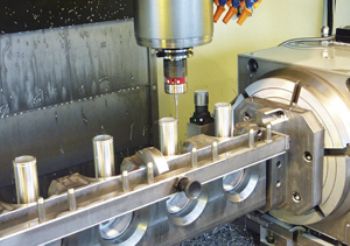
Investigation showed that on-machine in-process measurement would allow measurements to be taken during the machining process — at high speed — so two of the company’s engineers attended a measuring technology workshop run by Blum-Novotest, which has a UK subsidiary in Lichfield (Tel: 01543 257111 – www.blum-novotest.com). They immediately ordered a pair of tool and workpiece measuring probes. Over the following months, the number of probing systems was increased, as was the number of machines; these included a horizontal machining centre with a pallet changer and a cell for six pallets (this was also equipped with measuring technology from Blum-Novotest). Now, every machining centre at Ernst & Landerer that produces high-precision parts is fitted with Blum’s Z-Nano tool probe and a TC52 workpiece probe; more than 25 Blum systems are currently in use.
Company director Thomas Ernst says: “All tight-tolerance gearbox parts are now measured using the Blum probes, and we have verified that it is a fast and reliable process. We had few complaints even before the introduction of Blum-Novotest’s measuring technology, and the number has decreased even further since the probes have been in use. Of the 20,000 gearbox castings we manufactured in 2010, fewer than 10 were returned.”
Mr Ernst also confirms that probing has significantly increased the availability of the company’s machining centres. “Even in the past, inspection of the workpieces was extremely stringent, so the number of rejects has not fallen significantly. However, with Blum’s measuring technology, the processing times are lower, and process reliability has improved significantly.”
Broken-tool detection

Structural irregularities are common in castings and are frequently caused by impurities. Ceramic particles in a casting can cause premature wear on the tool — and tool breakages in small-diameter bores. Previously, a broken tool (or one that was not working correctly) could only be identified by a visual inspection of a component after completing the entire machining cycle.
However, since implementing Blum’s Z-Nano tool probes, no more parts with a missing hole or thread have been recorded, as every critical tool is checked after machining the component — in just seconds — by the Z-Nano tool probe. This ensures that the tool is functional and that the appropriate machining operation has been performed. If the Z-Nano detects any damage to the tool, machining is stopped and the tool replaced. The Z-Nano tool probes allow tools with a diameter of more than 0.1mm to be measured.
The Z-Nano performs tool length measurement checks with a repeatability of 0.2µm; and while Ernst & Landerer does not currently use temperature compensation, Z-Nano units provide this capability. Measuring a tap also ensures that the thread has been cut correctly and that the tool has not been pushed back into the collet, thereby reducing the thread depth (this was previously a problem in the production of high-precision components).
The TC52 workpiece probe has also become an indispensable part of the production equipment at Ernst & Landerer, particularly as it provides repeatable measurement regardless of the direction of measurement. In the chill-casting foundry, it is are used for zero-point detection, verifying clearances and for monitoring the position and orientation of the workpiece. During inspection with the TC52 probe, the coolant continues to flow at the same rate as with machining, because the probe is designed to exert a measuring force that is sufficient to obviate the effects of the coolant’s presence when generating the ‘skip signal’. When the opto-electronic measuring element generates this signal, the positions of all the machine’s axes are read and stored in the controller memory. Moreover, the non-contact opto-electronic measuring principle ensures that the measuring element on all Blum probes is wear-free, allowing maintenance-free use over a longer period.