The science of channelling light — a process called total internal reflection — was first demonstrated in the mid-19th century, although practical applications came much later. NASA, for example, used fibre optics in the cameras that it sent to the moon, but it was not until the late 20th century that terrestrial TV adopted the medium. Tapered fibre optics work on the same principle — bouncing photons along a clad glass conduit — but use clusters of fused fibres to magnify or (more typically) reduce an image for transmission. The American company Incom is regarded as the world’s leading manufacturer of commercial, rigid, fused fibre-optic face-plates, tapers and micro-well arrays, and its advanced technology supports researchers, scientists and instrument makers in the dental, medical, life-science, scientific, homeland security, and defence industries.
Founded in 1971, the company has two facilities covering more than 90,000ft
2 — and more than 200 employees. To start with — and with just a handful of employees — the company’s primary product was fused fibre-optic face-plates for cathode-ray tubes (CRTs). Its early years were moderately successful, and its revenues grew steadily. However, its management knew that CRT technology would eventually be replaced by LCDs; they just did not know when.
Anthony Detarando, the company’s vice-president and chief financial officer, says: “In 1994, we had the opportunity to purchase a competing line of fused fibre-optics from a local company called Galileo Electro-Optics. We didn’t fully realise it then, but it was very good timing, as our existing business was about to take a nose-dive. As part of the deal, we also acquired the formula for the fibre-optic glass that we still use today.”
Military applications
Galileo was one of two nearby companies that specialised in manufacturing fused fibre-optics for military applications, and they were competing with each other for contracts that the government warned would soon disappear. However, they did not disappear, and today this type of work continues to generate a large part of Incom’s revenue. “We also acquired the technical expertise to make 50mm tapered fibre-optics in high volume, and many of Galileo’s employees came to work here. Very soon, we were twice our previous size — and one of the two main government suppliers for night-vision systems,” says Mr Detarando.

Incom manufactures tapers from billets produced using its own hot-drawing process. Individual fibres are bunched coherently together, heated and stretched to create the desired magnification. The more fibres in a bunch — as many as 16 million per square inch — the higher the resolution. Scott Farland, director of business development, says: “Some seven years ago, we looked at how we wanted to grow. We decided to get much better in military applications, and to find new opportunities in the life-science, scientific and medical sectors — such as X-ray.
“Photographers have long since embraced the flexibility and speed of digital imaging; now, radiographers are swapping X-ray cassettes for oversized CMOS sensors with thin, fibre-optic plates — instead of lenses — providing the image transmission capability. It was making these types of larger tapers that first led us to
investigate automation and CNC machine tools.”
Separate business units
Incom divided its manufacturing into business units, each with its own equipment and arranged for maximum efficiency. Mr Farland says: “We are very focused on yield. Glass is costly; it is also easy to make mistakes during hot-drawing and end up with damaged, useless fibres or clusters, so we’ve developed our process to reduce this possibility. When it came to automating our mechanical operations and machining operations, we had to make sure that we kept scrap to an absolute minimum; by the time the taper gets to the machining stage, most of the cost has been incurred.”

Incom bought its first Haas CNC machine tool — a used VF-2 vertical machining centre — in late 2003. Since 2005, it has bought an average of two further Haas machines per year and now has a total of 11. These include five Mini Mills and a DT-1 drill/tap centre — Incom’s newest Haas — that is currently cutting medical and dental face-plates.
In the early days of its reorganisation, Incom had very little in-house CNC machining experience, so they recruited programmer Dean Westhoff to ‘pilot’ the company around the hazards of machining glass. In turn, Mr Westhoff was guided by product and process development engineer John Escolas, who says: “To start with, we were only machining around 10% of our production on Haas machines at feed rates of around 0.2in per min. It was a slow and costly process. We were holding the part using a ‘traditional’ wax compound, but the wax would often fail and the part pop off the mount — even at the low feed rates we were using. The only advice I offered Dean was to turn off the control panel and go by sound and feel.”
Fixture and process development
Mssrs Westhoff and Escolas began by changing the composition of the wax to give it greater shear strength. Once Mr Westhoff felt confident that the parts were fixed, he ‘tweaked’ the feed rates until the Haas ‘hit the right note’.
Incom machines its glass with diamond-coated tooling, which will burn the part if there is insufficient coolant. Conventional machining uses nozzles to deliver the liquid from multiple directions, spraying the contact area. However, when the tool is changed, the direction of the coolant needs to be adjusted. “To achieve the high-volume machining we had in mind meant we couldn’t adjust the coolant manually. It just wasn’t practical,” says Mr Westhoff.
The answer was to submerge the parts and the tools completely. Each time a component is loaded and the operator presses ‘cycle start’, a custom-made watertight tank mounted on the machine’s table floods until the part disappears. Mr Escolas says: “Using this approach took a lot of faith. We were fine-tuning cutting operations, but we couldn’t see what was going on with the part. Sometimes, we’d drain the tank, and there would be nothing but shards of glass. Now, we are machining more than 90% of our production, and feed rates are typically 30in per min. Now that we’ve perfected the process, cutting under water produces better surface finishes, the tools last longer, and we can use coarser diamonds.”
Once Westhoff and Escolas had worked out how to make the product, it became the job of quality engineer Earl Davis to understand the processes. The subject of his initial study was one of Incom’s Haas Mini Mills. “Our priority is always improving and maintaining yield. We aim to reduce scrap to a minimum by really understanding the machining process. We felt confident that the Haas machines were sufficiently accurate, so we introduced statistical process control techniques to measure what was causing variation.”
Probing benefits
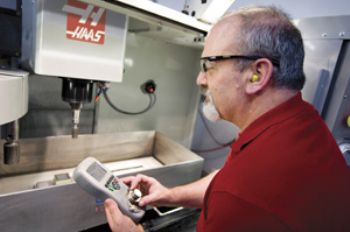
One feature of the Haas machines that Incom makes frequent use of is the Renishaw probing system, as this allows Incom to export machine data that can be used to understand process parameters. Mr Davis uses probe data to ‘track’ the outside diameter of a machined part and gain a consistent measurement of the machine’s capability for maintaining tolerance (samples are taken every 150min across three shifts).
“Because each Mini Mill produces 250-300 parts per day, we take a measurement about every 30 parts,” says Mr Davis. “The first series of tests revealed a process capability of 0.61Cpk, equating to 35,000ppm out-of-spec. This was not very good, so we introduced X-bar charts to the cell, allowing the operator to see what was happening in real time; we also introduced an out-of-control action plan, which indicates what to do when the process is going out of control.
It transpired that most variation was due to tool wear, and it came immediately before and after a tool change.
“A few years back, we were achieving yields of around 84% for that part. Now, we’re closer to 99% — and process capability has improved to 1.06Cpk, which equates to 750ppm out-of-spec. The other amazing thing is that the Haas machine is only supposed to cut to a tolerance of 0.0002in, but we are regularly achieving 0.00015in.”