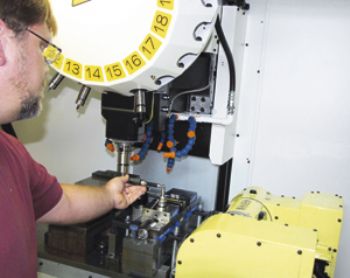
Ballbar analysis is a proven method for determining machine tool capability, and it is the most practical, convenient and comprehensive tool for assessing the contouring accuracy of CNC machines.
Ballbars have been commonplace at precision machining operations for more than 20 years, but a medical-device manufacturer in Fort Wayne, Indiana, is showing how the latest wireless ballbar technology makes a big difference in doing fast capability checks on small machines, as well as establishing a benchmark on their volumetric
accuracy.
Nemcomed — a division of Avalign Technologies — is a ‘full service’ supplier of implants, instruments, cutting tools, special instruments, cases and trays for medical-device OEMs. Avalign’s strategy is to be a ‘one-stop shop’ for OEM providers to the orthopaedic, spine and trauma sectors, its aim being to supply everything a physician needs to perform implant procedures. Ensuring that machine tools and processes are capable of producing parts to specification is the goal of the company and its 450 employees,
as well as federal regulatory agencies.

Eric Arnold, a manufacturing engineer at Nemcomed, says: “Obviously, we have to meet FDA and ISO requirements; we also have special customer requirements, as well as personal interest and pride, knowing that our products will end up in someone’s body. As potential patients ourselves some day, we want to make parts of the highest possible quality.”
As a manufacturer of medical devices, Nemcomed must comply with both the FDA 21 CFR Part 820 Quality System Regulation and the ISO 13485 Medical Device Standard. To qualify machines, the company had been using a traditional wired QC10 ballbar from Renishaw plc (www.renishaw.com). “We test the X-Y, Y-Z and X-Z planes, and the QC10 required a set-up for each, so our set-up time was about 1.5hr,” says Mr Arnold.
The company acquired Renishaw’s new QC20-W wireless ballbar in 2010, and this immediately had a positive impact on part quality — and on the company’s ‘bottom line’. The new ballbar retains the principle of using a CNC circular program and powerful software to quickly diagnose and quantify machine positioning errors including servo mis-match, stick-slip errors, backlash, repeatability, scale mis-match and machine geom-etry, as well as providing an overall circularity error value. It also adds new capabilities, as Mr Arnold highlights. “The wireless ballbar requires just one set-up — less than 15min — for testing in all three planes. More importantly, it doesn’t disturb our production set-up, so we don’t have to re-set the machine when we go back to production mode. We remove the ballbar, insert a tool and get back to making parts in minutes.”
Wireless operation is also ideal for Nemcomed’s small machines. “Machine tool makers understand how much ‘lean operations’ value floor space, so new machine tools are designed with smaller footprints. This results in less interior space to manoeuvre a wired ballbar, so wireless data transmission is a big advantage. Safety is also improved by the ability to fully close the doors on the machine during the tests.”
Implants and instruments

Nemcomed manufactures approximately 1,000 different parts — either implants or the tools used during implant procedures — and it supplies parts to the top orthopaedic OEMs. The company makes implants for knees, hips, shoulders, wrists, elbows, fingers and the spine; tools include pliers, cutters and wire cutters.
Implants are generally produced in a variety of sizes, with five to six sizes for each part. Batch sizes are typically 30-40 pieces. Many of the implants are complex, incorporating curved and spherical features. The company also makes proprietary products, and licenses them to customers. For example, its patented Flex-Shaft and Self-Retaining technologies are used in a variety of applications, including spinal procedures and hip, shoulder and knee arthroplasties. The Flex-Shaft is used in conjunction with surgical screwdrivers, taps and drills.
Parts are generally made of stainless steel, titanium or cobalt chrome, and they start as bar stock or forgings (for implants). Raw materials are processed through a cut-off cell, then move on to a mill or turning centre, depending on the part’s complexity.
“Shortly after receiving the new ballbar, we had a machine go out of spec, so we tested it with the ballbar; we also had it checked with a laser interferometer, and the results were identical. We then knew that the ballbar would allow us to test our CNC machines quickly — and with an extraordinary level of confidence.”
New customer
This ability to test quickly and accurately resulted in Nemcomed getting a new (and large) customer that was quality-focused and required verification of machine calibration. “The expense of bringing in the laser interferometer for every machine would have made it prohibitive to supply this customer with parts,” says Mr Arnold. “We showed the customer the results of the ballbar and interferometer tests, and they agreed that ballbar testing would meet their verification requirements. Basically, the QC20-W paid for itself after testing just two machines.”
The new ballbar design gives the advantage of testing in three orthogonal planes through a single reference point with a single set-up, which allows the accompanying software to produce a representative measurement of volumetric positioning accuracy by correlating all three. Mr Arnold says this benchmark of volumetric accuracy is valuable to Nemcomed, because positioning errors can be compounded by simultaneous multi-axis motion during contouring.
In August 2010, Nemcomed completed a 10,000ft2 addition to its Fort Wayne plant, to consolidate another plant’s operations and add space for new machines — five new Citizen sliding-head machines and a five-axis Fanuc Robodrill — to complement its line-up of Mori-Seiki and Mazak five-axis machining centres, Fadal three-axis machining centres, Brother and Fanuc wire-cut EDM machines, and a Samsung three-axis lathe.
The company uses the ballbar on 20 machines, including all of its CNC machining centres and wire-cut EDM machines. Maintenance engineers monitor results as part of a predictive maintenance program, tracking a three-month time-frame for early detection of errors, for optimum efficiency in scheduling maintenance and repairs.
“The ballbar comes in a case that has spaces for the most popular accessories, making it easy to transport. We can take it to any of our four global manufacturing facilities, set it up quickly and get the machine qualifications we need,” says Mr Arnold. “Knowing the machine’s capability before it cuts parts allows us to minimise scrap and down-time. That gives us high part quality and productivity, while keeping manufacturing cost down.”