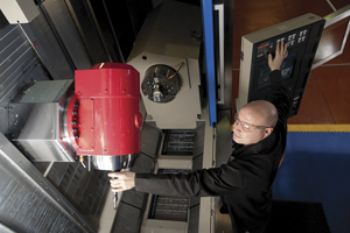
In order to provide ‘game changing’ deliveries on the special seals it manufactures, Rotherham-based Aesseal has introduced a new production concept. This is based on a pair of DMG/Mori Seiki NT4300DCG 1500SZ mill-turn centres (www.moriseiki.co.uk), which now effectively comprise the company’s ‘stock’.
Aesseal manufactures mechanical seals for a wide range of industries, including oil and gas, power generation, chemical, mining, food and beverage, and metal processing. Its objective is to give its customers such exceptional service that they need never consider alternative sources of supply. It achieves this by dispatching 62% of all its product orders within 24hr and 72% within 48hr — world-wide.
Production and personnel director Richard Cook says: “In the oil and gas sector, the majority of installations have fixed pipework. Changing the pipe runs is impractical so each of our seals has to have a bespoke gland to suit, hence the radical approach to our customers in this market area. The consequence of working in this industry is that customers can not stock spares for every eventuality and need delivery extremely quickly, as downtime is exceptionally costly.”
Rather than attempt to stock combinations of seals in all of its 72 facilities, Aesseal has strategic stocks in key areas of the world, and uses these to build each assembly to customer-specific requirements on a just-in-time basis. Where this is not possible — such as non-standard products for oil and gas customers — the company has introduced a flexible rapid-manufacturing cell for producing one-off seal components (primarily glands and sleeves) right first time and within demanding timescales.
Mr Cook says: “With the two DMG/Mori Seiki mill-turn centre’s forming the heart of our Hydrocarbon Processing cell, our philosophy has been to leverage technology — rather than increase stock — and achieve highly competitive lead times at the touch of a button. The alternative was to use our existing sequential machining process, which was carried out on a number of different machine tools with several operations and hence set-ups.”
Significant advantages

The principle advantages of the HP cell are: floor to floor times are greatly reduced; there is only one set-up; parts come off the machine completely finished and fully deburred; and finished parts are more accurate as there are no alignment errors between related geometric features. Furthermore, human error is eliminated because parts are handled and set just the once — plus on-machine engraving ensures that port identifications and component serial numbers are error-free (the required text and its orientation forms part of each component’s 3-D model).
The nine-axis machines feature twin driven-tool turrets and opposed spindles and allow all surfaces to be machined in one set up and with minimal manual intervention, resulting in production lead times that are measured in minutes (not hours or days) — and the machines are run 24hr a day, 365 days a year. Other cell features include: the automatic creation of CAM programs from a 3-D CAD model, along with electronic verification of the post-processed code; and an industrial PC on each machine for accessing the latest works orders, designs and CNC programs, as well as manipulating the 3-D model in a paperless and revision-controlled environment. Where appropriate, pre-prepared billets are available to allow an immediate start to machining. There is also quick-change work-holding (which includes six-jaw chuck technology for thin cross-section workpieces), and a 120-tool ATC.
“For years, we have embraced one-hit machining on lower-complexity high-volume parts, so we are very experienced in multi-axis machining,” says Mr Cook. “We expanded this philisophy to our complex non-standard manufacturing areas in the early 1990s, but the real step-change was the further development of this approach into multi-tasking technology. We only have one chance to make the part, so the support systems are fully integrated to eliminate human error at every stage. Very few other companies are at this level of integration, which allows operators to simply load a billet, press cycle start and walk away.”
Selection and evaluation
Machine selection and evaluation was exhaustive, with trial components and a scoring system for machine features, which eventually resulted in Aesseal concluding that the DMG/Mori Seiki NT4300 was the best machine for its requirements. “We had to be very thorough in our evaluations and selection procedures, as the concept was new and the investment substantial; we also wanted to minimise risk, as far as possible, regarding the performance of the cell and any changes in our future work mix.”
The cell was installed on 16 September 2008. By 13 October, commissioning and training had been completed and the first test cuts carried out. On 27 October, the first parts were completed for a customer. “Fully machined glands can be produced in one set-up from pre-cut billets in little over an hour; a multi-operation approach took over 4hr — plus there was the possibility of accruing queuing time. Some two weeks later there was a major test for the cell when a number of complex seals for the oil and gas sector were produced within 12hr of receiving the order; this time included all administration, design, programming and machining work. Our sales personnel ‘hand carried’ two seals to South Africa; a further four were also despatched to mitigate a breakdown situation at a customer in France.”
Customer service
Cost reduction was not the primary driver for Aesseal introducing the HP cell. The main objective was to meet its commitment to customer service and thereby increase market share. The industry it operates in is not overly price sensitive, because the cost of a replacement seal is low in comparison to the cost of lost production due to poor reliability or a breakdown. “Oil and gas is now the fastest-growing part of our business and the DMG/Mori Seiki NT4300s are enabling us to achieve our goals. As part of our next phase of planned growth we are evaluating the possibility of replacing most of our conventional CNC machinery with three more multi-tasking NTs. This would give us the same machining capacity, while at the same time freeing up a considerable amount of floor space and existing machinery for inter-group deployment, rendering building expansion unnecessary. We already have the foundations in place for a further eight NTs as part of our original future-proofing philosophy.”
Reliability and accuracy are important to Aesseal, because a machine breakdown rapidly becomes a customer service issue, which is unacceptable to the company. “The results we get from the DMG/Mori Seiki machines are highly predictable. Moreover, compensation for thermal expansion is exceptional; and the robust design of the machines allows us, where necessary, to achieve surface finishes better than 32µin — despite aggressive material removal rates. In addition to preventative maintenance schedules we have DMG/Mori Net for on-line fault analysis and advanced self-diagnostics on the machine.
“Our new method of machining also saves on raw material, because a shorter length of material is required for holding in the chuck than would be required with sequential machining. We also use vegetable-oil-based coolants in all our machines, to minimise environmental impact. Indeed, we are very conscious of our environmental responsibilities and the welfare of our workforce. The NT4300s help in this respect, as handling is minimised, reducing the chance of injury; and because parts are deburred on the machine as part of the machining cycle, there are no sharp edges for operators to contend with — or abrasive deburring operations post-manufacture.”