Born in the US, Allan Edwards, owner and CEO of Dorset-based FGP Precision Engineering Ltd, has infused his firm with a new process-obsessed culture in which one of the most important areas is quality. The company is reducing its scrap rate by rigorously applying best practice and by employing the latest ‘quality’ technology.
Sourced from Renishaw plc (www.renishaw. com), this technology includes a PH20 five-axis touch-trigger-head system for co-ordinate measuring machines, an Equator shopfloor gauging system, and a QC20-W wireless ballbar. Mr Edwards says: “My background was in investment banking. In 2004, I started looking for investment opportunities in the UK and was introduced to FGP. I acquired the company in 2006 and have since relocated to England.
“Before FGP, I had never worked in a company that manufactured parts. It’s been an interesting learning experience, and one which I am enjoying every minute of. FGP manufactures critical parts for aerospace applications, and it was while serving in the Marines that I learned the meaning of ‘flight-critical’. At FGP, we understand what it means to be safe in the air, so we take quality very seriously.”
A little over 12 months ago, Mr Edwards appointed aerospace quality expert Nigel Manning to oversee the transformation of the company’s quality processes. What struck Mr Manning (inset right) was that, while the company had some very good ‘state of the art’ manufacturing equipment and machine tools, it needed to invest in the latest quality control processes.

“Before we bought any new equipment, however, we looked closely at our scrap rate,” says Mr Manning. “The amount of scrap FGP was producing was more than 14.7% of its total output, so we examined and prioritised ways in which we could quickly and effectively reduce that figure. First of all, we thought carefully about how our CMMs should be used, and we decided to retrofit our IMS Merlin with a Reni-shaw PH20 five-axis head, which offers exactly the level of precision we need for aerospace parts.”
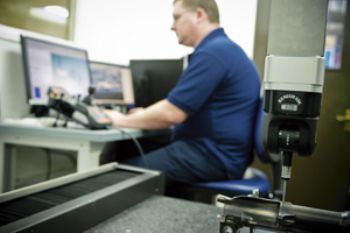
The responsibility for FGP’s CMM operations lies with Dave Robins, the company’s CMM programmer, whose job as inspection operator is to verify parts before they are shipped to customers. Some parts are inspected 100%, some are batch- or sample-checked, but increasingly many of the parts being checked on the CMMs are first-offs. Mr Robins says: “When the first machined component comes off the machine, we check it to make sure it is to specification before the operator runs a batch.”
Many of the items that are routed to the CMM room are complex parts that would be time-consuming to check manually, so the inspection team has to write inspection programs. “For example, on a tail-rotor component for the AW139 helicopter, we have to check all dimensions,” says Mr Robins. “It is a critical component machined from titanium. We manufacture a batch of 35 every month, and we check 100% of two of them. We measure the outside profile, the holes and their positions, as well as other features.
The program takes around 15min to measure 350 dimensions, whereas the older PH10 indexing head took about an hour to measure the same part. The PH20 is a five-axis measuring system, so it can get to every feature in one set-up. Its performance is such that we’re planning to buy another this year.”
Accurate machines
Inaccurate parts may result from bad tooling, worn spindles or poor workpiece clamping, but defects can often be attributed to positioning errors resulting from geometric, dynamic and ‘play’ errors within the machine. Moreover, it does not matter if a machine is new or old; the secret of reject-free production is to know just how good a machine really is and to catch potential problems before defective parts reach the CMM.
Mr Manning says: “Along with the PH20 retrofit, we decided to invest in a Renishaw QC20-W wireless ballbar. It turned out to be another very good decision. The ballbar has really helped us with every one of our five-axis machine tools. We’re able to make a part better, because our machines are more accurate and more predictable.”
.
FGP’s five-axis section manager, Simon Griffith-Hughes, is charged with maximising and maintaining the accuracy of the company’s three DMU Evolution CNC milling machines supplied by DMG; these are used to make a wide variety of parts in a variety of materials, from aluminium to titanium alloy. He says: “Parts like turbine blades are machined to within 2-3µm. We bought the Renishaw ballbar to benchmark the DMG machines and make sure they are in good condition — and maintaining their high level of accuracy. For safety reasons, we don’t run the machines with the doors open, so the fact that the QC20 is wireless makes it much easier to use.”
Once FGP had addressed the issue of machine accuracy and final inspection, Mr Manning turned his attention to in-process checking. During a visit to Renishaw, he was introduced to the company’s new Equator gauging system, and one was subsequently added to FGP’s growing ‘arsenal’ of quality-control systems.
“Renishaw’s Equator is a compact, bench-top system that allows an operator to quickly and easily check a part between operations,” says Mr Manning. “The idea isn’t that you inspect every feature, but pick those features that control the process. So, if you are drilling a particular hole 20 times with the same tool, you inspect, say, the first, second and last; if they are correct, this gives us the confidence to say that the others are also machined correctly.”

The Equator’s gauging technology is based on the traditional comparison of dimensions on a production part relative to a reference master part. Moreover, re-mastering is as quick and easy as measuring a production part — and Equator immediately compensates for any thermal effects, returning accurate data as if collected in a temperature-controlled quality room.
Mr Griffith-Hughes says the Equator also benefits FGP’s five-axis machining operation: “We didn't purchase the Equator to take the place of the PH20, but to give us another inspection opportunity on the shopfloor and to help us quickly double-check and re-check the finer points of the parts we are making. This way, we do not have to keep running to the inspector to ask him to check out a dimension. When the part comes off the machine, we simply put it on the Equator and we immediately know if we have a problem.”
Simple set-up
The compact Equator gauging system can be ‘up and running’ — straight out of the box — in less than 20min. The gauge weighs just 25kg, requires single-phase power, and does not need a compressed-air supply. The intuitive, operator-friendly front-end software requires little or no training, and the optimised ratio of working envelope to machine footprint means that an Equator can be used in even the most crowded factory. The combined benefits of the new company-wide quality culture and the investment in the latest Renishaw technology have resulted in a dramatic decrease in FGP’s annual scrap rate. Mr Manning says: “For the first 11 months of 2011, we were down to 4.9% of the overall volume, which means we’ve more than halved the monetary value of scrap in the first year of using the new Renishaw equipment. For the first quarter of 2012, our current reject rate is 2.5% of the total output.”
The benefits of FGP’s increased focus on quality are also being felt in the company’s sales, as Mr Edwards confirms: “Our order book is currently the largest we’ve had in the history of the company. I put this down to the fact that our customers are very pleased with our quality and delivery. I believe that technology is important in improving quality, but we also have to make sure that our people buy in to our quality goals, take ownership and check their work as they go along. The Renishaw equipment is easy to use and reliable, which makes the task that much easier.”