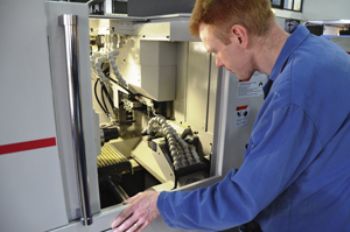
The use of a non-guide-bush sliding-head turn-mill centre in the production of specialised sleeve connectors for the fibre-optic industry has allowed BCMZ Precision Engineering to benefit from the rigidity of the collet arrangement normally found on a fixed-head lathe, plus the flexibility, consistency of machining accuracy and performance associated with sliding-head machines.
The company’s selection of a Citizen A20-VII CL non-guide-bush machine followed machining trials at Citizen Machinery UK Ltd, Bushey (www.citizenmachinery.co.uk), on small batches of the nickel-silver fibre-optic connectors; these are just 3mm in diameter x 4mm long and have a 1.25mm-diameter through-hole. The reason for the trial — and investigations into the capabilities of different machine types — was to ensure that it would be possible to reliably maintain tolerances of 3µm on the OD and bore, a 0.0005mm TIR concentricity and a surface finish on the OD of 0.4Ra.
Following the successful sample runs at Citizen Machinery UK, it was agreed to install the machine at BCMZ’s Sudbury facility and extend the trial to normal production conditions over a four-week period in order to complete a month’s call-off of 4,000 pieces. The extended trial also allowed the company’s customer to be involved in ‘fit for function’ approval of the components.
Managing director Glenn Boydell said: “We had been machining these parts for some time on a Citizen C16; we also had a Citizen L32, so we knew the capability of the sliding-head concept. However, these parts are so demanding that we felt we really needed the rigidity of a fixed-headstock machine, if we were to minimise rejects and improve consistency. That said, we didn’t want to lose the benefits of overlapping tooling provided by sliding-head machines; neither did we want to break the budget with a special ultra high-accuracy lathe that would be dedicated solely to one job.”

Machine options
Due to the micron tolerances involved and the influence of temperature, BCMZ had always worked closely with the customer and provided 100% inspection and ‘fit for function’ monitoring; this was essential, as the rejection rate could be as high as 40%. Mr Boydell says: “While we were keen to perfect the process, we had to work with a margin that we and the customer could live with.”
When Mr Boydell decided to investigate different machine options with several suppliers, Citizen’s application engineers suggested running trials on the latest non-guide-bush version of the A20, which features a heavier construction than the earlier Citizen C16, making it more stable and better able to absorb any vibration. Moreover, because the A20-VII CL does not have a guide bush, the distance between the collet and the cutting tool can be minimised; and in the case of the short 4mm-long sleeve connector, the material is fed out on the non-guide-bush machine to its final length, as it would be on a fixed-head lathe. This change in the machining concept compared to the C16 overcame BCMZ’s quality issues and even allowed special batches of 316 stainless-steel components to be produced to the same standard.
The machining process involves facing and chamfering, rough- and finish-turning of the OD and drilling through a 1.1mm-diameter hole, followed by high-precision fine-boring to achieve the final tolerance of 3µm. The component is then parted off and transferred to the sub-spindle, where the part-off face is machined using a single-point tool; this also used to produce ‘slight’ chamfers and undertake deburring in-cycle.
The rigidity of the machine is such that BCMZ setters change all tools every 500 parts — an increase of 200 parts compared to the C16. Moreover, the reduced length of remnant bar end that comes with the use of a non-guide-bush system means that more components are obtained from each length of bar — adding further to the benefits of the new machine.

Company background
BCMZ was set up in 1967 by four engineers from the original Colchester Lathe machine tool company in nearby Colchester. It was bought by Mr Boydell and his brother in 1987, when the business was based on providing a sub-contract turning service using manual lathes, capstan lathes and hydro-pneumatic lathes.
In 1993, the company introduced CNC milling; two years later, BCMZ bought its first CNC lathe and machining centre. From that point on, the company has never looked back. The installation of its first CNC sliding-head lathe — a Citizen L32 in 1998 — set the business up for single-cycle machining that combined up to four operations into just one.
Each year, more CNC machines were bought, and space in the 4,000ft2 factory was soon running out. In 2010, Mr Boydell bought-out his brother and moved into 12,000ft
2 premises that would accommodate his expansion plans; these involved buying four new machines (including the Citizen A20-VII CL) and a co-ordinate measuring machine. BCMZ also bought an aluminium extrusion company and integrated it into the new facility. “Although a totally different business area, many of the customers require machined components, creating additional work and expanding the customer base.”
The company now has a workforce of 17, including one apprentice machinist, and growth in turnover over the last five years has exceeded 30% (2008 was a record year, with sales of more than £1 million). De-stocking by customers caused a ‘hiccup’ in 2009, but by maintaiingn his on-going investment, Mr Boydell is confident that 2012 will hit another high; he is predicting that turnover will exceed £1.3 million.
Customers, which tend to be within a 70-mile radius of Sudbury, come from a range of industry sectors, including automotive, aerospace, fibre-optic, connector, MoD, medical and media equipment, as well as packaging machinery and air conditioning.
Having such a wide base of customers means that BCMZ machines a variety of materials; these include a wide range of plastics, stainless steels, copper, and tool steels, as well as exotics such as Monel, nimonics and titanium. Batch sizes are generally in the range 20-200, but they can reach 5,000. Batches on the three Citizen machines are generally between 500 and 4,000.
The Citizen A20-VII CL non-guide-bush machine has a working stroke of 55mm and a spindle speed of 8,000rev/min. BCMZ tends to run the nickel silver components at 6,000rev/min and use the main spindle and sub-spindle (both have a full C axis) to finish the part in a single cycle.Moreover, the ability to cut with two tools simultaneously on the front and rear of a com-ponent considerably shortens cycle times. The maximum driven-tool speed is 6,000rev/min.