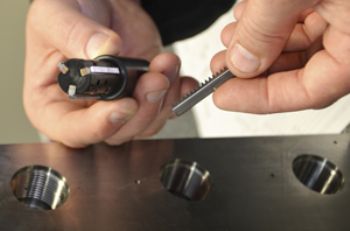
Following thread-milling trials using multi-flute indexable thread mills, BIS Valves was able to cut the time required to machine 1
1/4 x 12 UNF threads in valve body manifolds by almost 25min, reducing the previous time per thread from 5min to just 140sec.
The change in the thread-milling process, and the switch to the use of the Vargus MiTM (Multi-flute Indexable Thread Mills) with their 40mm-long inserts and multiple-flute holders, coincided with the installation of a Dahlih MCH 630 twin-pallet horizontal machining centre in 3,000ft
2 of newly acquired production space at its facilities in Wimborne, Dorset.
This machine provided the additional spindle capacity required to not only meet a significant increase in the size of the current order book but also support the company’s planned growth for 2013. BIS Valves called in Telford-based Vargus Tooling UK Ltd (www.vargustooling.co.uk), to advise on possible improvements that could be applied to its in thread-milling process, which involves up to eight ports being produced on three faces of seven variants of manifold block made from 316 stainless steel. Vargus suggested its latest multi-fluted thread-milling system. This was the subject of trials at BIS and saved more than 3min per hole; moreover, the tool showed no signs of wear after more than 500 cycles — and it achieved an improved finish on the class 2B thread form that has to accommodate pressures up to 10,000psi.
The largest of BIS Valves’ manifolds are 100mm squarex 330mm long with up to eight ports on each of three longitudinal faces, as well as a variety of feed and connecting holes on all six faces. Smaller versions are 100mm square x 127mm long and 75mm square x300mm long. These variants have up to six ports to the same specification, which includes a 26.7mm depth of thread. These manifolds are used to control hydraulic systems that are mainly installed in the oil and gas industry for top-side, sub-sea and down-hole applications.
Minimising cycles
With the ‘horizontal machining’ strategy, one face and both ends of each block are initially milled. The part is then located using the mach-ined datum faces, and the other three faces are skimmed square and flat. The manifold is then gun-drilled as a separate process and returned to the machining centre, where the various drilled and threaded features — including the port holes — are finished in the same set-up.

When BIS Valves used vertical spindles for machining these manifolds, the various operations were all separate cycles, which extended lead times with re-setting; batches are no bigger than 60 but more likely less than 10. Prior to the use of Vargus’s MiTM, the porting cycle uses a U-drill to hog out the material, followed by another U-drill with a formed insert that finishes the form in the port, creates a chamfer and produces a 60deg cone. As part of the proving trials, Vargus also supplied its TM Gen (thread-milling) software; this provides optimised machining data and G-codes that are acceptable to most machine control systems. The tool-holder supplied was an RTMC 2522-43L3 with R40I12UNTM VBX TiCN-coated inserts with two cutting edges.
The MiTM tool-holder features three equi-spaced inserts that can be either 25 or 40mm long (as in BIS Valves’ application). The tool allows the use of a significantly increased feed rate, provides longer tool life and requires fewer machining passes — and it offers improved finish-machined quality. MiTM tools have cutting diameters ranging from 13.6 to 58mm and one to eight flutes. The inserts are supplied with varying numbers of teeth in a variety of pitches and are offered in a range of threading standards. Conical and shell-mill holders are available for other thread types.
The tool that BIS Valves used prior to the Vargus MiTM was a single-insert type that was run at 129rev/min at a feed rate of 69mm/min; the Vargus tool is run at 2,400rev/min at a feed of 188mm/min. Workshop team leader Adrian Booth says: “We could increase the speed to cut even faster, but we have a policy of ‘insurance’ and tend to ‘throttle back’ to maximise tool life and process security. The reduced speed also helps with swarf control when machining 316 stainless.”
The company now known as BIS Valves was formed 1964. It adopted the name Bournemouth Industrial Supplies in the early 1970s, when it became involved in supplying valves to the offshore oil and gas industry.
Continuous growth
Following a management buy-out in 1994, the business had three directors: Paul Gardiner as managing director, Matthew Smith as production director and David Kelly as technical director. The company changed its name to BIS Valves in 1998. Continuous growth based on a policy of self-funding saw sales top £4.3 million in 2011, and the company is well on target to exceed £5 million this year. The business employs 62 people, is currently recruiting and has four apprentices.
BIS Valves’ headquarters and main production centre houses design, development and most of the company’s production resource. Some 80% of its products are destined for the oil and gas sector, with the remainder going to customers in the pharmaceutical, power generation, water, hydraulic and fuel systems sectors. Half of its production is exported directly to Norway, Europe, the Far East, Australia and the USA; a further 30% is exported indirectly, being incorporated in customers’ products.
Explaining the company’s success, Mr Kelly says: “We have our own product and our own hydraulic design specialists, which means we can adapt quickly to customer requirements. We also have a fairly small — but dynamic — operation with our own machining facility, which gives us the flexibility to respond promptly. Next on the thread-milling front will be the use of Vargus tooling to produce
1/2in BSP threads.”