Tool maker and sub-contract machinist Crossen Engineering increased its aerospace business last year to 20% of turnover and announced that it was aiming to expand it to 75% by 2015. As part of that plan, the group has started a new division called Crossen Aerospace at its factory near Belfast — and it will take on additional staff plus two apprentices during the course of 2012.
A Tier Two company serving the civil- and military-aerospace supply chains, the company holds AS 9100 quality management approval and completed the Revision C audit in June this year. Its customers include Bombardier-Shorts, Thales Air Defence, BE Aerospace and Lenis Aer in the UK; in the USA, air seal manufacturers Chromalloy and Seal Dynamics are users of Crossen products.
MRO (maintenance repair overhaul) and PMA (parts manufacturing authority) work accounts for most of the aerospace production at Crossen’s Belfast factory, while OEM (original equipment manufacture) of pressed components from nickel alloys and aluminium alloys such as Al 2219 is also undertaken.
Crossen Aerospace specialises in the manufacture of pressed high-temperature alloy components for aero engines. The company is one of the very few in the UK — and indeed in Europe — able to undertake this exacting forming work to aerospace standards.
Hastelloy X, RENE 41 and Inconel 600 are among the sheet and plate materials regularly processed. ‘Volume’ production is carried out using 17 power presses rated from 35 to 500 tonnes.
Forming technique

Pioneered several years ago, Crossen’s forming technique reduces the weight and cost of components such as engine air seals, compared with machining them from solid or from castings. It also offers a more-repeatable and accurate result than can be achieved by roll forming.
Another application is the manufacture of engine nacelle trailing-edge lip skin extensions and repair sections from sheet metal (these are currently in aluminium, but titanium and stainless steel are scheduled for the future). Due to the novel method of forming that Crossen Aerospace has developed, there is no need for subsequent heat treatment; this reduces the cost of manufacture and shortens lead times.
Sometimes, the sub-contractor is asked to assist with customers’ R&D programmes. For example, it designed tooling and produced prototype parts and assemblies for launchers and battery trays for Thales Air Defence, which led to the subsequent ‘volume’ production of pressed parts.
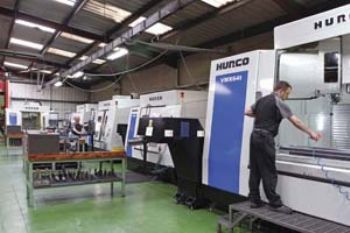
Press-working batch size is normally in the range 100-400. Second-operation metal-cutting on pressed components is completed on multi-axis CNC machining centres with capacities up to 1,626 x 864 x 762mm.
Fixtures to assist in measurement and inspection of aircraft parts are also manufactured. Crossen Aerospace, together with Crossen Engineering, designs tools and moulds for ‘legacy’ parts, as well as current and future parts based on customers’ CAD models or drawings. Alternatively, it reverse-engineers aerospace components on co-ordinate measuring machines using both touch-probe and laser-scanning for data acquisition.
The same metrology equipment, running under the industry-standard PC-DMIS operating system, verifies the tooling it makes against CAD files supplied by customers or generated on-site.
Optimised designs

Simulation software allows optimisation of tool design according to the material to be processed and ensures that any potential bugs are eliminated in the virtual environment before production starts. The machining of tools and moulds is completed in-house to exacting tolerances and surface finish, prior to component manufacture. Sometimes, just the tool is supplied to contract moulders and to customers that want to produce their own components.
For example, Bombardier-Shorts uses press tooling made by Crossen Aerospace, which also manufactures vacuum-forming tooling for aircraft seat manufacturer Kilkeel (a subsidiary of BE Aerospace). Design and manufacture of plastic injection mould tools followed by prototyping and ‘volume’ production of aircraft parts in the mould shop — plus assembly, if necessary — are further services provided. So far, most of the work in this area has been for the marine and military sectors; it has included Eurofighter pilot life-vest parts and components for ejector seats and parachutes.
The mould shop uses the latest digitally controlled machines with ratings from 50 to 650 tonnes. Parts can weigh from 5 to 2,100gm. The most recent plastic injection moulding machine to be installed is a Demag Ergo-tech 50-200 compact with a clamping force of 50 tonnes.
The firm operates 24hr for larger production runs and urgent orders. The next major investment is likely to be a much larger hydraulic press than is currently operated, probably with a 4m square bed and rated between 3,000 and 4,000 tonnes.
This will allow Crossen to produce even larger lip skins and other components for the aerospace industry. The company is also planning to buy a larger machining centre for producing larger moulds.