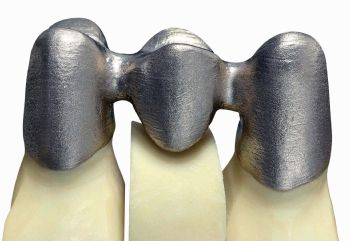
No two people’s teeth are identical, and the type and extent of tooth damage is unique to each individual, making bespoke manufacture of crowns, bridgework and implants a prerequisite. Traditional methods use lost-wax casting technology that has barely changed in 100 years. Now, additive manufacturing is replacing this labour-intensive process, resulting in many benefits.
Bill Oremus, president of Rhode Island-based dental-prosthetics manufacturer BEGO USA, says: “Our current product line based on lost wax is probably going to be obsolete in 10-15 years. The end of casting is approaching, as the introduction of layer-by-layer manufacturing begins to alter the landscape.”
In 2011, the company launched an on-site production service for non-precious alloy prosthetics using a direct metal laser sintering (DMLS) system from EOS GmbH, which has a UK subsidiary in Warwick
(www.eos. info). Moreover, less than a year after installing its Eosint M 270 AM system, BEGO USA was producing hundreds of units a week from CAD data, each prosthetic being fully dense and without porosity. “Our customers simply send us an STL file of a patient’s mouth scan and, after file review, we manufacture the coping — the inner core of a dental crown — in about 48hr.”
The laser sintering machine, which holds a vertically moving bed of powdered metal, builds crowns and/or bridges simultaneously, layer by layer, each one successively solidified by a focused laser beam. The DMLS system runs automatically, quickly and economically, providing a typical accuracy of ±20µm; and whereas a traditional casting process can produce about 20 dental frames per day, DMLS can make up to 450.
Mr Oremus adds: “EOS technology is giving us a lead over the competition at the moment, because we can do larger bridges with more than three or four copings in a row. The quality of the restorations is truly excellent, the surface structure of the copings is much better, and the marginal integrity is phenomenal. Moreover, we save cost and time.”
Because its EOS system can work with virtually any properly prepared metal powder, BEGO USA has patented its own chrome-cobalt-molybdenum alloy — Wirobond C+. According to Mr Oremus, the material contains more than 20% chromium; during manufacturing, this creates a passivity layer that prevents the release of free ions and ensures
a high level of bio-compatibility. Next on the materials menu for BEGO is a noble powder — a chrome-palladium trace-element alloy — that the company is in the process of developing for DMLS-manufactured prosthetics.
Palladium, a platinum-group metal, provides strength, stiffness and durability. The additional trace elements contribute an improved coefficient of thermal expansion, plus better elongation and malleability.