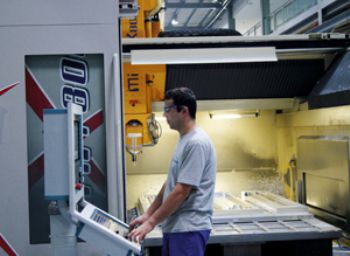
Although KaleAero is in its infancy, this aerospace manufacturer has developed rapidly and is now an important player in the global market. That said, the company is quick to point out that advanced machine tool simulation software has been a key factor in its success.
Based in Tuzla, Istanbul, KaleAero was established by the Kale Group in 2008. All aerospace activities were previously under the name of Kalekalıp, but as the amount of defence work grew beyond the available manufacturing capacity, the group decided to invest in a new facility dedicated to supplying aerospace and defence customers.
An 18,000m
2 building was finished at the end of 2007 and occupied early the following year. Since then, the new company has secured a number of international aerospace and defence supply contracts; its direct customers include Boeing, Lockheed Martin, PFW and Spirit AeroSystems. As well as the Boeing 787 Dreamliner, other commercial aircraft programmes that KaleAero is involved with include Boeing’s narrow- and wide-body 737, 747, 757, 767 and 777 aircraft. The largest defence programme supported is the Lockheed Martin F-35 Lightning II (Joint Strike Fighter).
Employing over 230 people and operating more than 30 high-speed CNC machine tools — mainly five-axis machining centres, but also some three- and four-axis units — KaleAero has established the machining of high-precision mid-size structural aerospace components up to 1m cubed as its core proficiency. Parts are predominantly cut from aluminium (currently around 80%), with titanium and stainless steel also being machined.
Production and engineering manager Selim Erol says: “The demand for titanium machining is growing. Indeed, this difficult material forms part of our future plans and will require investment in the best machines.” Some of the company’s larger five-axis machines can accommodate parts longer than 3m; mill-turn machines with up to nine axes are also operated. With a full range of aerospace and customer approvals including NADCAP-approved non-destructive testing (NDT), all post-machining processes can be carried out on site.
“Investment is very important for future growth,” says Mr Erol. “We are not structured for today but for targets set some years ahead. Only about 50% of our capacity is currently used, because the unit was built to match growth in the aerospace industry.”
Five-axis demands
When KaleAero decided to invest in five-axis machine tool technology, it visited established aerospace companies in the UK and the USA for demonstrations. “Although each company had a different operational style, different machine types and even different CAD/CAM solutions, almost all of them used Vericut simulation software.” says Mr Erol.
He could see that Vericut was essential, so he arranged for CGTech Ltd (www.cgtech.com) to demonstrate the benefits of the software. “Investing in Vericut is one of the best things we have done on our journey towards our company goals,” he confirms.
KaleAero’s competitive edge is attributed to its efficiency and the fact that all methods engineering is done internally. Like the company itself, the 15-strong engineering team is relatively young and faces the challenge of using its CAD/CAM solution, CATIA 5, to create NC cutting tool-paths for the production of five-axis components.
As well as operating CATIA 5 to an expert level, the engineers must operate Vericut to the same high standard. It is a company rule that none of the programs — even revisions — can be run on the machine tools without verification of the NC code by Vericut. A crashed spindle would result in weeks of down-time for the machine involved; KaleAero can not afford the lost capacity, as every customer measures on-time in-full (OTIF) delivery of components as a key performance parameter.
“If you do not use Vericut to check for collisions, gouges and undercuts, you will need to run several scrap parts before you get one that is correct — and, you risk damaging your machine tools. With First Article Inspection Reports linked to serial production runs and milestone project dates, quality is taken as given, thereby placing the emphasis on delivery. We aim to always make the component right first time, even with complex aero structure parts, and Vericut helps us achieve this goal.”
CATIA interface

Component CAD models are supplied by the customer, and KaleAero’s engineering team uses CATIA 5 to generate the NC cutting tool-path, before launching Vericut within the CATIA program. The CATIA-Vericut interface ensures that all the data is efficiently transferred to Vericut and that the programs can run simultaneously. Following verification, the NC code is uploaded to the server.
Vericut models of machine tools have been created by KaleAero from the CAD models supplied by the machine tool suppliers. However, for complex machines — such as the company’s latest nine-axis Okuma mill-turn lathe — CGTech provided the necessary modelling support.
As well as machining strategies, fixtures and cutting tools are major considerations within the production process (fixtures are specific to each structural part to minimise cycle times). The whole manufacturing system is modelled in Vericut to simulate the complete operation in a virtual environment.
Vericut is a module-based simulation program, and KaleAero uses different modules to suit specific requirements. The company currently has three seats of Vericut containing three modules of Verification, Multi-Axis and Machine Simulation; two modules of Auto-Diff and one module of the CATIA-Vericut interface, as well as Optipath (this adjusts cutting speeds to make the machining process faster and more efficient — and to improve quality).
Based on the amount of material removed in each segment of the cut, the software calculates and inserts improved feed rates where necessary. OptiPath increases feed rates in areas of light material removal and reduces them when more material is being removed. With typical cycle times ranging from 1 to 12hr — and longer for some of the large machines — the company believes the gains provided by Optipath will be significant.
The company is about to begin a project to eliminate paperwork from the shopfloor and make the process more visual. The first stage will incorporate Vericut Reviewer, which was launched with the latest version of the software. Mr Erol says: “We want to use Vericut Reviewer to show the operator what to expect from the NC program, and thereby remove the current reliance on engineering supervision and support.”
In conclusion, Mr Erol says: “Without Vericut, we could not have made it to our current position. Imagine what could happen with an inexperienced programmer creating NC code for complex, high-cost machine tools without using Vericut. I am pleased to say that, thanks to this software, we have not suffered a major machine crash. Of course our machine tools are covered by a company insurance policy, but the real insurance is provided by Vericut.”