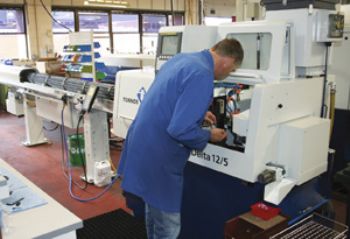
As a long-standing Tornos customer, Solartron Metrology sought advice from the Swiss manufacturer of sliding-head machines when its workload and component complexity
requirements changed.
Solartron, which has an established reputation for the design and manufacture of precision dimensional and position measurement transducers and instrumentation, acquired its first Tornos machines — three Elector 16 turning centres — in 1981. With these machines — along with a Tornos TOP200 in 1990, two Tornos Deco 10 machines in 1999 and a Sigma 20 in 2008 — having stood the test of time with regard to production quality and reliability, in May last year the Swiss company (www.tornos.ch) provided another Deco 10 and a Delta 12/5 — both single-spindle sliding-head lathes.
Since it was formed in 1973, Bognor Regis-based Solartron has grown to become a global supplier of measurement products used in a wide variety of applications that include: precision dimensional measurement, multi-channel electronic dimensional gauging, hand tools, positioning systems, process control, displacement monitoring and material testing for a range of industry sectors. In 2008, the company was acquired by the Ametek Group and, despite the recession, it has grown significantly over the last five years, increasing its staff numbers to cope with growing demand for a high variety of low-volume products.
The Sigma 20 machine installed in 2008 replaced the three ‘ageing’ Tornos Elector machines and soon demonstrated its ability to machine all Solartron’s stainless-steel components. Technical manager Peter Shepherd says: “The Sigma 20 managed to replace the three machines thanks to its overlapping operations and reduced chip-to-chip times. As the company runs double shifts, five days a week, this machine has been running for 21hr a day for more than three years. It was specified for its ability to accommodate fast change-overs, which the company demands for its vast families of parts — produced in batches that range from 50 to 5,000. The Sigma 20 has not only improved reliability, but with its high-pressure — 120-bar — through-tool coolant, it has also slashed some cycle times from 9 to 1.5min.
“With regard to the Deco 10 and a Delta 12/5 installed last year, these were bought for machining specific families of parts of varying complexity, with the Deco 10 machining the more complex ones. Moreover, the new Deco 10 is at least 40% faster than its predecessor.”
The company machines bar in the diameter range 1-20mm, and both the Deco and Delta machines were supplied with LNS Triton bar-feed systems. “We are machining our parts to tolerances of less than 10µm, with some dimensions having a finished tolerance of 5µm. The parts we machine are incorporated into metrology assemblies that have many sub-micron tolerances, so accuracy and quality are paramount.”
The Sigma 20, Delta 12/5 and Deco 10 have enabled Solartron to eliminate second operations that were required prior to the installation of these machines. This has resulted in improved component quality, shorter cycle times and significantly reduced stock levels. These machines have also allowed Solartron to substantially reduce its sub-contracting costs while ensuring that it retains full control over the quality of its components.
Open House answer
Meanwhile, when Precision Aerospace Component Engineering Ltd (PACE) was looking for a new turning centre to produce bolts for the aerospace industry, the Braintree-based company found the solution it required at a Tornos UK Open House. The aerospace manufacturer, which produces components for actuators, filter systems, motors, generators and engines for commercial airliners and military aircraft, wanted a high-specification turning centre to replace ageing sliding-head lathes and bought a Tornos Gamma 20/6 sliding-head turning centre to add to its 18 turning centres and eight machining centres.
The Tornos Gamma 20/6 is the first Tornos purchase since the AS9100-registered business bought a Tornos ENC164 in 1994. PACE’s production director John Green says: “When looking for a new machine, we wanted something that was extremely capable, flexible and productive to the point that it could replace three ageing sliding-head lathes. With the Gamma 20/6, we have achieved this.”

The Gamma 20/6 was purchased primarily for the production of bolts that the company produces in quantities of more than 15,000 per month. The S80 bolts are used extensively throughout an aircraft, and the family of bolts produced at PACE varies from 2 to 15mm in diameter and in lengths up to 100mm. The bolts were turned on three Manurhin sliding-head lathes in 50sec and then transferred to a machining centre for the hexagonal bolt head to be machined; this took 20sec and was labour-intensive. The Tornos Gamma 20/6 completes bolts in one hit in less than 40sec by simultaneously machining the hexagon on the sub-spindle while turning the next part on the main spindle.
“Completing the bolts in one hit improves productivity, process reliability, component quality and consistency. Previously, having an operator involved introduced an element of
inconsistency to production.
For example, the setter putting the parts on the machining centre for hexagonal milling needed breaks; with the Gamma, we can load the bar-feeder with bar and take the labour-intensive element out of the equation.” Mr Green says another advantage offered by the Gamma 20/6 is its ability to operate without a guide bush, reducing bar remnants and the subsequent material waste by up to 15%. “Additionally, the Gamma is more capable than other sliding-head machines in the same price bracket, as it has a Y axis on the sub-spindle.”