Gary Trim, managing director of West-Midlands sub-contractor De-Met, says that the idea behind the company was to offer prototype work at a reasonable cost, and this type of work is still at the core of the business. “We have always aimed at the low-volume high-value market — one-offs, prototypes and specialist work. Nowadays, we also do some higher-volume work, but it is a case of customers asking us to do it, rather than us going out to look for that kind of work.”
De-Met’s customer base is quite wide-ranging, including kit-car suppliers, parts for Ferrari and Honda race teams, point-of-sale display companies, makers of bus seats — and even manufacturers of crematorium equipment. “We are designers and engineers. Indeed, we can do the design work for customers from scratch — or work from their drawings. We also do a lot of cutting and bending for other laser sub-contractors in the area. Unlike companies that just focus on offering a laser cutting service, we have always stayed as sheet metal engineers offering a range of processes. Laser is just one tool we can add into the mix, rather than us being just a laser cutting sub-contractor.”
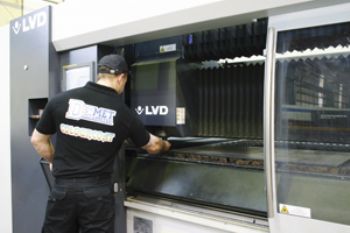
That said, a recent investment is an LVD Sirius 3015 CNC laser cutting system with twin 3 x 1.5m shuttle tables that ensure a rapid turn-round on complex components. Supplied by Banbury-based LVD UK Ltd (www.lvdgroup.com), the 4kW CO2 laser gives De-Met the ability to process thick or thin mild steel, stainless steel or aluminium on the same machine. On thin material, cutting in the plasma mode, the combined axis speed of 120m/min allows very high processing speeds, while the table size allows the use of large sheets, which means De-Met can process parts up to 3m long and set up large nests that allow efficient use of the machine time and unmanned overnight running.
De-Met has been in business for around 15 years, and one of its two LVD press brakes has been there from the very start; it also has a three-year-old LVD Strippit Sienna punch press, which replaced an LVD Delta machine. The new Sirius laser replaced a 10-year-old LVD Axel laser, which was installed in 2001 and proved itself to be a dependable ‘workhorse’. However, with advances in laser technology and a pending move to new premises, installing a new machine in the new premises was deemed a logical choice.
As well as the larger table size, the new Sirius is offering all-round efficiency gains. The shuttle change-over is faster (less than 30sec), the ergonomic layout of the machine makes for easier operation and maintenance, and the plasma-mode cutting offers high-speed processing on thinner material. Works director Lee Kempson says: “We have never had that capability before, and we can use it on material up to 2mm. We did look at fibre lasers because of their speed on thin material, but we soon realised that we needed the flexibility offered by a CO2 source — a machine that could do thick or thin material with optimal quality.”