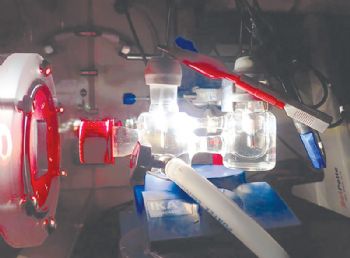
A new study — led by researchers at St John’s College at the University of Cambridge
www.cam.ac.uk — have successfully “split’ water into hydrogen and oxygen by altering the photosynthetic machinery in plants.
Hydrogen has huge potential to be a ‘green’ and unlimited source of renewable energy, and this research could now be used to revolutionise the systems used for renewable-energy production.
A new paper published in Nature Energy outlines how academics at the Reisner Laboratory in Cambridge developed their platform to achieve unassisted solar-driven water-splitting. Their method also managed to absorb more sunlight than natural photosynthesis.
Katarzyna Sokól, first author (and PhD student at St John’s College), said: “Natural photosynthesis is not efficient. It has evolved merely for the plant to survive, so it makes the bare minimum amount of energy needed — around 1-2% of what it could potentially convert and store.”
Artificial photosynthesis has been around for decades, but it has not yet been successfully used to create renewable energy, because it relies on the use of catalysts, which are often expensive and toxic.
The Cambridge research is part of the emerging field of semi-artificial photosynthesis, which aims to use enzymes to create the desired reaction.
Ms Sokól and the team of researchers not only improved on the amount of energy produced and stored, they also managed to re-activate a process in an algae that has been dormant for millennia.
“Hydrogenase is an enzyme present in algae that is capable of reducing protons into hydrogen. During evolution, this process has been de-activated because it wasn’t necessary for survival, but we managed to bypass the inactivity to achieve the reaction we wanted — splitting water into hydrogen and oxygen.