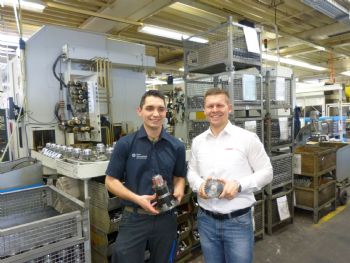
Work-holding specialist Hainbuch (
www.hainbuch.com) says that when a new product like its Mando G211 mandrel is launched, the product must be tested thoroughly under real-world conditions, so it approached gear manufacturer Hänel GmbH in Bad Friedrichshall, Germany.
Jürgen Renner, Hänel’s production manager, said: “We already use Hainbuch clamping devices, and we could see that the Mando G211 mandrel could improve our manufacturing and processes; we had no hesitation in agreeing to support the trials.”
Hänel initially received two prototypes of the Mando G211 mandrel, in sizes zero and two. These were tested on a manually loaded Richardon R400 and a Gleason-Pfauter GP200 hobber with automatic loading, to see if the mandrels would be compatible with these machines.
Mr Renner said: “On the Gleason-Pfauter, we were not able to reach our zero-line because the mandrel was too tall, necessitating adjustments to the machine and loading system.
However, following conversations with designers at Hainbuch, changes were made to the mandrel system, and revised prototypes were then tested.
These confirmed that the stiff and slender mandrel could go into series production and be produced for stock.”
Mr Renner added: “With our previous clamping system, we couldn’t achieve good concentricity, as the workpiece was pressed axially downwards.
“With the G211 mandrel, it is clamped from the inside — radially outwards — giving a higher level of clamping stability and eliminating the re-working of certain components.”
In addition, Hänel has improved set-up times with the new mandrel, because only the segmented clamping bushing and not the entire clamping system has to be changed.
Andreas Hoffmann, head of tool making at Hänel, highlighted another benefit: “Thanks to better stability, we can use higher feed rates.
“Moreover, tool wear is reduced, because we have less vibration.”