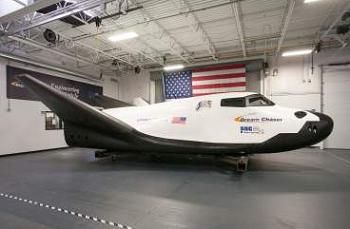
The Dream Chaser flight vehicle from Sierra Nevada Corporation (SNC) has arrived at NASA’s Dryden Flight Research Centre in California to begin tow, captive-carry and free-flight tests.
First, a truck will tow the aircraft down a runway to validate the performance of its nose strut, brakes and tyres. The captive-carry flights will then examine the loads encountered during flight while it is carried by an Erickson Skycrane helicopter. The free flight later this year will test the aerodynamics through landing.
Meanwhile, several NASA astronauts have been at the agency’s Langley Research Center in Hampton, Virginia, to fly simulations of a Dream Chaser approach and landing to help evaluate the spacecraft’s subsonic handling.
The tests will measure how well the spacecraft would handle in a number of different atmospheric conditions — and assess its guidance and navigation performance.
The Dream Chaser — likened to the little brother of the recently retired Space Shuttle — is based on Langley’s Horizontal Lander HL-20 ‘lifting body’ design concept.
The design builds on years of analysis and wind-tunnel testing by Langley engineers during the 1980s and 1990s.
Langley and SNC joined forces six years ago to update the HL-20 design in the Dream Chaser orbital crew vehicle. In those years, SNC worked with the centre to refine the spacecraft design. SNC will continue to test models in Langley wind tunnels.
Langley researchers also helped to develop a cockpit simulator at SNC’s facility in Louisville, Colorado, plus the flight simulations being assessed at the centre.