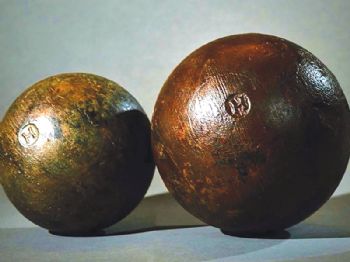
Major progress in preserving a haul of iron cannonballs found on the Mary Rose (Henry VIII’s flagship vessel) has been made by UCL (University College London) (
www.ucl.ac.uk) and the Diamond Light Source X-ray facility in Oxfordshire (
www.diamond.ac.uk).
The 1,200 cannonballs — discovered when the ship was raised from the sea in 1982 — have been at risk of disintegrating due to the chlorine in seawater, which causes corrosion that eats away at the metal and weakens its structure.
Researchers first attempted to remove the chlorine from the cannonballs, but this did not prevent disintegration when they were put on display.
To better understand this, Eleanor Schofield, head of conservation at the Mary Rose Trust, established a research project to understand what was going on inside the cannonballs.
X-rays have now produced detailed maps of the elements involved in the corrosion process, giving the team an unprecedented insight into what is happening on a molecular scale.
Dr Schofield said: “We have taken 12 of the cannonballs — less than 1% of the Mary Rose’s stock but enough to provide statistical validity of our findings — to investigate different methods of conservation through synchrotron science.
“They were all raised from the sea at the same time and are of very similar construction, as only one iron blast furnace existed in Britain when the Mary Rose was built.
“This means that once we’ve found the solution, the cannonballs can be preserved for generations to come, and the science can be made available to all those whose conservation work involves maritime or iron-rich artefacts.”