Metal-working fluid for machine materials
Posted on 12 Dec 2012. Edited by: John Hunter. Read 1491 times.
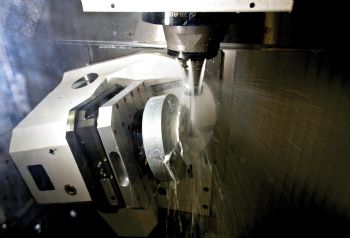
The expertise of the Swiss manufacturer Blaser Swisslube in creating vegetable-based metal-working fluids has led to a breakthrough in the machining of titanium — particularly in aerospace applications where a stable and safe working environment is paramount. Vasco 7000 is a new vegetable-ester oil-based micro-emulsion that is available in the UK from Uckfield-based Jemtech (UK) Ltd
(www.jemtech.co.uk). This high-performance metal-cutting fluid specifically targets what are seen as difficult-to-machine materials, including titanium and nickel-based alloys. Its composition excludes the use of chlorine, boron, formaldehyde and zinc, making it safe for operators, components and machine tools.
Alan Dalton, technical director at Jemtech (UK), said: “During customer trials, Vasco 7000 has been benchmarked against competing metal-working fluids that are also reputed to be market leaders; the Blaser product has consistently out-performed them in terms of increased tool life, longer sump life and reduced fluid cost — and in providing significant reductions in overall manufacturing costs. Customers are experiencing a doubling of tool life, while taking advantage of the increased cutting data — in some cases by as much as 65%.”
Vasco 7000 has also been shown to reduce the amount of topping up required in order to maintain the correct cutting-fluid strength, with users topping up with 1% concentrations instead of the more typical 4%. The fluid also exhibits good rinsing characteristics, thereby ensuring that components and machine tools are relatively clean after use and reducing concern about components becoming ‘streaked’ from residual cutting fluids.