A NASA (
www.nasa.gov) mission to Mars, supported by the UK Space Agency, has successfully landed on the Red Planet and will soon begin the first study of its interior.
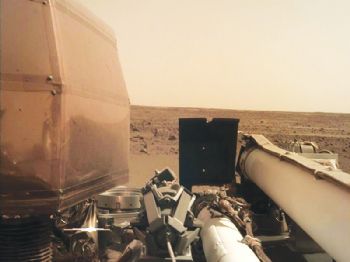
The picture is the first ‘selfie’ it beamed back to Earth after landing. InSight will drill down 16ft under underground and deposit a Heat-flow and Physical Properties Probe (HP3), so scientists can discover how the planet is constructed and how active it is under the surface.
As part of the project, the UK Space Agency has spent £4 million on a short-period Seismometer (SEIS-SP). This will stay on the surface of Mars to monitor Marsquakes; scientists expect to detect up to 100 over the course of two years.
Sue Horne, Head of Space Exploration at the UK Space Agency, said: “It is wonderful news that the InSight spacecraft has landed safely on Mars.
"The UK scientists and engineers involved in this mission have committed several years of their lives to building the seismometer.
"We can now look forward to the deployment of the instrument and the data that will start to arrive in the New Year, to improve our understanding of how the planet was formed.”
InSight carries three instruments designed and built in the UK as part of the seismic package.
These micro-seismometer sensors were developed by Imperial College London and integrated with electronics built by the University of Oxford.
The UK team is led by Tom Pike at Imperial, who designed the sensors to withstand the shock and vibration of the launch from Earth and the landing on Mars.
The sensors can detect motion at sub-atomic scales with the help of the electronics built at Oxford under Simon Calcutt, with support from STFC RAL Space.