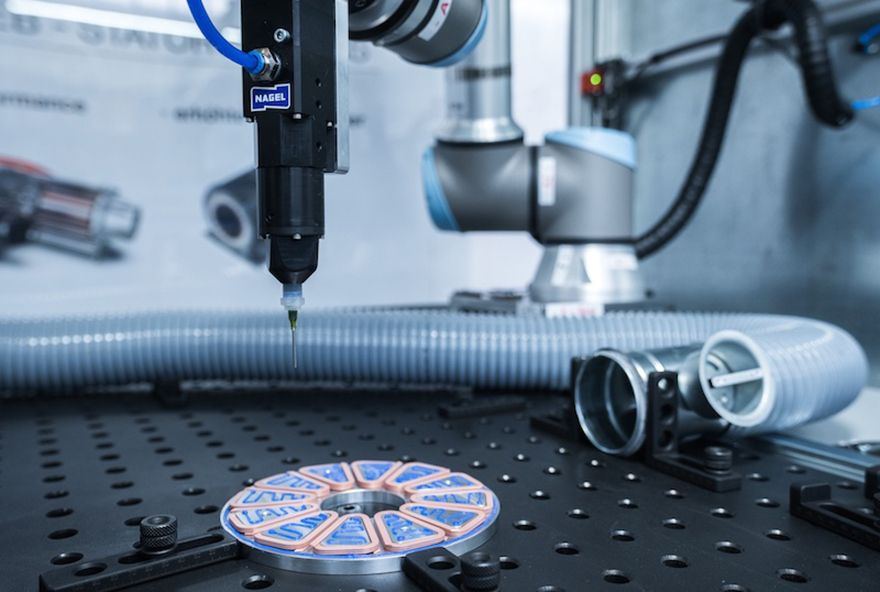
Rising quality requirements in electric mobility are placing adhesive processes under increasing pressure. Reproducible bond strength, precise dispensing volumes and stable surface treatment parameters are essential for scalable series production. To address these demands,
Nagel Technologies GmbH and
Plasmatreat GmbH have jointly developed an integrated automation solution that combines plasma treatment and precision dispensing within a flexible robotic cell.
Nagel Technologies has stood for technological excellence for decades, delivering highly sophisticated solutions for the automotive industry and other demanding high-tech sectors. Plasmatreat is a global leader in atmospheric plasma systems and equipment.
The project originated from a manually executed bonding process for oil-cooled electric motors. Over time, the required tolerances and quality parameters could no longer be maintained with sufficient long-term stability. The objective was clear — automate the existing process while preserving the proven parameters. Nagel assumed system integration and, together with Plasmatreat, developed a solution that seamlessly interlinks dispensing technology, plasma treatment and robotics. A key focus was the creation of a flexible architecture suitable for both development environments and full-scale series production.
In this application, plasma pre-treatment provides inline micro-cleaning and surface activation of components. A rotary plasma nozzle is used, particularly suited for thermally sensitive and geometrically complex parts. By increasing surface energy, absorbency is significantly improved and bond strength markedly enhanced.
Sonja Reuster, technical sales support at Plasmatreat said: “The automated plasma treatment ensures defined, reproducible surface conditions and replaces wet-chemical pre-treatment processes. This enables stable bonding processes while simultaneously reducing environmental impact.”
Shared robotic applicationSurface energy measurements before and after treatment verify process effectiveness and allow for qualified process approval. One of the key technical challenges was integrating both the plasma nozzle and the dispensing tool into a shared robotic application. A tool-changing system enables seamless switching between processes without restricting the robot’s workspace or range of motion.
“An adapted cable routing system with a balancer ensures secure and stable supply of the plasma unit. Philipp Schuh, advanced robotic solutions at Nagel Technologies, said: “Our goal was to create a modular platform capable of integrating multiple process steps within a single cell while remaining flexibly expandable.”
To ensure precise dispensing accuracy, the robotic cell is equipped with TCP calibration sensors and a precision scale. Depending on the application, adhesive volumes between 0.003 and 1ml per min can be dispensed reproducibly. A simulation and path-planning tool complements the hardware setup. Plasma and dispensing paths can be digitally modelled in advance, enabling collision detection
and optimisation of motion sequences. Virtual commissioning reduces engineering time and minimises risks when working with complex component geometries.
The solution addresses key requirements in modern electric motor production: multi-material bonding, stringent leak-tightness specifications and thermal resistance. By combining surface cleaning and activation, precise dispensing and automated path control, stable and reproducible adhesive processes can be achieved even in highly demanding applications. At the same time, chemical-free plasma technology offers a resource-efficient pre-treatment method that can be easily integrated into existing production lines.
The project highlights the importance of integrated system partnerships in advanced manufacturing. While Plasmatreat contributes its expertise in surface technology, Nagel is responsible for system integration, robotics and process control. For users, this results in a seamless solution that scales from prototype validation to high-volume production — combining precision, process stability and sustainability in a single automated platform.