 ABB
ABB is advancing the company’s ‘Mission to Zero’ programme at its Sasbach manufacturing site in Germany, and thereby demonstrating how on-site renewable energy, electrification and digital energy management can deliver ‘meaningful emissions reductions while strengthening energy resilience’.
The Sasbach site manufactures enclosures and energy distribution systems for local and regional markets, supporting ABB’s production footprint in Germany; and as part of the company’s global ‘Mission to Zero’ programme, the site is implementing a data-led decarbonisation roadmap focused on energy efficiency, renewable electricity, and smart energy management. Sasbach is one of 37 ABB sites worldwide currently participating in the programme, which aims to significantly reduce operational emissions across ABB’s global footprint.
ABB says that with manufacturing and production accounting for around one-fifth of global carbon emissions, improving energy efficiency and accelerating electrification are critical to achieving European climate targets, adding that the Sasbach site shows how manufacturers can reduce emissions while maintaining reliable, competitive operations.
Taken together, the actions implemented at the Sasbach site deliver total CO
2 savings of around 3,786 tons. This includes around 2,700 tons of CO
2 savings from the purchase of certified renewable electricity from the grid, alongside annual emissions reductions of some 1,086 tons of CO
2 delivered through on-site measures. Of these yearly on-site savings, around 550 tons of CO
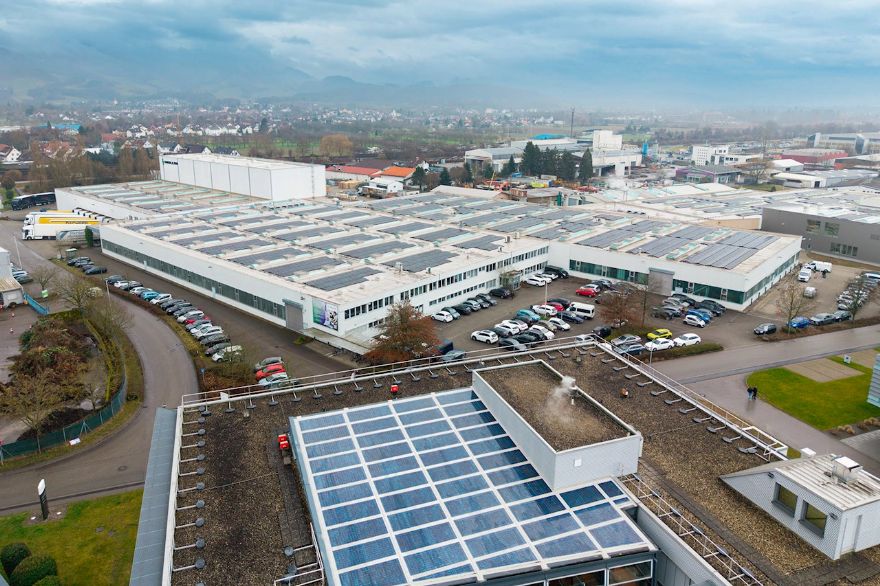
2 per year come from on-site solar generation, which has been expanded. Indeed, the site now operates 3,410 photovoltaic modules, generating around 1,500MW/hr of electricity annually.
On-site generation will cover close to one-third of the site’s total electricity demand, reducing exposure to ‘volatile energy prices and enhancing long-term energy security’. A newly installed transformer station ensures stable and efficient integration of the renewable electricity into the site’s power infrastructure; the remaining reductions will be from electrified production upgrades, energy efficiency measures, and digital energy management.