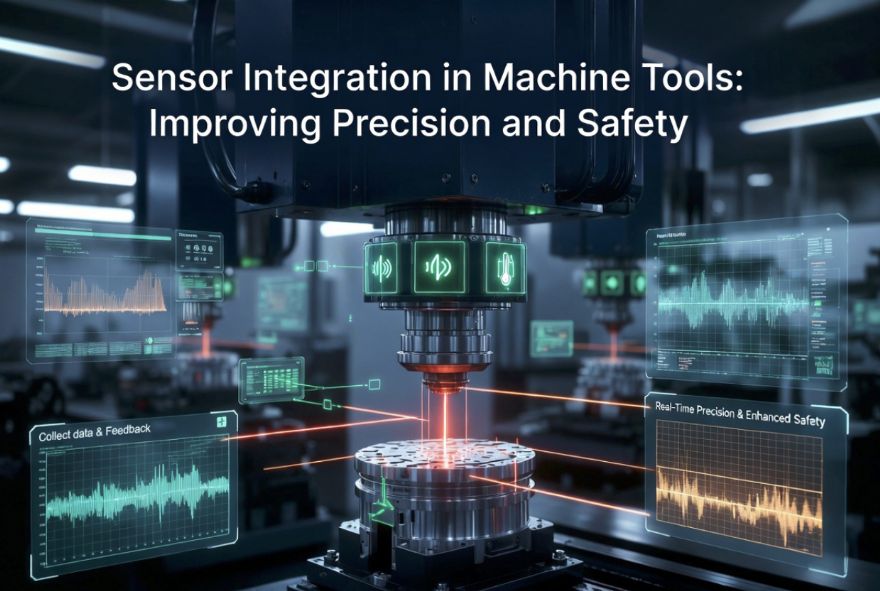
The modern machine shop has undergone a quiet but powerful transformation. What was once a craft guided largely by operator experience is now an environment driven by data, connectivity, and intelligent systems. At the heart of this shift lies sensor integration, an innovation that is redefining how machine tools operate, how accurately they produce components, and how safely they function on the shop floor. In today’s manufacturing landscape, precision is no longer optional.
Industries such as aerospace, automotive, and medical engineering demand tolerances measured in microns, while also expecting higher productivity and lower operational risks. Traditional machine tools, even highly advanced CNC systems, are no longer sufficient on their own, making sensor integration essential.
Understanding sensor integrationSensor integration in machine tools refers to the embedding or attachment of devices that monitor physical parameters such as position, temperature, vibration, pressure, and force. These sensors continuously collect data and feed it back to the control system, creating a closed-loop environment where machines can dynamically respond to real-time conditions. Instead of simply executing programmed instructions, machines equipped with sensors can adjust their operations instantly, improving both efficiency and output quality. This shift represents a move from static machining processes to adaptive manufacturing systems.
One of the most significant advantages of sensor integration is the improvement in machining precision. Position sensors provide accurate, real-time data on tool and workpiece location, allowing the system to correct even the smallest deviations during operation. Temperature sensors help mitigate the effects of thermal expansion, which can otherwise compromise dimensional accuracy during prolonged machining cycles. Similarly, vibration sensors detect irregularities such as chatter, enabling corrective action before it affects surface finish or tool life. Together, these sensors ensure that machine tools maintain consistent accuracy, even under demanding production conditions.
Among the various sensing technologies, photoelectric sensors play a particularly important role in modern machine tools. These sensors use light typically infrared or laser beams—to detect the presence, position, or movement of objects without physical contact. In machining environments, where precision and speed are critical, this non-contact detection method offers significant advantages.
Photoelectric sensors are widely used for tasks such as workpiece detection, tool positioning verification, and material handling automation. For instance, in an automated loading system, a
photoelectric sensor can confirm whether a component is correctly positioned before machining begins. If the sensor detects misalignment or absence of the workpiece, the system can immediately halt the operation, preventing potential damage or defects.
In addition to precision, safety is greatly enhanced through sensor integration. Modern machine tools operate at high speeds and often with minimal human intervention, increasing the need for reliable safety mechanisms. Proximity sensors can detect the presence of operators or foreign objects within hazardous zones, preventing potential collisions. Force and load sensors monitor operational limits, ensuring that machines do not exceed safe working conditions. By continuously evaluating system behavior, sensors help reduce the risk of accidents, protect equipment, and create a safer working environment for personnel.
CNC milling in automotive manufacturingA practical example of sensor integration can be found in CNC milling operations within the automotive industry. During the production of engine components, force sensors are used to monitor cutting loads in real time.
If the system detects an abnormal increase in force, often an indication of tool wear or material inconsistency it automatically adjusts feed rates or halts the operation. At the same time, vibration sensors identify early signs of instability, allowing operators to intervene before defects occur. This real-time responsiveness not only improves product quality but also prevents costly machine damage and enhances operator safety.
Modern sensor systems designed for machine tools are highly advanced and engineered for industrial reliability. A typical integrated solution may include multi-axis accelerometers for vibration monitoring, thermocouples or resistance temperature detectors for precise thermal measurement, and strain gauges for force detection. These components are often supported by embedded processing units capable of filtering signals and transmitting data through industrial communication networks such as Ethernet or fieldbus systems.
Key specifications typically include high measurement accuracy, rapid response times, and durable construction suitable for harsh environments. Many systems are also equipped with diagnostic features, self-calibration capabilities, and compatibility with digital manufacturing platforms, enabling seamless integration into smart factory ecosystems.
One of the most valuable outcomes of sensor integration is the ability to implement predictive maintenance strategies. By continuously monitoring machine conditions, manufacturers can identify signs of wear, misalignment, or overheating before they lead to failure. This proactive approach minimizes unplanned downtime and extends the lifespan of both tools and equipment. In addition, sensor data can be analysed to optimise machining parameters, reduce material waste, and improve overall efficiency. As a result, manufacturers benefit not only from improved reliability but also from lower operational costs.
As manufacturing continues to evolve, sensor integration is becoming increasingly aligned with advanced technologies such as artificial intelligence and industrial data analytics. Machine tools are now capable of learning from historical data, adapting processes automatically, and continuously improving performance. This convergence of
sensing technology and intelligent systems is paving the way for fully autonomous machining environments where precision, efficiency, and safety are maintained at optimal levels.
Sensor integration has become a cornerstone of modern machine tool technology. By enabling real-time monitoring, adaptive control, and enhanced safety mechanisms, sensors play a crucial role in meeting the growing demands of precision manufacturing. While challenges such as system integration and data management remain, the benefits far outweigh the complexities. For manufacturers seeking to stay competitive in an increasingly demanding industry, investing in sensor-integrated machine tools is not just a strategic advantage, it is a necessity.