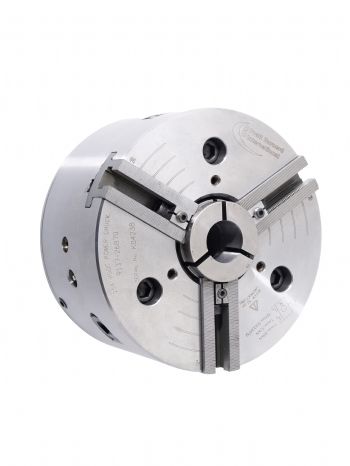
Pratt Burnerd International, part of Elland-based
Colchester Machine Tools Solutions (CMTS), will be showing how the company’s Gripfast power chuck minimises set-up interruption in CNC turning environments where job mix and change frequency are high at
MACH 2026, taking place 20-24 April at the NEC, Birmingham (Hall 6, Stand 60).
Central to the system is a quick-change jaw mechanism that allows base jaws to be released and replaced with a half-turn of a key. This capability allows complete jaw changeovers to be typically achieved in under one minute, thanks to a design feature that sees top jaws remain undisturbed during changeover.
This arrangement preserves jaw position when sets are removed and later refitted, maintaining repeatability typically to within ±0.12µm. As a result, repeated indicating or soft-jaw reboring between jobs is reduced. Moreover, jaw-setting fixtures are available; these enable positioning and adjustment to be carried out away from the machine tool.
The chuck incorporates a three-point adjustment system within the body that allows accurate centring for extended soft jaw life, while an internally counterbalanced construction enables high-speed operation; rotational speeds up to 6,000rev/min are achievable when using standard top jaws — without loss of gripping force.
Multiple workholding modesGripfast also integrates multiple workholding modes within a single unit, as in addition to conventional power chuck operation, the master jaws accept collet pads and mandrel applications, thereby removing the need for physical chuck changeovers when switching between bar work, small components, or irregular parts. Transferring jaw-setting activity away from the machine tool reduces the amount of non-cutting time associated with each job change; and over repeated setups, incremental time reductions accumulate into a notable increase in spindle availability.
A spokesperson for CMTS said: “The avoidance of on-machine jaw resetting reduces variation between setups, supporting consistency across repeat batches, while extended soft-jaw life and fewer corrective adjustments also influence tooling consumption and maintenance intervals. Where chuck removal and refitting would otherwise be required, consolidating multiple workholding methods into one body simplifies machine configuration and reduces handling time.”
He concluded: “When considered over a full operating year, reductions in set-up duration measured in minutes per change convert into recovered machine hours. At typical hourly machine rates, even modest reductions in nonproductive time influence overall operating cost and capacity utilisation, without changes to labour levels or capital equipment.”