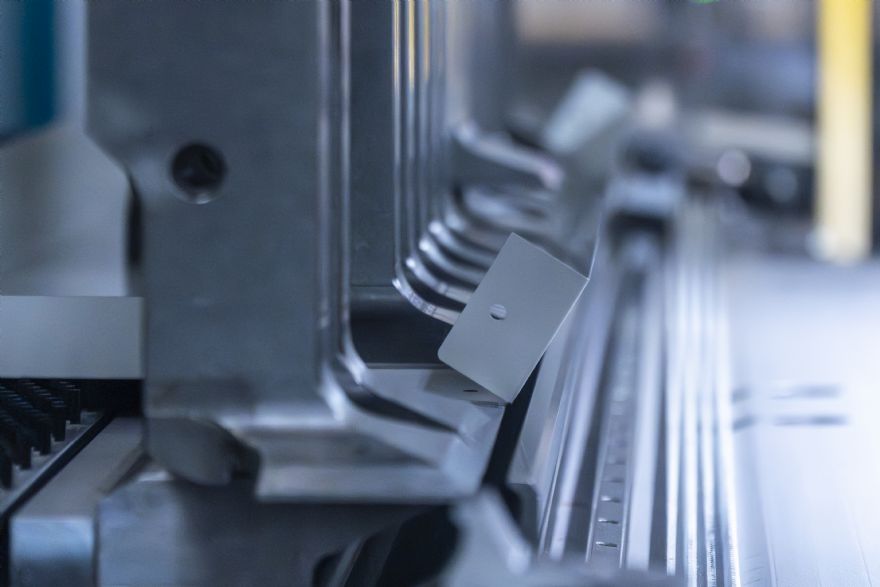
Once considered a niche technology, panel bending is rapidly becoming a cornerstone of modern sheet metal manufacturing. Advances in software, automation, robotics and artificial vision are transforming panel benders into highly productive, flexible work centres, capable of reducing cost per part while addressing many of the industry’s most pressing challenges. At the forefront of this evolution is Italian manufacturer
Salvagnini.
Based in Sarego, in the province of Vicenza, Salvagnini has been synonymous with panel bending since it introduced the technology to the market in the 1970s. Today, with around 5,000 installations in more than 80 countries, Europe’s largest production facility dedicated to panel benders and 50 years of accumulated expertise, the group remains the global reference point for the technology. Panel bending is still at the heart of the company’s offering, and current market conditions are fuelling renewed growth.
A shifting manufacturing landscapeThe sheet metalworking industry has spent years weighing the advantages and disadvantages of two fundamentally different approaches to bending. On one side stands the traditional press brake: familiar, manually intensive and widely perceived as flexible. On the other, panel benders promise automation, repeatability and speed, but have often been viewed as expensive or limited to high-volume production.
That balance is now changing. Manufacturers are under increasing pressure to cut set-up times, cope with labour shortages, maintain consistent quality over long periods and manage growing variability in batch sizes. In this context, panel benders are no longer a solution for a select few, but are becoming a strategic asset in modern factories.

Nicola Artuso, product manager for bending technologies at Salvagnini says one of the biggest obstacles to wider adoption of panel benders remains psychological rather than technical. He added: “Even today, some companies that are used to complex machining operations can be resistant to introducing panel benders. The press brake is often assumed to be easy-to-use, but that is not the case if you do not understand it deeply.”
By contrast, the usability of panel benders has improved dramatically thanks to software development. Salvagnini’s Streambend CAM allows operators to load a 3-D model directly into the system, with the software automatically generating the bending programme.
Mr Artuso explained: “The operator simply follows on-screen instructions,” says Artuso. “They position the flat part, leave the safety area, start the cycle and collect the finished panel. This simplicity makes production easier and plays an important role in mitigating labour shortages.” The result is a process that is less dependent on scarce, highly skilled operators, while still delivering precision and repeatability.
Another entrenched assumption is that the higher purchase price of a panel bender demands constant, multi-shift operation to justify the investment, making it suitable only for series production. Salvagnini is actively challenging this view. Mr Artuso continued: “Imagine you need 24hr to produce a batch on a press brake, our data shows that a panel bender is generally three- to five-times faster. In the worst-case scenario, the same batch could take 8hr.”
That time saving fundamentally alters the economics. Two thirds of production capacity are freed up, and if there is no immediate follow-on work, the machine can simply be switched off. This brings savings not only in labour costs, but also in overheads such as lighting, heating, cooling and general building operation. The benefit scales with production requirements. Mr Artuso cites a customer with minimal prior sheet metal experience who increased output sevenfold simply by introducing a robotised panel bender to replace a manual process.
Because of this combination of speed, flexibility, precision and automation, panel benders are increasingly being used for small batches and fluctuating demand, helping manufacturers avoid bottlenecks caused by tool changes while safeguarding delivery times.
A renewed panel bending platformListening closely to market requirements, from subcontractors to large OEMs, Salvagnini has recently enhanced its panel bending range. The updates expand maximum part dimensions while also offering more compact solutions to suit constrained production environments.
The most significant addition is the P2‑3020, capable of bending flat parts up to 3m long. Mr Artuso notes that bending panels of this size on a traditional press brake often requires two operators and complex handling systems, particularly when bend inversions are involved. He explained: “With the P2‑3020, ergonomic management is much easier. The operator positions the part horizontally and collects it once bent, using simple roller conveyors or lifting devices.”
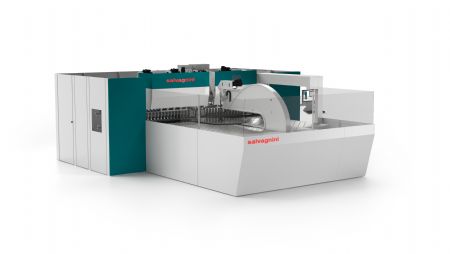
The response, particularly in the USA but also across Europe and Asia, has been strong. Technologically, the P2‑3020 offers many of the same features as Salvagnini’s flagship P4, with the main difference being the absence of fully automatic loading and unloading.
At the other end of the spectrum, the P2‑1620 was introduced in 2024 to address the need for a smaller footprint. While maximum part length is limited to 1,600mm, the machine still bends up to 3.2mm thickness and covers around 80% of length requirements across a wide range of industrial sectors.
Flexibility is one of the defining characteristics of Salvagnini panel benders, largely its range of comprehensive optional equipment. Sub-contractors, in particular, tend to specify highly equipped machines to maximise versatility and future-proof their investment. Combined Linear Auxiliary (CLA) tools are fitted on around 90–95% of machines and enable auxiliary bends, welding tabs and small positive or negative flanges, supporting complex geometries.
Profile (PP tools extend capability further for demanding applications, while the CUT option allows profiles to be sheared directly on the machine. Mr Artuso said: “These options can be combined. turning the panel bender into a real work centre and dramatically expanding the application range.”
Smarter automation and artificial visionWhile Salvagnini’s P4 machines have long been designed for integration into fully automated lines, the most significant recent shift has been the automation of stand-alone systems, particularly the P2, through the P‑Robot solution.
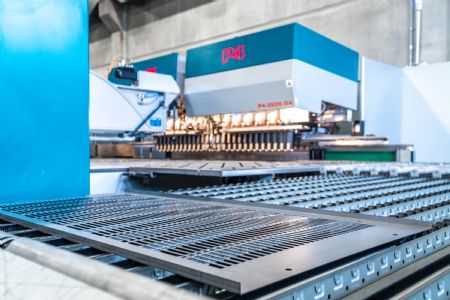
Mr Artuso recalled: “This came directly from our customers. They wanted to run unmanned shifts, optimise layouts or switch easily between automatic batches and manually loaded single parts.” P‑Robot supports multiple levels of automation, from simple pallet loading and unloading to full integration into flexible manufacturing systems. Programming is handled directly at the machine — the operator defines loading and unloading areas and stacking criteria, while the control software calculates optimal robotic trajectories automatically.
The next frontier is artificial vision. In highly integrated scenarios, autonomous mobile robots can deliver cut parts from a laser to the bending cell. The P‑Robot then scans the work area, recognises the coded part and begins production without manual intervention.
Behind these developments is a dedicated production and R&D hub in Austria, employing more than 450 specialists focused exclusively on panel bending technology. This investment underpins Salvagnini’s reputation not simply as a machine builder, but as a long-term partner.
Beyond equipment supply, the company provides feasibility studies, detailed cycle-time calculations and consultancy support throughout the transition process. Comprehensive training, consistent process quality and high safety standards remain central to the approach. As panel bending continues to evolve, its role is shifting decisively from a specialist option to a business-critical technology. By focusing on cost per part, flexibility and intelligent automation, Salvagnini is helping manufacturers move from bending metal to building sustainable profitability.