Earlier this month,
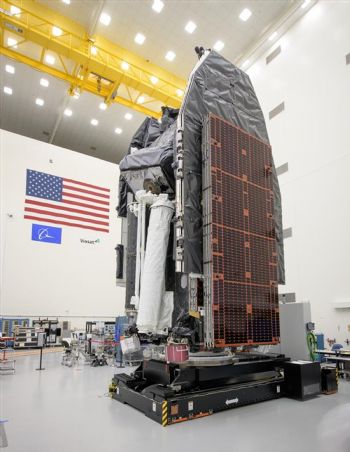
Boeing delivered the ViaSat-3 Flight 3 (VS-3 F3) spacecraft to Viasat. Built on Boeing’s high-power 702MP+ platform and integrated at Boeing’s El Segundo facility in California, VS-3 F3 will provide the Asia-Pacific region with ‘advanced technology to maximise efficient, flexible bandwidth deployment and enhanced performance for commercial mobility and defence customers, among others, in high-density markets across the region’.
Ryan Reid, president of Boeing Satellite Systems International, said: “ViaSat-3 F3 reflects the strength of Boeing’s 702 family and our long-standing partnership with Viasat. With this delivery, we are providing a high-power, flexible platform designed to support Viasat’s next-generation connectivity mission, which is proving more valuable every single day.”
Following final spacecraft integration, testing and verification at its El Segundo factory, Boeing delivered the satellite to Cape Canaveral Space Force Station, Florida, where Boeing and Viasat teams will support pre-launch processing and mission preparations ahead of a SpaceX Falcon Heavy launch.
Dave Abrahamian, Viasat’s vice president of Space Systems, said: “The delivery of ViaSat-3 F3 marks an important milestone for the programme, and for the customers who will rely on it for resilient, secure, flexible and high-performance connectivity across the APAC region. Throughout the ViaSat-3 program, Boeing’s platform performance and mission operations have been essential to achieving these goals for our business and our customers.”
Boeing’s 702MP+ platform was developed to support larger, more power-intensive payloads and was ‘scaled’ to accommodate larger solar arrays, higher-capacity batteries, upgraded supporting electronics, and large deployable radiators to manage the thermal demands of a high-power mission.
The platform also incorporates all-electric propulsion, building on Boeing’s earlier ‘702SP heritage’ while extending that efficiency into the larger 702MP class; Boeing also enhanced structural elements and attitude-control performance so the spacecraft can maintain precise pointing despite the size and flexibility of the system.
Boeing and Viasat will jointly support launch operations in Florida, continuing the collaboration that brought this satellite from design and integration to delivery.