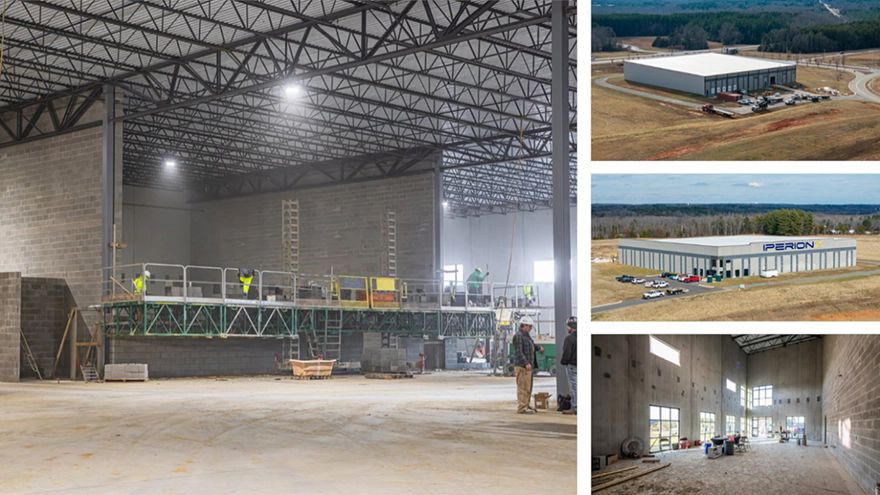
 IperionX’s titanium manufacturing campus in Virginia. Photo via IperionX
US-based manufacturer of premium metal powders and alloy additions
6K Additive has been awarded a Phase II contract, valued at about $2 million and running 18 months, to recover and repurpose discarded metals from US military depots. The targeted materials, nickel, titanium, tungsten, and niobium, share a common thread — each is either partly or entirely sourced from overseas.
China accounts for the vast majority of global tungsten supply, niobium arrives almost exclusively from Brazil and Canada, and federal commerce officials have already identified titanium imports as a potential national security issue. Rather than opening new extraction operations, the programme looks inward, converting scrap and spent components generated at existing military sites into high-grade powders for use in advanced manufacturing (AM).
Aviation maintenance depots alone shed upwards of 60,000 pounds of mixed metal scrap every week. Under this initiative, that material becomes a starting point. The work involves collecting discarded parts and machining waste from Defense Logistics Agency (DLA) facilities, then running it through a multi-stage process that produces finely calibrated spherical powders ready for use in defence-grade applications.
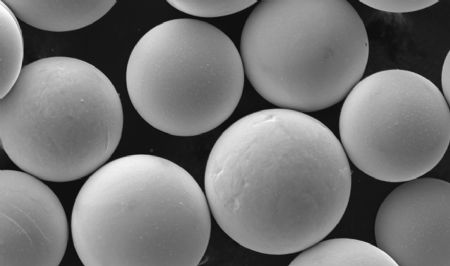 Pictured right: 6K’s UniMelt microwave plasma process. Photo: 6K Additive
The company’s processing approach rests on three proprietary capabilities: a method for reducing bulk scrap into angular particles, a microwave plasma-based refining platform called UniMelt, and a finishing stage that brings the material to the spherical form required for AM. The resulting powders will be tested by military facilities against benchmarks established by conventionally sourced virgin metals.
The project also ventures into automation, with a proof-of-concept robotic sorting system designed to identify and classify incoming scrap without manual intervention, a step toward scaling the operation beyond the pilot phase. Cold spray experiments will further test whether the upcycled nickel and titanium powders can function as a repair medium, potentially allowing worn components to be restored rather than replaced.
Upcycling domestic scrapFrank Roberts, CEO of 6K Additive, said: “The US government has made it clear that to advance our defence readiness we cannot rely on geopolitically sensitive regions for the materials essential to our most advanced weapon systems. By upcycling domestic scrap from DoD stockpiles and maintenance centres, we are creating a circular, secure, and sustainable supply chain for the US defence sector. This award enables us and the DoD to further identify end-of-life parts and scrap to convert back into high-value powder ultimately leading to strategic components for the military.”
In the past, the company has accumulated a portfolio of government support that signals sustained institutional confidence in its approach. A Defense Production Act grant contributed $23.4 million, a series of DLA programmes have collectively added $12.4 million, and an Export-Import Bank loan facility of $27.4 million has been approved. A separate $1.8 million engagement focused on niobium and titanium scrap was awarded earlier in 2025.
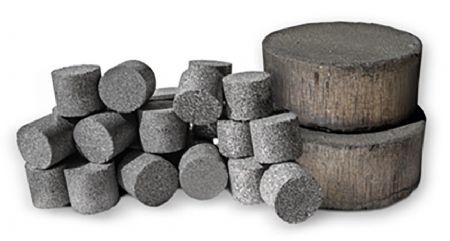 Pictured left: 6K Additive's titanium and zirconium alloy additions
Beyond 6K Additive, other manufacturers are drawing on the same federal push to onshore critical materials supply chains. IperionX secured a contract worth up to $47.1 million from the US Department of Defense to build a fully integrated domestic titanium supply chain, from mineral extraction through to metal production. The funding covers two phases over two years, targeting both a critical minerals project in Tennessee and a titanium manufacturing campus in Virginia.
Separately, Amaero has been expanding US production capacity for molybdenum, tantalum, tungsten, and zirconium powders, installing new gas atomisers capable of producing over 800 metric tonnes annually to supply defence and aerospace platforms domestically. All of these efforts reflect a common thread: that the powder supply chain for defence-critical metals must be owned on US soil, from raw material through finished feedstock.