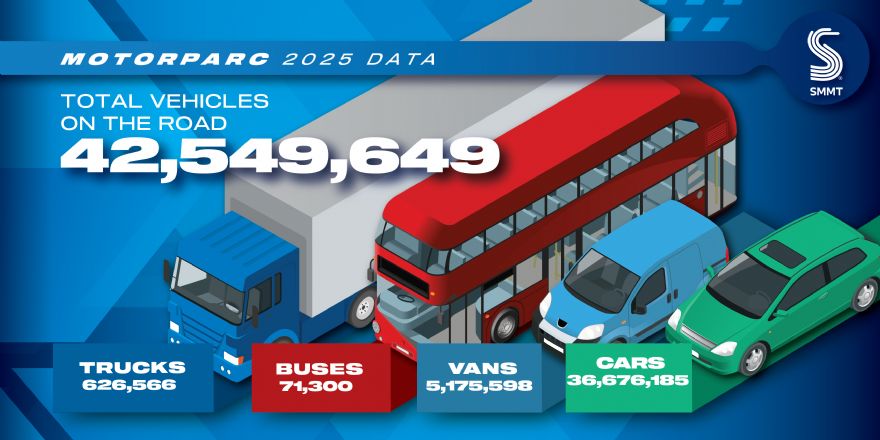
Britain now has more vehicles on its roads than ever before, with the total fleet rising by 1.4% to 42,549,649 vehicles in 2025, according to new
Motorparc data published today by the
Society of Motor Manufacturers and Traders (SMMT). The number of cars in use rose by more than half a million – or 1.4% – to 36,676,185, marking the fourth consecutive year of growth and the second-largest volume increase since 2016, driven by a recovering new car market and high build quality supported by a vibrant aftermarket.
Van and truck volumes also grew to record levels, up by 1.4% to 5,175,598 and 0.2% to 626,566 units respectively. The UK’s bus and coach fleet, meanwhile, rose for the first time since 2021, by 0.2% to 71,300 units – although volumes remain a third (-31.3%) lower than the sector’s 103,817-unit peak in 2007. However, last year saw the new bus market reach the highest level since 2008, with 2,523 zero-emission buses entering service, indicating significant fleet renewal.
Fleet renewal across all vehicle types is helping to decarbonise road transport, as more drivers switch to low- and zero-carbon technologies. One in nine (4.5%) vehicles on the road are now electrified, with around one in 22 (10.9%) completely zero emission.
Zero-emission trucks recorded the strongest growth, doubling to 1,056 units, although this was still less than 0.2% of heavy goods vehicles (HGVs) in use, while zero-emission bus volumes also rose sharply, up 65.2% to account for 8.1% of Britain’s bus fleet. Battery electric vans grew by 34.6% to exceed 100,000 for the first time, with 113,256 now supporting businesses across the country, 2.2% of vans in service.
Shift to cleaner technologiesMeanwhile, a record 1,797,809 battery electric cars (BEVs) are now in use, up 34.7% on 2024 after significant uplifts in the new car market, driven by unprecedented manufacturer discounting and UK Government incentives, and now accounting for almost 5% of the car parc. The shift to cleaner technologies is delivering environmental benefits according to the SMMT, with average car CO
2 emissions down by -2.9% on 2024, demonstrating the importance of fleet renewal and increasing demand for lower-emission powertrains.
However, a record 45.7% of all cars on the road have now been in service for more than a decade, up from 43.4% in 2024. As a result, the UK’s cars are getting older, with the average age rising to 9.7 years, up from 9.5 in 2024, as motorists hold on to vehicles for longer amid cost-of-living pressures and economic uncertainty. If road transport emissions in terms of both carbon and pollutants are to improve faster, the pace of fleet renewal must also quicken, benefitting both the climate and air quality.
Mike Hawes, SMMT chief executive, said: “Britain’s vehicle parc is growing with record numbers of newer zero emission vehicles on our roads driving environmental, economic and safety benefits. This is grounds for celebration but the pace has to quicken if ambition is to match demand with the average age of vehicles on our roads actually rising. A holistic review of the UK’s ZEV transition is essential, therefore, to ensure that every business and consumer can make the switch so that we can deliver ‘net zero’ by 2050.”