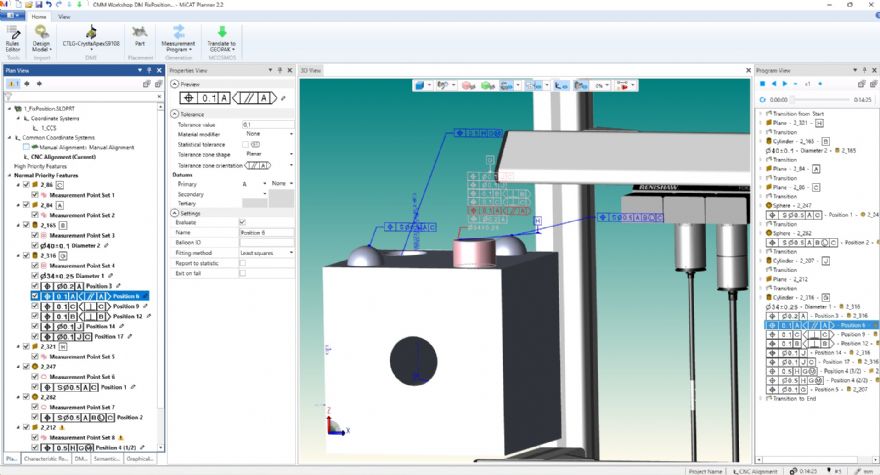
 Pic: MiCAT Planner interprets PMI and geometric tolerances directly from the CAD model to automatically define measurement features and strategies
For more than four decades, Mitutoyo’s Computer Technology Laboratory (CTL) has been quietly shaping the digital foundations of the company’s global measurement systems. Since its establishment in 1983, CTL Germany has been responsible for the development of advanced metrology software used by manufacturers worldwide. Among its many achievements, one development has come to represent a true milestone in automated measurement programming: MiCAT Planner.
MiCAT Planner is not simply another piece of inspection software. It is the result of long-term vision, deep metrology expertise and a clear response to changes in the way products are designed and manufactured.
When data outpaces measurementAs industry transitioned from 2-D drawings to fully annotated 3-D CAD models, complete with Product Manufacturing Information, manufacturers encountered an unexpected bottleneck. While design departments were rich in digital information, inspection departments were still relying heavily on manual programming methods.
Measurement programmes for coordinate measuring machines were time-consuming to create, vulnerable to inconsistency and highly dependent on the availability of experienced specialists. This gap between digital design intent and practical measurement execution became increasingly unsustainable.
Petra Brieger, feature owner of MiCAT Planner and a CTL specialist with 14 years’ experience, describes the challenge: “Customers had powerful CAD models, but they lacked a fast and reliable way to convert all this PMI information into a high-quality measurement program. MiCAT Planner was our answer to this industry-wide problem.”
The demand was clear across automotive, aerospace, medical technology and many other sectors. Manufacturers needed faster programming, standardised strategies, improved quality and traceability, and reduced reliance on scarce expert profiles.
A new vision for automated metrologyFrom its earliest concept, MiCAT Planner was designed with a single objective: to transform CAD and PMI data directly into a complete CNC measurement programme, automatically and consistently.
“We wanted to take a big step into Industry 4.0 and automate what was previously expert work,” Petra Brieger explains. “If we could embed metrology knowledge directly into the software, customers could save enormous time and get consistent results.”
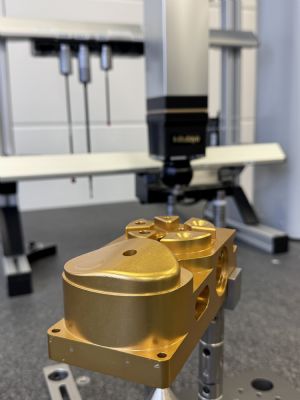
The ambition went far beyond simple feature recognition. MiCAT Planner would interpret PMI intelligently, apply predefined rules, select appropriate probes and tools, generate collision-free measurement paths and produce a ready-to-run programme, even before the first physical part existed.
“It wasn’t meant to be just an assistant,” Brieger confirms. “It was meant to be a partner that thinks like an expert.”
Engineering collaborationDeveloping such a system required extensive collaboration. While CTL Germany led the project, Mitutoyo teams in Belgium and the United States contributed specialist expertise in areas including CAD translation, geometry handling, feature recognition and path optimisation.
“This was never a one-person project. It succeeded because the team stood together, across countries and time zones. Whenever we faced a challenge, we solved it as one team,” Brieger emphasises.
The technical demands were significant. The development team had to balance computing speed with accuracy, powerful functionality with usability, and sophisticated geometry processing with the practical limitations of external CAD environments. Crucially, the developers combined software engineering skills with many years of hands-on metrology experience, ensuring the logic embedded in MiCAT Planner reflected real-world inspection practice.
The result was a robust, scalable solution capable of supporting global manufacturing organisations.
Concept milestonesLooking back, Brieger identifies several pivotal moments in MiCAT Planner’s evolution. The first was the initial release. “It proved the concept,” she says. “We showed that rule-based, CAD-driven programming was possible.”
A further leap came around version 1.9, when the software matured into a fully professional product deployed across real industrial environments. Yet the most meaningful validation came not from internal benchmarks but from user feedback. “When users and application engineers started telling us how much faster and easier their work had become, that was incredibly rewarding.”
For Brieger, true success was defined by industry specialists recognising MiCAT Planner as a genuine breakthrough rather than just another tool.
What sets MiCAT Planner apartThe distinctive strength of MiCAT Planner lies in its combination of rule-based logic and automation. Companies can define their own measurement strategies, embedding best practice directly into the software. Once configured, every programme created follows the same logic, regardless of who generates it or where in the organisation it is used.
“No matter who presses the button, the logic behind the program is always the same,” Brieger explains. “That level of standardisation is unique.”
The productivity gains are substantial. Many customers report programming time reductions of 80 to 95% on PMI-rich models. Intelligent path planning and optimised probe usage contribute to stable, collision-safe programmes, while CAD-based logic allows programmes to be adapted easily to different CMMs.
If a new revision of a CAD model becomes available, it can be replaced within an existing project while preserving established settings and strategies, avoiding the need to start again from scratch.
“A Mitutoyo differentiator” is how Brieger describes it, adding: “Some customers choose Mitutoyo specifically because MiCAT Planner exists. It gives us a clear competitive advantage.”
Measurable impact on the shopfloorIn day-to-day use, MiCAT Planner has changed how metrology teams work. Measurement tasks that once consumed hours or days can now be completed in minutes. Offline programming keeps machines productive, accelerates production cycles and helps manufacturers scale inspection capacity despite ongoing skills shortages.
Feedback from application engineers has been particularly telling. “Hearing from application engineers and customers that they ‘wouldn’t go back to manual programming’, that’s the best feedback we could get,” Brieger says.
The team behind the technologyBeyond the technical achievement, Brieger highlights the culture within CTL as a key factor in MiCAT Planner’s success. “The teamwork was exceptional. Nobody said, ‘that’s not my problem.’ We shared mistakes, we shared successes, and we held the same goal.”
There is also a strong sense of pride in contributing to a product that strengthens Mitutoyo’s global reputation. “It’s motivating to know you’re working on software that contributes to Mitutoyo’s global reputation,” she adds. “MiCAT Planner is something special, no other company has a solution like this.”
Looking aheadThe development of MiCAT Planner is ongoing. With a solid foundation in place, CTL is now looking towards the next phase of automated metrology. Brieger sees significant potential in AI-supported interpretation, adaptive rule sets, increasingly intelligent path optimisation and deeper integration across digital manufacturing workflows.
Future developments are expected to bring closer links between CAD, CAM and CMM environments, enhanced simulation and validation, and tighter integration within the wider MiCAT ecosystem.
ConclusionMiCAT Planner is more than a software product. It is the result of long-term vision, collaborative engineering and a deep commitment to precision; the same qualities that have defined Mitutoyo CTL since 1983.
By dramatically reducing programming time, standardising measurement strategies and enabling manufacturers to unlock the full value of their digital data, MiCAT Planner has become a transformative solution for automated metrology. Above all, it stands as a clear demonstration of Mitutoyo CTL’s team spirit, technical excellence and willingness to innovate.