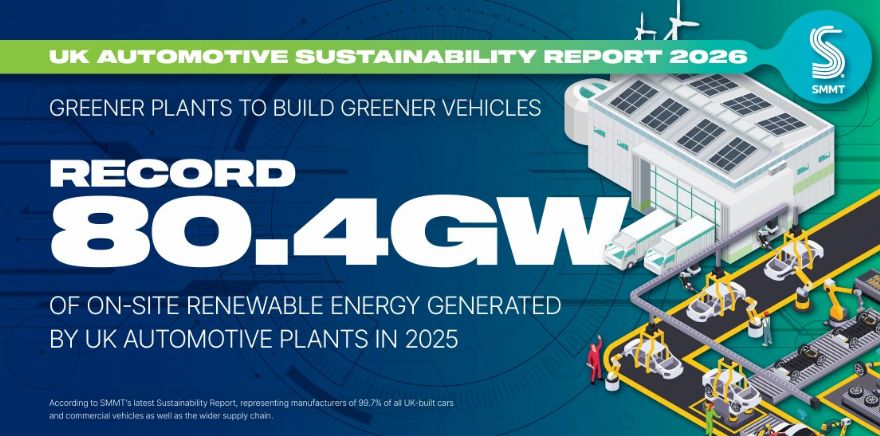
UK vehicle manufacturers significantly increased their investment in renewable energy generation last year, helping to cut carbon emissions, reduce costs and strengthen the sustainability of automotive production across Britain.
According to the
Society of Motor Manufacturers and Traders’ (SMMT) 27th UK Automotive Sustainability Report, on-site renewable energy generation at automotive manufacturing facilities rose by 36% in 2025 to a record 80.4GWh. The output is enough to power more than 32,000 UK homes for a year and is estimated to have removed around 14,000 tonnes of CO₂ from vehicle production processes.
The findings highlight the sector’s continued efforts to decarbonise operations while supporting the transition to zero-emission mobility. Covering manufacturers responsible for 99.7% of all UK-built cars and commercial vehicles, as well as much of the wider supply chain, the report points to growing investment in cleaner production methods and resource efficiency.
Renewable generation is only one part of the industry’s sustainability progress. More than a third (36.5%) of electricity used by the sector last year came from green energy supplied through the grid, while over 93% of manufacturing waste was reused or recycled. At the same time, vehicle makers continued to expand their electric vehicle offerings, with more than 160 zero-emission models available to UK buyers and almost 470,000 new battery electric cars registered during 2025.
The industry is also investing in its future workforce, with the number of apprentices and trainees increasing by almost a third to more than 6,000. The growth reflects the changing skills requirements of a sector preparing for a net-zero future and adopting increasingly circular manufacturing practices.
Despite the progress, manufacturers warn that expanding on-site renewable energy generation remains challenging. Large-scale projects often require substantial capital investment, lengthy planning processes and upgrades to local grid infrastructure. In some cases, companies face waiting times of up to 15 years to secure grid connections for major renewable energy schemes.
The availability and cost of electricity remain key concerns. While renewable generation helped manufacturers reduce annual energy bills by around £20 million last year, UK industrial electricity prices continue to be among the highest in Europe. According to the SMMT, costs are more than double the European average and have risen sharply since 2019, creating a competitive disadvantage for domestic manufacturers.
The issue is becoming increasingly important as production shifts towards electrified vehicles, which typically require more energy-intensive manufacturing processes than conventionally powered models. With 27 zero-emission vehicle models already in production or announced for UK manufacturing facilities, access to affordable, low-carbon electricity is seen as essential to future investment decisions.
Industry leaders are therefore calling for faster grid infrastructure upgrades, streamlined renewable energy connections and reforms to electricity pricing. Measures such as decoupling electricity prices from international gas markets and reviewing network and standing charges could help improve competitiveness while accelerating decarbonisation.
Mike Hawes, SMMT chief executive, said: “The UK automotive industry is investing significant amounts to try and remain competitive, innovating to decarbonise from well to wheel and creating greener factories for greener vehicles in every nation of the UK.
“But ambition alone cannot deliver sustainability at the pace needed. Manufacturers need faster connections, more low-carbon power and energy costs that are internationally competitive. With the right conditions, industry can go faster and further, delivering investment, jobs, economic growth and decarbonisation for generations to come.”
The SMMT said a more comprehensive approach to energy policy would help unlock further investment in renewable generation, manufacturing capability and low-carbon technologies, supporting the Government’s ambition of restoring the UK as a 1.3 million vehicle and zero-emission vehicle manufacturing hub by 2035.