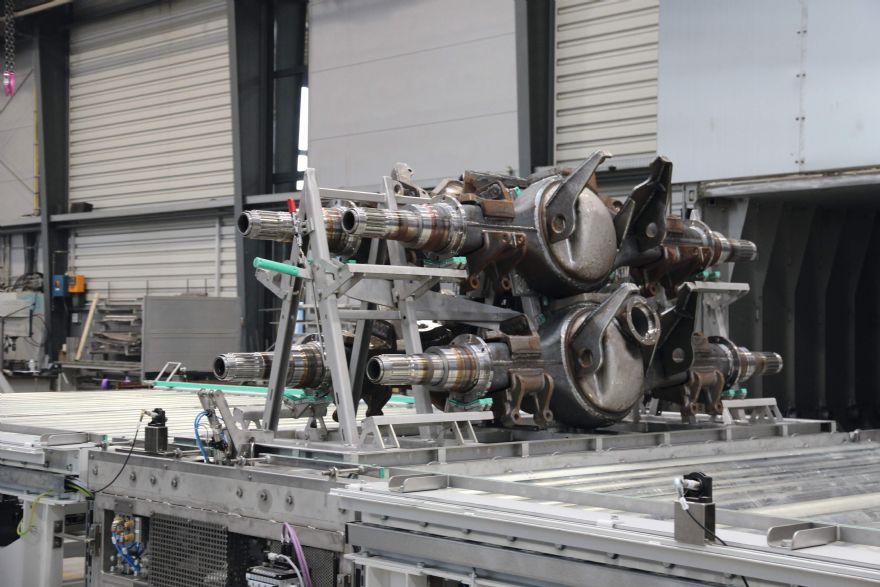
 Preserving value instead of producing new parts: Industrial parts cleaning provides the basis for economically scalable remanufacturing and supports sustainable production
Reusing high-quality components after their first service life conserves resources and can significantly reduce costs compared with manufacturing new parts. However, whether remanufacturing is technically reliable and economically viable is often determined as early as the industrial parts-cleaning stage.
Only clean surfaces allow the condition of a component to be assessed reliably and provide the basis for all subsequent inspection, machining and assembly processes. Automated cleaning and coating-removal processes provide the process reliability required for this.
Clean surfaces prerequisitesCracks, corrosion, dimensional deviations or material damage can only be detected when the surface is fully accessible. Subsequent processes such as coating, machining or assembly also require defined cleanliness levels.
Industrial parts cleaning is the gatekeeper of the industrial circular economy. It determines whether a used part can become a safe and reliable component of a new product. This also makes it a decisive factor in the economic viability of the entire remanufacturing process. Only when cleaning results are reproducible can inspection, machining and assembly processes be reliably standardised and scaled economically.
This process reliability is achieved through automated or semi-automated cleaning and coating-removal processes. They ensure reproducible results, reduce manual work and lower the risk of rejects. This makes remanufacturing economically viable even at industrial production volumes.
BvL Oberflächentechnik GmbH develops customer-specific system concepts for this purpose. Depending on the component, contamination and inspection requirements, aqueous cleaning processes, workpiece carriers, media treatment and drying are precisely coordinated.
The technologies used include spray and flood processes, ultrasonics, high-pressure water technology, and combined pre-cleaning and final-cleaning stages. The following practical examples show how reproducible cleaning processes can be implemented for a wide range of remanufacturing applications.
Engine remanufacturingCrankcases, cylinder heads, turbochargers and other engine components combine complex geometries with oil, grease, soot, carbon deposits, paint layers and corrosion. A European remanufacturing specialist therefore relies on a customer-specific BvL system that automatically cleans and removes coatings from grey cast-iron parts weighing up to several tonnes using high-pressure water.
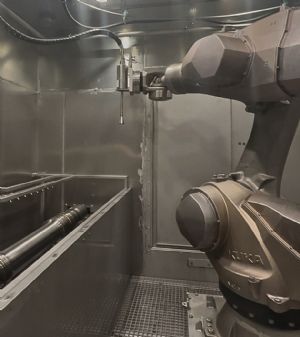
The components are secured on dedicated workpiece carriers. A robot guides the water jet tool precisely along exterior surfaces, bores and internal areas; additional workpiece rotation reduces spray shadows. Low-pressure pre-cleaning and final-cleaning stages complement the process. This replaces labour-intensive manual operations and creates consistent conditions for visual inspection, crack testing, dimensional inspection, and the assessment of sealing and functional surfaces.
With high contamination loads, adequately sized tanks, oil separators, coarse and fine filtration, and coordinated media management ensure long bath service lives. Stable processes reduce rework, rejects and unplanned bath changes.
BvL cleaning systems are used for passenger-car engines as well as components for commercial vehicles, large engines for gas-fired power plants, and applications in the maritime industry. The range of systems extends from cleaning smaller engine components to cleaning large-format components such as parts for truck and marine engines, as well as axle and drive components.
The cleaning process, system concept and process control are individually tailored to the component, contamination and production sequence.
Process-reliable cleaning and coating removalIn the rail industry, bogies, wheelset components, traction motors, bearings and ancillary components are exposed to brake dust, sand, grease, corrosion and lubricants. Before scheduled inspections and refurbishment, these residues must be removed reliably without affecting sensitive bearing seats, sealing systems or electrical areas. BvL develops customer-specific cleaning systems for this purpose, delivering reproducible results even at high volumes and short cycle times.
A current project demonstrates the importance of coating removal particularly clearly: An impact-protection coating on wheelset axles is removed using a fully automated BvL Geyser high-pressure coating-removal system. The robot-guided high-pressure water technology is non-abrasive and gentle on the surface. Jet guidance, workpiece rotation and feed rate are coordinated so that the coating is removed completely and reproducibly without unnecessarily altering the surface condition. This gives the wheelset axle a bare-metal surface for subsequent ultrasonic and magnetic particle testing.
For this cleaning and coating-removal system, particular emphasis was placed on operating efficiency. An energy and media concept specially developed by BvL enables low water consumption, reduces operating costs and ensures compliance with stringent environmental requirements in rail operations.
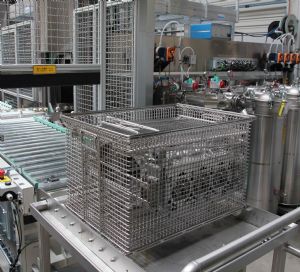
The circular economy for small partsSmall plastic components can also be reused directly after application-specific cleaning. In a project for the toy industry, large quantities of loose parts are cleaned in baskets to remove skin oils, dust and foreign matter. Combined flood and spray processes with rotating or swivelling baskets gently wash around the parts and limit mechanical stress.
Drying requires particular attention because plastic stores little residual heat and moisture can easily remain in cavities or between small parts. Individually designed system technology provides a reproducible process that enables the components to be reused directly.
Parts cleaning and the circular economyCurrent projects show that cleaning and coating removal are becoming more highly automated, monitored more precisely, and more closely integrated with inspection and refurbishment processes. This turns a repair process that is difficult to predict into a controlled industrial process.
Industrial parts cleaning extends the service life of high-value components, reduces waste and helps conserve resources and cut CO₂ emissions. For companies seeking to scale remanufacturing, it is therefore not a secondary function but a fundamental prerequisite for quality, safety and sustainable value creation.
BvL will be exhibiting at AMB in Stuttgart from 15 - 19 September 2026 in Hall 5, Stand C84.