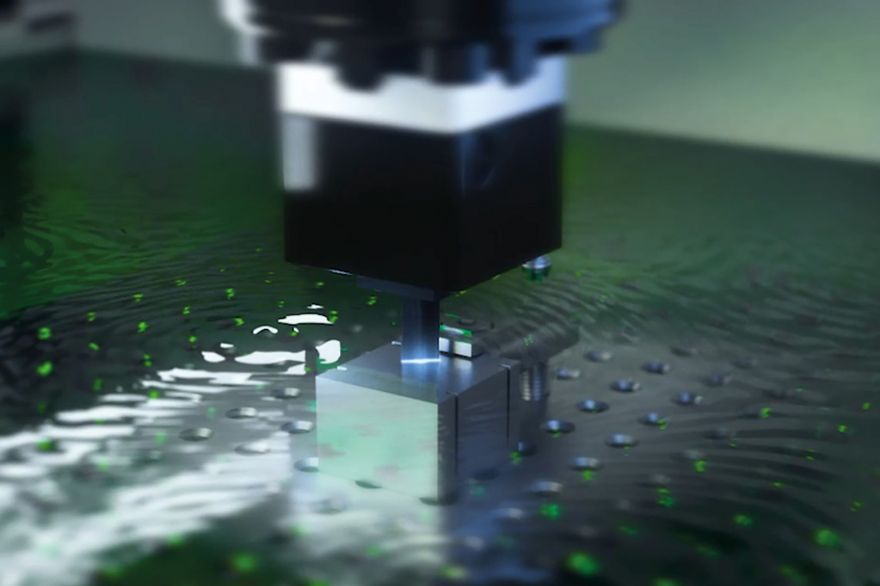
Since the dawn of the semiconductor age in the 1970s, electronics have transformed nearly every facet of our lives. Fifty years ago, one computer filled a room and its processing power was a fraction of what now fits in the palm of a hand. Today’s smartphones pack millions of times more transistors than the computers that guided last century’s space missions or powered early machine controls. The same accelerated semiconductor capability that puts a talking atlas in our hands is driving a transformation inside EDM.
With faster switching speeds, tighter integration and cooler-running, more compact generator designs that control spark energy in real-time, the new generation of microelectronics has reshaped the capabilities of die sinker EDMs, particularly for mould and die shops. Early EDM generators used analog systems that occasionally produced inconsistent sparks and required skilled operators to be on hand to ensure precision. As semiconductors advanced, EDM control systems evolved from simple spark timers into intelligent, feedback-driven pulse management systems. Each improvement meant more refined control over the spark, which is at the heart of EDM.
While much attention has focused on the sophistication of spark control, an advancement that is perhaps less talked about and understood is the physical location of the generator itself. Martin Spencer, managing director of
United Machining UK said: “By keeping generator modules cool and close, today’s die-sinking machines achieve a higher level of thermal and electrical stability.”
Traditional EDM machines often house their generators in separate cabinets or compartments, connected to the spark gap via several metres of heavy cable. This layout was logical when power supplies were large, heat-intensive and less susceptible to signal degradation. However, as generator components became smaller, more thermally stable and increasingly efficient, EDM machine builders began to ask, “Can we improve the process if we move the generator closer to the spark?”
The answer has is a resounding “Yes”, and is one that has proven transformative.
Reduced capacitance enables faster controlWhen a generator is located physically closer to the spark, the electrical path between the power source and the gap shortens. In electrical terms, shorter cables mean lower inductance and capacitance, both of which are critical for EDM. Reduced capacitance enables faster and more precise control of voltage changes, and also enables the generator to produce high-frequency bursts of energy that deliver controlled discharges with no overshoot or delay. The needle-like pulses are ultra-fast and deliver faster erosion rates, less heat transference into the workpiece and smoother surface finishes.
'Ultra-fast’ means tens to hundreds of nanoseconds. Shorter pulses allow higher frequencies, as they reduce the risk of wire breakage in wire EDM and electrode damage in die-sinking machines. Additionally, this pulse type minimises contamination of the workpiece by the wire or electrode material - especially critical in industries like aerospace and medical device component manufacture.
The answer to the question about location is therefore clear. The closer the generator is to the spark, the more immediate and accurate each spark becomes. The payoff for mould and die shops is higher throughput, improved accuracy and surface quality, less rework and polishing, reduced heat-affected zones (HAZs), more compact machine footprints and easier thermal management
For example, a manufacturer producing precision turbine blade moulds for the aerospace industry must meet extreme dimensional tolerances while maintaining material integrity. Even microscopic cracks caused by thermal stress can lead to defects in final components, and ultimately, in their rejection. Using a patented die-sinking EDM platform featuring a compact, high-speed generator mounted directly on the Z-axis or behind the back wall of the work pan and only inches from the electrode, the mould manufacturer can experience up to 20% reduction in cycle times.
Most important to the end-user, a close quality-assurance inspection shows a reduced HAZ on the workpiece. With less HAZ, the risk of micro-fractures is reduced, and the workpiece is more stable for finishing applications. In high-performance mould and die work, these kinds of improvements translate into significant productivity gains.
New designs allow closer physical placementAdditional and related advancements have made it possible for a generator to be in close proximity to the spark. Where older EDM generators required bulky transformers and large heat sinks, today’s systems rely on high-efficiency semiconductor switches [Metal-Oxide-Semiconductor Field-Effect Transistors (MOSFETs) and Insulated-Gate Bipolar Transistors (IGBTs)] and liquid-cooled modules that can operate in compact enclosures. Modern generators are highly energy-efficient, converting over 80% of electricity directly into material erosion. In contrast, older models operated at significantly lower efficiencies, typically ranging from 30% to 50%.
The temperature-stable designs not only allow closer physical placement to the spark but also improve reliability too. Heat management is critical in EDM because thermal drift can alter pulse performance. By keeping generator modules cool and close, today’s die-sinking machines achieve a higher level of thermal and electrical stability.
The move toward placing generators near the spark reflects a broader manufacturing trend that blends mechanical engineering with advanced electronics. For example, with the advent of high-bandwidth memory (HBM) microchips that embed artificial intelligence (AI), EDM systems will be able to process and interpret far more operational data than a human operator ever could.
There are multiple parameters to control, and even the best operator cannot adjust them all manually. AI can act on multiple parameters simultaneously and apply solutions automatically. What’s more, AI can explore unconventional parameter combinations that humans might overlook or avoid, sometimes leading to surprisingly better outcomes.
At the same time, electronic sensor technology has advanced and become more affordable, enabling sensors to be placed throughout an EDM to automatically compensate for thermal deformation. This intelligent integration of sensors ensures consistent accuracy even as machining temperatures fluctuate.
Mr Spencer added: “The payoff for component manufacturers and mould and die shops is higher throughput, improved accuracy and surface quality, less rework and polishing, reduced heat-affected zones (HAZs), more compact machine footprints and improved thermal management.”
The line between hardware and control software will continue to blur, with AI, digital twins, predictive algorithms and adaptive spark control pushing EDM into new realms of precision and productivity. One core principle does remain timeless, though. In EDM, everything starts with the spark. And the technology has shown that the closer we can get to the spark physically and electronically to the action, the better the results.