 Tekpak Automation
 has helped a UK transdermal patch manufacturer increase production throughput by more than 30% with a robotic packaging system combining machine vision, inspection and active tracking.
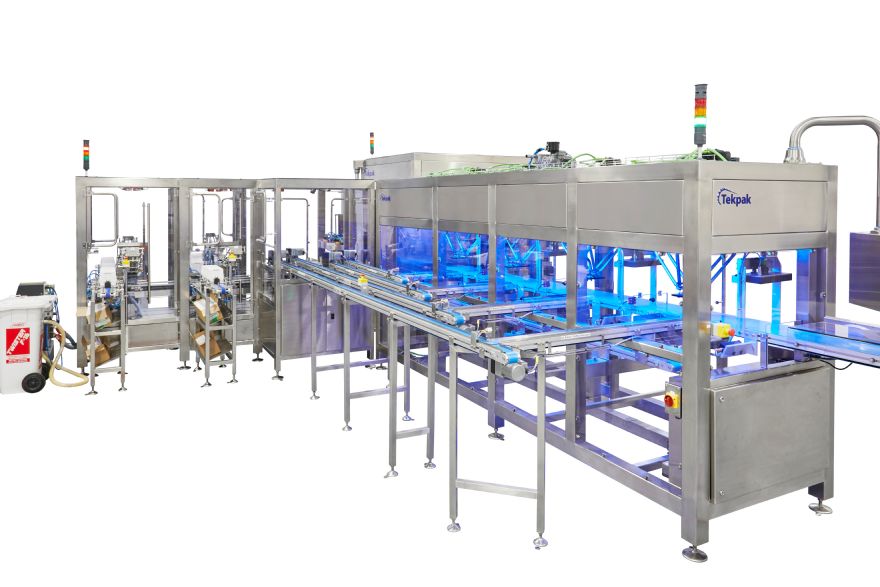
Built around four Schneider Delta robots, the Tekpak QC-Sleever inspects, verifies, picks and packages patches at speeds of up to 1,600 patches per minute while reducing the reject rate to below 1%. The system has also enabled the customer to cut labour requirements by up to 12 operators per shift and reduce overall floor space by more than 30% compared with a conventional multi-machine setup.
Based in Wexford, Ireland, Tekpak Automation has more than 25 years of experience supplying robotic automation systems to food and pharmaceutical manufacturers across the UK, Ireland, Europe and the USA. When tasked with developing a faster and more efficient inspection and packaging solution for a manufacturer of transdermal patches, the company created its Quad Cell (QC)-Sleever system.
Transdermal patches are adhesive medical products applied to the skin to deliver medication for applications including pain management, hormone therapy and smoking cessation. To meet the customer’s quality and productivity requirements, Tekpak designed a system that combines multiple vision inspection stages with high-speed robotic handling and automated packaging.
The QC-Sleever incorporates four vision inspection stations. Two are integrated into the upstream manufacturing process, where they inspect patch shape, solution quality, woven material, foreign material and heat-seal integrity. Inspection data is transmitted to the downstream quad cell, enabling the robots to track individual products and leave defective patches on the conveyor for automatic rejection.
Within the quad cell, another inspection station checks the position of each patch on the conveyor, reads alphanumeric information and verifies batch details. The data is then used by the robots to determine whether each patch should be picked or rejected. Operating at up to 400 patches per minute each, the four Delta robots deliver a combined throughput of 1,600 patches per minute.
Following picking, every patch undergoes a final inspection stage. A specialised UV-backlit camera examines the underside of the product, checking characteristics including the concentricity of the patch contents, roundness, the presence of foreign material and the position of the robot gripper. Products failing inspection are automatically rejected, while approved patches proceed to packaging.
The verified patches are transferred to an automated sleeving section, where they are counted and collated into groups of 30. A leaflet and the patches are inserted into a pillow-style sleeve, which is sealed with hot-melt adhesive and printed with batch information. The completed pack then undergoes final verification before being transferred to the case-packing section.
Robotic automation is also used at the end of the line. Groups of 10 sleeves are accumulated before being picked by a Delta robot using a customised gripper. The sleeves are placed into a corrugated shipping case, which is tilted pneumatically to improve robot access and facilitate the insertion of layer cards. Once the case is full, it is transferred for sealing and labelling.
According to Tekpak Technical Director Darragh Sinnott, the nature of the product presented significant automation challenges.
“The patches are made up of multiple layers and materials,” he explains. “A paper-like backing supports a woven mesh that is covered with a wet solution before being sealed. Quality control was one of the client’s primary requirements. Each patch is subjected to ten separate vision inspections at a throughput of 1,600 patches per minute before it is approved for packing.”
The system checks patch shape and size, content concentricity, solution content, seal integrity, batch information, conveyor position, alphanumeric data, foreign material, physical damage and print colour. As a result, the return rate for unsatisfactory products has been reduced to less than 1%.
Alongside improvements in quality and throughput, the compact footprint of the QC-Sleever was a key advantage for the customer. The system replaced a manual packing operation with significantly lower output while occupying considerably less space than comparable multi-machine alternatives.
Sinnott says: “The QC-Sleever has saved the client more than 30% in floor space compared with a conventional multi-machine system. It has also reduced the number of operators required on the line, saving up to 12 operators per shift compared with the previous manual process and up to six compared with alternative automated systems.”
For the pharmaceutical manufacturer, the result is a solution that increases output, strengthens quality control and reduces both labour requirements and factory footprint.
To learn more about the QC-Sleever and Tekpak’s range of automated packaging systems, visit Stand G74 at PPMA Show 2026, 22-24 September at the NEC Birmingham, or Booth L52 at Medical Technology Ireland, Galway Racecourse, 23-24 September 2026.