A swarm of autonomous drones could transform the way wildfires are detected and tackled, thanks to pioneering technology developed by robotics experts at the
University of Bristol. The team has received a $500,000 award in the global XPRIZE Wildfire competition after demonstrating a system capable of identifying and responding to fires faster and more effectively.
The award was announced during the
XPRIZE Wildfire Awardee Ceremony at the New York City Fire Museum this month.
The Bristol researchers form part of AURA Foresight, an international collaboration that has developed autonomous technology capable of detecting wildfire ignitions within minutes and coordinating rapid responses before small fires escalate into major incidents.
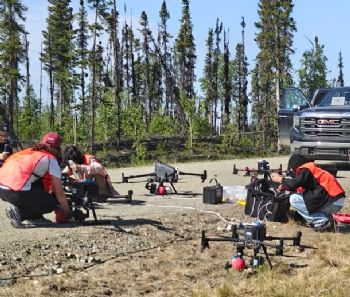
AURA Foresight was one of three finalists selected from more than 130 teams worldwide to compete in the final challenge of the $11 million XPRIZE Wildfire competition, held in Alaska in June. Launched in 2023, the competition was designed to accelerate innovation in wildfire detection and suppression technologies.
During the challenge, the team deployed its system across a 270-square-mile (700 km²) wilderness area, using autonomous technology to detect potential ignitions, verify threats and coordinate responses. A fully autonomous drone swarm was successfully launched to investigate potential fires within 10 minutes.
The collaboration brings together the UK-based AURA team, led by the University of Bristol, and Australia's Fire Foresight. Its platform continuously monitors landscapes using optical and thermal sensors, identifies potential wildfire ignitions using artificial intelligence, dispatches drones to verify threats and coordinates rapid intervention before fires can spread.
The technology is designed to tackle fires at the earliest possible stage, reducing environmental damage, economic losses and risks to human life.
A key element of the project has been collaboration with researchers at the
University of Sheffield, firefighters in the UK and Australia, and emergency response professionals. The consortium works closely with Lancashire Fire and Rescue Service, alongside wildfire specialists in Canada and Australia, to ensure the technology addresses real-world operational challenges and can integrate into existing emergency response procedures.
The University of Sheffield developed the thermal and electro-optical vision detection systems deployed on the UAV swarm demonstrated during the Alaska challenge.
By combining frontline expertise with advances in robotics and AI, the team aims to strengthen firefighting capabilities and reshape how wildfires are managed.
Sabine Hauert, team co-lead of AURA Foresight and Professor of Swarm Engineering at the University of Bristol, said: "This award is a fantastic recognition of years of collaboration between researchers, firefighters and technology specialists working towards a worldwide challenge: preventing small ignitions from becoming devastating wildfires."
Andrea Santy, XPRIZE Wildfire Executive Program Director, said: "Destructive wildfires are becoming more extreme, costly and difficult to manage, making faster, more effective approaches increasingly urgent.
"The three finalists pushed the boundaries of what is possible today, demonstrating meaningful advances in wildfire detection and response while helping identify where continued innovation is needed to move these technologies toward real-world deployment at scale."
Dr Georgios Tzoumas, team co-lead of AURA Foresight and Senior Research Associate at the University of Bristol, added: "Our ambition was always to deliver practical, affordable tools that help emergency services detect and contain wildfires before they become major disasters. We are incredibly proud that our research expertise is now helping to tackle a global challenge that could better protect communities, ecosystems and critical infrastructure."
AURA Foresight has been designed as a practical and affordable solution that requires minimal setup and can be adapted to environments ranging from forests and remote wilderness areas to critical infrastructure corridors. Built using commercially available technologies, the system aims to make advanced wildfire protection accessible to organisations of all sizes.
The consortium includes the University of Bristol, Bristol Robotics Laboratory, University of Sheffield, Lancashire Fire and Rescue Service, Fire Foresight, Indicium Dynamics, Robotic Cats, Taz Drone Solutions, SkyFly Drones, the University of Southern Denmark, the University of Manchester and Little Place Labs.
Together, the partners bring expertise in swarm robotics, autonomous systems, artificial intelligence, computer vision, aerial robotics and wildfire operations. By uniting researchers, engineers, firefighters and technology companies across three continents, AURA Foresight demonstrates how international collaboration can accelerate solutions to one of the world's most pressing climate challenges.
To watch a video about AURA Foresight see below.