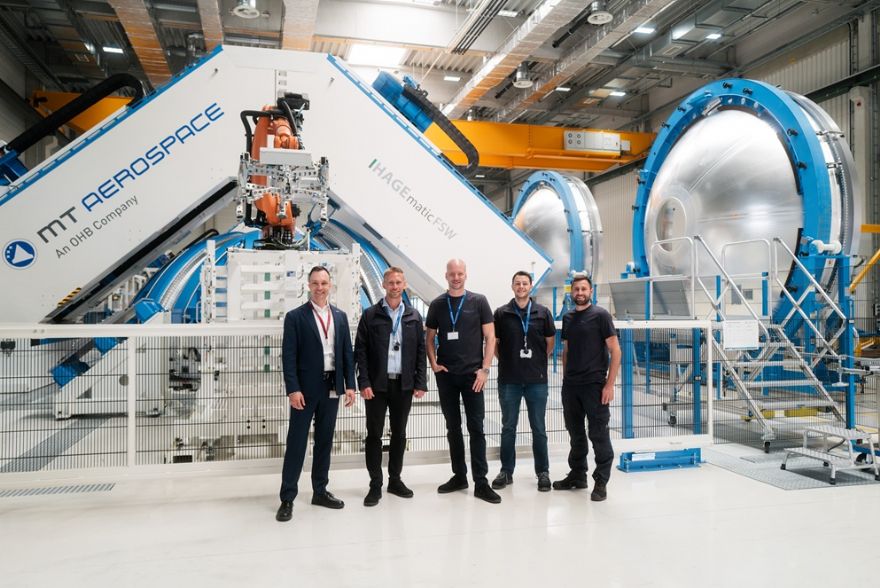
Aerospace manufacturer prepares for higher volumes with digital production management
Rising demand for launch vehicles, satellites, aerospace components and defence systems is forcing manufacturers to rethink how they operate. For Augsburg-based
MT Aerospace, a long-established supplier to the European Ariane 6 programme, that means preparing production for far greater volumes than in the past.
The company manufactures tanks and structural components for launch vehicles, alongside parts for satellites, aviation and defence applications. Production that was once focused on relatively small batches is increasingly shifting towards industrial-scale output.
According to Tobias Hannen, Engineer for Digitalisation of Industrial Processes and Project Manager Space International at MT Aerospace, this transition requires more than investment in machinery.
“In the past, we tended to manufacture small batches. Today, we're talking about several thousand components per year,” he explains. “Processes must become more transparent, and our employees must know at all times what tasks are coming up and how they can prepare for them.”
To create that transparency, MT Aerospace selected
GROB's COSERA manufacturing execution system (MES), despite operating no GROB machine tools.
Replacing paper-based visibilityThe company began looking for a replacement for its existing MES when it became clear that the system could no longer support future growth.
“We looked at several providers,” says Hannen. “In the end, the deciding factor was that GROB understood our processes very quickly. It was immediately clear that they possessed manufacturing expertise.”
A key requirement was integration with SAP, ensuring production data is updated automatically whenever work plans or process steps change.
“When something changes in SAP, that information should reach the operator immediately. That saves time and prevents misunderstandings,” he says.
The decision was reinforced by visits to existing COSERA users and by the fact that GROB deploys the software within its own factories.
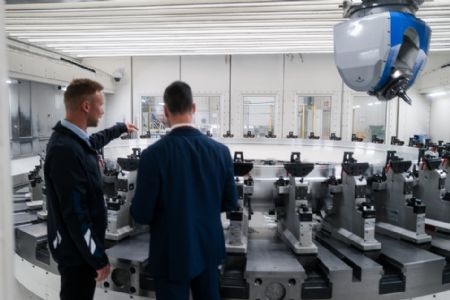
For MT Aerospace, digital traceability was another critical factor. Aerospace customers require comprehensive documentation throughout a component's lifecycle, with every process step fully recorded.
“Our customers expect complete traceability,” says Hannen. “We must be able to say at any time which employee worked on which component and where that component was later used.”
COSERA provides a centralised source of production information, giving staff immediate access to job status and process history.
“Today, we can see at a glance where an order is in the process and whether there are any delays,” Hannen says. “In the past, we had to search through paper job tickets to find this out.”
The system has also replaced much of the manual tracking previously used to monitor production progress. Real-time dashboards now allow managers to identify bottlenecks before they affect delivery schedules.
Alexander Müller, Production Manager for Large Tank Manufacturing, says the benefits are immediate.
“We can see very clearly where products are getting held up and at which piece of equipment a bottleneck is developing. This enables us to take corrective action before the delays affect the entire production process.”
Real-time information on the shopfloorThe introduction of COSERA has also changed how operators access information.
Previously, employees often had to switch between multiple software systems to review drawings, bills of materials and process documentation. Today, this information is available directly through the production order.
Marco Diener, operator of an FSW welding system, says the difference is significant.
“When I arrive at the system in the morning, I can immediately see what tasks are pending and which components will be processed next. Drawings and work instructions are stored right there.”
Recording production data has also become simpler.
“Today, I can log machine times or setup times with just a few clicks. That saves time and makes the work easier,” he adds.
Beyond production management, MT Aerospace has implemented GROB's machine data acquisition system to monitor equipment performance and availability.
The technology collects machine status information, identifies feed-rate reductions and reports periods of inactivity automatically. For unmanned operations, the system can alert responsible personnel if a machine stops unexpectedly.
“If a machine stops running at night, the responsible employee automatically receives a message on their mobile phone,” says Patrick Thurner, Sales & Operations Planner at MT Aerospace. “This allows us to respond immediately rather than hours later.”
A similar approach is now used within the company's additive manufacturing operations, where sensors monitor material levels and provide early warnings before shortages interrupt production.
“In the past, we often didn't notice that a machine had stopped until someone happened to walk by. Today, all of this happens automatically,” says Thurner.
Building for future growthAlthough MT Aerospace originally anticipated a two-and-a-half-year implementation programme, COSERA was operational on company servers just three weeks after the project began.
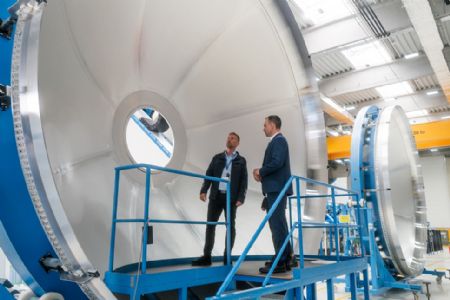
An initial pilot deployment in additive manufacturing was followed by a phased rollout across other production areas. Throughout the process, project teams from both companies worked closely together, with workshops covering MES functionality as well as integration with SAP and quality management systems.
“We were able to show the system to employees very early on,” says Hannen. “That was important because we wanted to involve them in the project from the very beginning.”
The project also highlights a growing trend in manufacturing software. COSERA is designed to operate independently of machine tool brands, allowing it to connect equipment from multiple suppliers and create a common production database.
For MT Aerospace, the objective was never simply to replace software, but to establish a platform capable of supporting future expansion.
“Anyone selecting an MES system today shouldn't focus solely on current problems,” Hannen concludes. “What's far more important is where the company wants to be in five or ten years.”
With COSERA now providing real-time production visibility, improved traceability and faster access to information, MT Aerospace believes it has laid the foundations needed to support the next phase of growth.