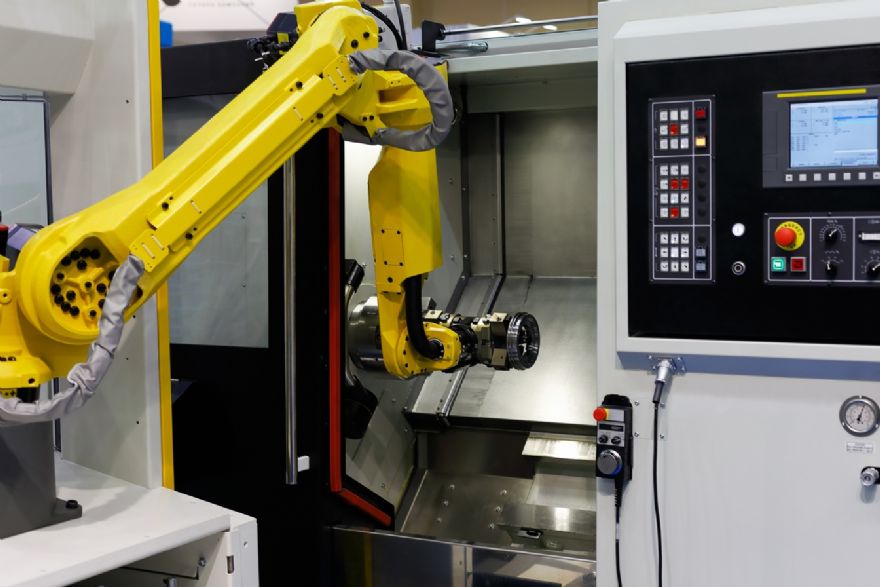
 In this article Ashish Kolte, from marketing and business strategy specialist Dataintelo, examines how the business case for automated tending of CNC machinery is changing.
For years, the business case for machine tending seemed straightforward: give a robot a repetitive loading and unloading job, keep the machine cutting for longer and spread the investment across a large production run.
Recent developments in CNC automation are increasingly aimed at manufacturers making different parts in smaller batches. The challenge is no longer simply how to automate a process, but how to automate it without losing the flexibility that high-mix production demands.
Machinery Market has reported several examples of this direction in recent months. Mills CNC, for example, introduced its SYNERGi T Series at MACH 2026 specifically for high-mix, low-volume production. The compact systems can serve one or more machine tools and are designed for unattended and lights-out operation.
Hurco also placed machine tending at the centre of its MACH 2026 offering, describing automation for subcontractors dealing with high-mix, low-volume work. Its automated machining cell combined a five-axis machining centre with a six-axis industrial robot and was designed to handle everything from longer production runs to one-offs and small batches.
These developments point to a different role for machine tending. It is becoming less about replacing a person who repeatedly loads the same component and more about making a flexible machining asset productive for longer periods.
The economics of a short runHigh-volume production remains an important application for automation. If thousands of identical components are being produced, a dedicated loading system can justify its investment through high utilisation and predictable cycle times.
The calculation becomes harder when the production schedule contains dozens of part numbers.
A subcontract machine shop may move from one component to another during the same shift. Each job can have different dimensions, workholding requirements, quantities and programmes. Any automation that takes hours to reconfigure risks consuming the productivity it was supposed to create.
This is where modern machine-tending systems are changing the proposition.
Mills CNC's new T Series, for example, is designed around compact storage and flexible handling for high-mix production. The systems provide separate loading areas so operators can replenish workpieces or remove finished components without interrupting the robot and machining operation.
Other suppliers are pursuing the same objective through different architectures. Mazak's automation portfolio includes compact collaborative-robot systems for turning and machining centres, with software designed to support high-mix production and simplify robot setup. The underlying requirement is the same: changeover must become part of the automation strategy.
Programming as part of the equationA robot that can physically handle a component is only one part of a machine-tending cell. For a high-mix shop, the time required to teach and configure that robot can be just as important as its payload or reach. This is why simpler interfaces are appearing alongside the hardware.
Hurco's automation approach integrates its ProCobot systems with the company's CNC control environment, reducing the need for separate robot programming. The company positions this specifically for high-mix, low-volume job shops where part changeovers need to be made quickly.
 Pic: Ashish Kolte from Dataintelo
The same principle can be seen in earlier machine-tending developments covered by Machinery Market. ABB's FlexLoader M, for instance, was designed around interchangeable modules and software intended to make new workpieces easier to introduce, including applications aimed at batch-of-one production.
That is an important distinction from traditional fixed automation. Flexibility is no longer simply an optional feature; for many subcontract manufacturers, it determines whether automation can fit the production model in the first place.
Is a robot the biggest changeThe wider shift is also visible in the type of equipment being deployed. Six-axis industrial robots remain important where payload, reach and speed are priorities. But collaborative robots, vision systems, modular grippers, pallet systems and software-assisted setup are widening the range of applications.
Machine tending can now be built around different levels of automation depending on the workpiece, machine and production schedule. A compact cobot may be appropriate where parts are relatively light and the automation needs to move between jobs. A larger industrial robot may make more sense where heavier components or multiple machines are involved.
Machinery Market's coverage of MK Precision illustrates this broader approach. The company added a Kawasaki robot cell alongside a five-axis Hurco machining centre, while already operating an automated Hurco ProCobot system. The development was presented not simply as a high-volume automation project, but as part of a continuing investment in machining efficiency and capability.
The result is a more modular view of automation: add capacity where it is needed, use the same system across different jobs and avoid tying the investment to a single product family.
A market that reflects the broader changeDataIntelo estimates that the
global machine tending equipment market was worth $3.8 billion in 2025 and will reach $7.2 billion by 2034, representing a 7.8% CAGR. Robotic machine-tending equipment accounted for 42.5% of the market in 2025.
The significance of that figure is not simply the size of the market. The segmentation of the equipment market reflects how machine tending is expanding beyond a single type of robotic application.
The market includes robotic machine-tending equipment, CNC machine-tending equipment and automated machine-tending equipment. DataIntelo identifies labour shortages, demand for precision manufacturing, Industry 4.0 adoption and pressure to reduce costs among the factors supporting adoption. For machine shops, these pressures arrive together.
A shortage of skilled operators increases the value of unattended machining. Rising production costs make machine utilisation more important. More varied customer requirements make rigid automation less attractive. And increasingly capable CNC controls and robots make it easier to build cells that can cope with that variety.
From lights-out to flexible productionLights-out machining is not new. What is changing is the type of work that manufacturers are trying to run without constant operator intervention.
A recent example from Avant Manufacturing illustrates the point. The company's Brother five-axis machining operation was configured with an automated pallet storage and retrieval system and is being used for batch sizes ranging from one-off components to 100 pieces. The compact cell can support extended unattended operation while retaining the flexibility needed for complex, high-mix work.
That is a different proposition from simply running one component through a large batch overnight.
It suggests that the next stage of machine tending will be judged less by the number of identical parts a robot can load and more by how efficiently it can cope with changing production requirements.
For manufacturers, that changes the investment question. Instead of asking whether a robot can replace manual loading on a particular machine, the more useful question may be whether the complete cell can reduce the non-cutting time associated with a changing production schedule.
If programming, workpiece storage, gripping, machine communication and changeovers can all be simplified, machine tending becomes useful even when the next job is different from the last one.
The $3.8 billion market therefore represents more than continued demand for robotic loading systems. It points to a gradual broadening of where automation makes economic sense — from the traditional high-volume factory toward the smaller batches, frequent changeovers and varied workloads that increasingly define modern machining.
For the machine shop, the winning automation system may not be the one that runs the longest job fastest. It may be the one that can finish one job, change over quickly and be ready for the next.