Technology multinational
GMV has successfully completed a major field-testing campaign of its latest autonomous navigation software for lunar rovers, taking a further step towards enabling future robotic exploration of the Moon.
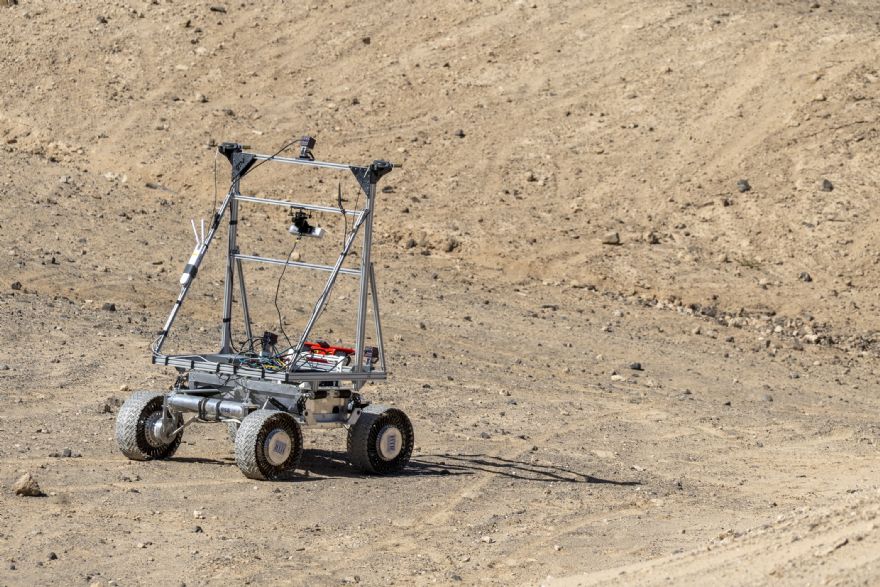
The company carried out the 11-day test programme in Lajares, Fuerteventura, validating a new on-board autonomy framework that combines its mature Guidance, Navigation and Control (GNC) technology, known as FASTNAV, with an AI-enabled perception system called Hawkeye.
The campaign forms part of the development of NOMAD, a modular autonomous navigation system designed to help lunar rovers travel more quickly and safely across challenging terrain using data gathered from multiple sensors. The project is co-funded through the European Space Agency's (ESA) General Support Technology Programme (GSTP) and supported by the UK Space Agency.
GMV’s engineers conducted a series of mission-inspired trials, including crater exploration and operations in low-visibility environments designed to mimic the permanently shadowed regions found at the Moon’s poles. These areas are attracting significant attention from space agencies because they may contain water ice and other resources that could support long-term lunar exploration.
The latest development combines FASTNAV with Hawkeye and ANIME, a navigation technology developed through ESA’s Navigation Innovation and Support Programme. Together, the three modules form the NOMAD system, which is implemented within the TASTE (The ASSERT Set of Tools for Engineering) software environment.
One of the principal challenges facing planetary exploration missions is the need for rover vehicles to halt frequently in order to assess hazards and determine a safe route. GMV says NOMAD is designed to overcome this limitation by allowing vehicles to identify obstacles, re-plan routes and continue moving without stopping.
The system combines artificial intelligence, computer vision, autonomous vehicle control and real-time route planning to improve localisation, obstacle avoidance and navigation performance in constantly changing environments.
Juan Bevan, FSR business manager at GMV’s UK subsidiary, said the project demonstrates the growing contribution of British industry to future space exploration missions.
“This achievement highlights the strength of the UK's contribution to European space exploration and demonstrates how investments in advanced robotics are helping to mature the technologies needed for future lunar missions,” he said.
“Through programmes like ESA's GSTP, we are accelerating the development of innovative solutions that will enable more capable, resilient and autonomous exploration systems.”
The work aligns with ESA’s Technology Vision 2040 strategy, which identifies autonomous robotic systems as a key enabling technology for establishing a sustained human and robotic presence beyond Earth. Future lunar missions are expected to rely heavily on intelligent rovers capable of operating independently in remote environments where communication delays, poor visibility and hazardous terrain limit direct human control.
Steven Kay, GMV’s technical lead for Advanced Robotic Concepts, said the successful trial represented an important milestone in the development of next-generation autonomous exploration systems.
“Future lunar missions will require rovers to operate safely and efficiently in environments where communications delays, limited visibility and challenging terrain make direct human supervision difficult,” he said.
“NOMAD demonstrates how advanced autonomy can enable rovers to continuously assess their surroundings, avoid hazards and adapt their route in real time, helping maximise scientific return while reducing operational constraints.
“This campaign is an important step towards the next generation of fast and able autonomous systems that will support sustained exploration of the Moon and beyond.”
The successful completion of the Fuerteventura trials marks another stage in the maturation of technologies intended for future lunar missions. As interest in exploiting lunar resources and establishing a long-term presence on the Moon continues to grow, autonomous navigation systems such as NOMAD are expected to play a critical role in helping robotic vehicles operate safely and efficiently in some of the most demanding environments ever encountered.