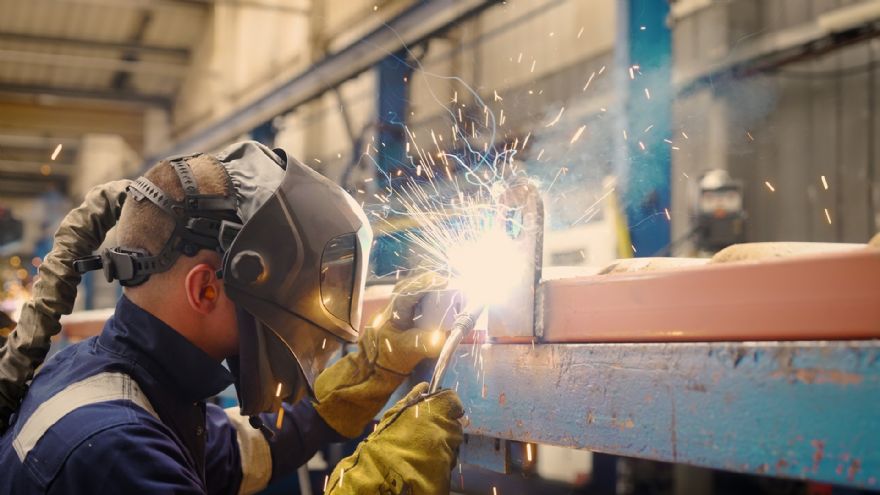
A forklift driver crosses the production hall a dozen times per shift. A quality inspector checks parts next to an active grinding station. An apprentice walks from the stores to the welding bay. None of them strikes an arc – yet all of them breathe the same air in which welding fume, metal dust and oil mist circulate. Measurements carried out by
Zehnder Clean Air Solutions at an active UK welding facility show how relevant this is: on a walkway next to the welding area, the average airborne particle concentration was 1,080µg/m³ – almost twice as high as the 549µg/m³ measured at the welding stations themselves.
The pedestrian effectZehnder describes this observation as the pedestrian effect. Many particles generated during welding, grinding and thermal cutting are in the respirable and ultrafine size range. They remain suspended long enough to spread through a facility before settling. Thermal currents from hot processes, HVAC systems, forklift and pedestrian movement as well as open doors and loading bays carry them into walkways, stores, quality control areas, maintenance zones, offices and welfare areas.
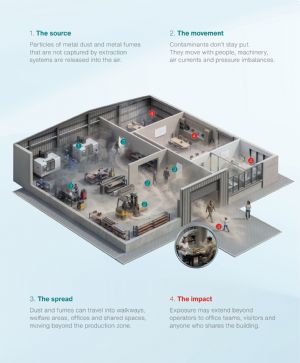
Why can a walkway read higher than the welding station? One plausible explanation: at the welding stations, local exhaust ventilation captures fume at the point of generation. Fine particles that escape capture are lifted by the thermal plume from the hot process, carried by general air movement, forklift and foot traffic, and can accumulate along circulation routes where there is no local extraction. Dust that has settled on floors, racking and machinery can also be stirred up again by traffic or cleaning. The values are averages recorded at one facility. They show a pattern worth checking on site, not a figure that applies to every workplace.
The people affected are not only the operators. Supervisors, forklift drivers, maintenance teams, quality inspectors, cleaners, apprentices, visitors and office staff entering production areas may cross several exposure zones in a single shift. Unlike operators, they may not routinely wear respiratory protective equipment and they may not be included in process-specific control planning.
William Burrows, sales manager Zehnder Clean Air said: “Most facilities we visit have invested in source extraction, and rightly so. But when we measure across the whole hall, the highest concentrations are not always where people expect them. Particles that escape capture don’t follow job titles – they follow airflow.”
Source extractionLocal exhaust ventilation (LEV) is the primary engineering control for welding fume and remains essential in metalworking. HSE expects suitable engineering controls, typically LEV, for welding indoors. How well LEV performs depends on correct design and positioning, regular maintenance, thorough examination and testing, and trained users. Under real-world conditions, the distance between hood and process, cross-draughts, large or awkward workpieces and very fine particles all influence how much is captured. What escapes locally becomes part of the wider environment.
Source capture controls the process at the point of generation. Ambient air cleaning can complement it by treating the air that is shared across the wider facility.
The health risksThe International Agency for Research on Cancer (IARC) classifies welding fume as carcinogenic to humans (Group 1). The UK Health and Safety Executive (HSE) states that all welding fume, including mild steel welding fume, can cause lung cancer. Under the Control of Substances Hazardous to Health Regulations (COSHH), employers must prevent exposure or, where this is not reasonably practicable, adequately control it. For carcinogens such as welding fume, adequate control means reducing exposure to as low as is reasonably practicable (ALARP). Staying below a workplace exposure limit (WEL) is therefore not the end point – especially for people who share the air without operating the process.
The air quality guideThe 24-page guide “Metalworking: The air quality guide” is aimed at operations, engineering and EHS managers. It explains how welding, grinding, cutting and CNC machining affect the air shared across a facility, why particles can still escape source capture and where pedestrian exposure typically happens. A short reality check helps readers assess their own facility. Warning signs that particles may already be moving beyond the source include:
- Dust returns shortly after cleaning.
- Dust appears where no dusty process takes place.
- People inside and outside production report irritation.
- HVAC filters load faster than expected.
- Shared spaces appear dusty or contaminated.
- Fumes stay suspended or linger for a sustained period of time.
From measurement to cleaner airZehnder’s approach starts with understanding, not with equipment. Air quality monitoring shows where airborne particle concentrations are highest, how they change during processes and shifts, and whether contamination reaches pedestrian routes and shared spaces. Where particles are present beyond the source, Zehnder ambient air cleaning adds a further layer of control alongside existing LEV: ceiling-mounted units such as the Zehnder CleanAir 3 Max continuously filter the surrounding air in production areas, walkways and shared spaces.
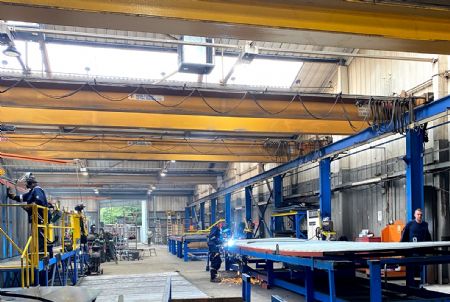
Metal fabrication specialist
Stackright Ltd in Skelmersdale, Lancashire, shows what this can mean in practice. Despite existing engineering controls, the company experienced visible haze and recurring dust deposits. After Zehnder ambient air cleaning systems were installed alongside the existing LEV, measured particle concentrations in the chalk-cutting, welding and grinding area fell significantly. Staff noticed the difference immediately, and the company’s own night-vision CCTV footage made the change visible.
Simon Greenwood, SHEQ Manager at Stackright comments: “The biggest surprise wasn’t just what we felt, it was what we saw. Watching our CCTV footage after the Zehnder units were installed, the airborne dust had virtually disappeared. It completely changed how we viewed our working environment.”
Measurable benefitsAir quality monitoring can deliver measurable operational benefits by identifying where airborne particle concentrations peak, including walkways and shared spaces that may not be apparent during routine inspections or site walkthroughs. At Stackright, average particle concentrations were reduced by 76%, falling from 486 to 118µg/m³, while peak concentrations dropped by 85%, from 17,580 to 2,460µg/m³. The cleaner environment also led to lower cleaning requirements and less visible dust accumulation.
Operationally, improved air quality reduced the need to pause production or prepare the factory ahead of customer visits, helping workflows run more smoothly. In addition, enhanced air quality provides greater confidence in the working environment, supporting customer visits, audits and ISO objectives.
Look beyond the sourceThe most important question is shifting: not only where contamination is generated, but where it ends up – and who breathes it on the way.
Mr Burrows explains: “Protecting the welder is essential. Protecting everyone who walks past the welder is the next step. Measuring across the whole facility, not just at the workstation, is where that starts.”
The guide 'Metalworking: The air quality guide' is available as a free download at
www.zehnder-cleanairsolutions.com/en/blog/metal-work-safety-guide At the end of the guide, readers can start an online air quality risk assessment for their own facility.