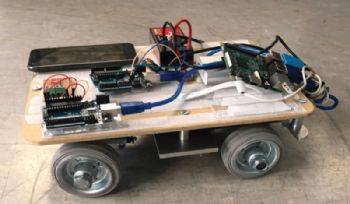
Engineering students at the University of Leicester (
www.le.ac.uk) have developed a miniature autonomous ‘drive-by-wire’ vehicle that could speed up the development of driverless cars.
Their ‘μPod’ prototype could potentially lead to a new system of testing code and algorithms for connected and autonomous vehicles (CAVs). It is a 1:6 scale version of the LUTZ Pathfinder Pod developed by the Transport Systems Catapult (TSC).
The students’ miniature vehicle has been created to act as a representative initial platform for the testing of the code and algorithms, which would then be applied to the full-size pod.
It can be driven under remote control, but it also has the electronic components required for autonomous control. The five mechanical engineering students behind the prototype are Daniel Thomson, Jingyu Chen, Scott Baker, Mohamed Khaled and Hongfei Chen.
They demonstrated it at the
Cheltenham Science Festival, which took place 5-10 June.
Daniel said: “The benefit of testing using a prototype such as ours is that it significantly reduces the risk of testing new code, in particular the obstacle detection and avoidance functions, as the overall cost to fix damage or reproduce our vehicle would be a lot lower than — for example — the LUTZ Pathfinder.
"We hope that our vehicle can be used as a platform to test new algorithms and coding for the purpose of enabling autonomous control of a full-size vehicle capable of carrying passengers.”