 Airbus
 and
ArianeGroup have signed a contract for the next transition batch of Ariane 6 large carbon-fibre structures. The contract includes the manufacturing and supply of innovative, large, lightweight structures for the next 14 Ariane 6 launchers, to be manufactured until 2025. The contract will support ArianeGroup’s ramp-up to full production rate by then.
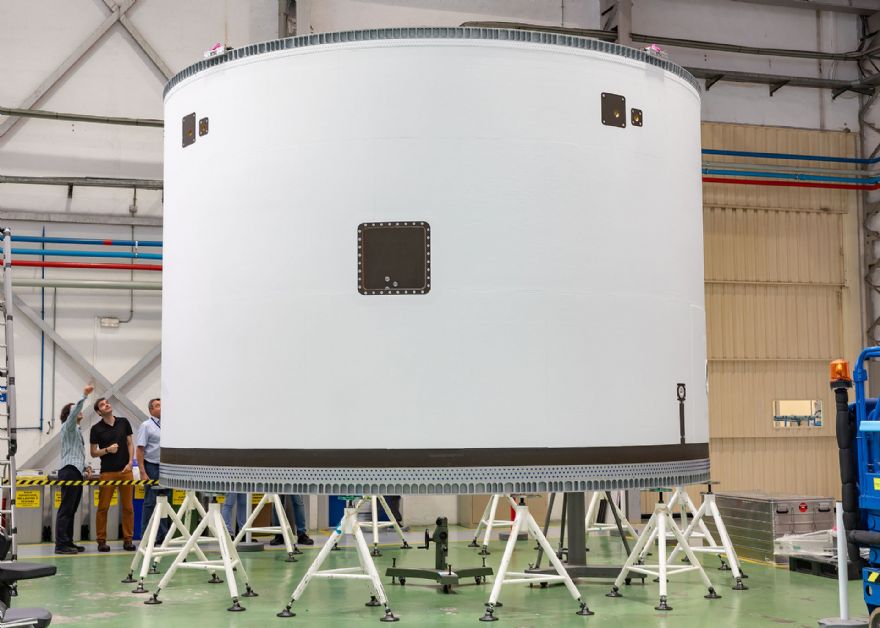
Airbus builds up to four carbon-fibre structures for each Ariane launcher at its Getafe site, near Madrid. The new ‘state of the art’ Industry 4.0 facility includes a dedicated manufacturing and assembly line for the Ariane 6 launcher structures. The latest technology innovations have resulted in a reduced mass while delivering a stronger structure in a single piece at a lower cost.
The Interface Structure (upper and lower) is the largest space carbon-fibre structure ever produced in Europe. The other structures include the Launch Vehicle Adapter, for the upper stage; and the Equipped Solid Rocket upper part of each rocket booster.
Luis Guerra, head of Space Systems at Airbus in Spain, said: “Signing this contract is a significant step forward, not only for Airbus and its launcher activities in Spain, but for the overall Ariane 6 programme. It demonstrates that Spanish participation is key to the future of Ariane 6 and what is next in space for Europe.”
Stephane Nogatchewsky, ArianeGroup head of procurement, said: “Following the signature of the exploitation contracts with Sabca, Europropulsion, Avio and MTAerospace, this contract with Airbus is a new and key step towards a strong Ariane 6 European team.
“While the inaugural flight of Ariane 6 is getting closer and the industrial ramp up is intensifying, this collaboration is a positive and critical milestone for the future of Ariane 6 operations. Also, unifying European actors is paramount to ensure further Ariane 6 industrial robustness, competitiveness and preserve European autonomous access to space.”
The Ariane 6 programme is the only European asset that allows independent access to space for strategic missions, and the flexibility to launch both heavy and light payloads to a wide range of orbits for applications such as Earth observation, telecommunication, meteorology, science and navigation.