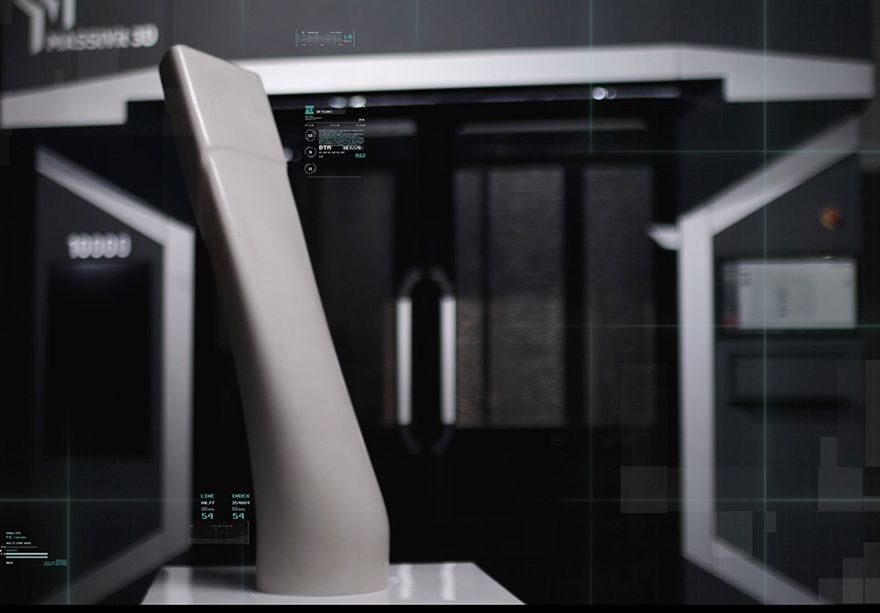
 Duct mandrel being printed on the Massivit 10000 machine
Additive manufacturing (AM) has the ability to disrupt industrial processes and to facilitate the achievement of innovative, cost-effective, and speedy outcomes when compared to traditional production processes. Coinciding with the rapid growth in demand for products made from composite materials — which are inherently stronger, lighter, and more environmentally-resistant than conventional materials — AM is set to revolutionise composite production in the defence, aerospace, and additional industries. In these sectors it can — among other things — be used to create mandrels for ducts and vents for air, fluid and energy management applications.
Mandrels are an essential tool when making hollow composite parts and components. During the manufacturing process, the mandrel is inserted into the end of a tube or pipe and held in place while the object is being formed around it. This ensures that the finished product retains its shape and size.
Traditionally, the most common type of mandrel is made from steel, but aluminum and other metals can also be used. Such mandrels, however, can have limited applications and can be expensive to produce. However, manufacturing processes can be simplified and optimised through the use of AM to produce mandrels as sacrificial tools for composite manufacturing.
Composite materials, used extensively across many manufacturing sectors, are materials that are made up of two or more distinct components. These parts can be a combination of metals, polymers, ceramics, fibres, and various other substances, depending on the application. Composite materials are used in a variety of industrial applications because they offer a number of benefits over traditional materials such as the fact that they are lightweight allowing for fuel efficiency, and exhibit increased strength, increased stability, increased resistance to wear and tear, and increased resistance to weathering and environmental damage.
Complex shapes Composite materials are also easier to fabricate and mould into complex shapes than the likes of metal, plastic, and ceramic. By combining different types of materials together, engineers can create materials that meet specific requirements and provide lasting service to many industries. With the growing demand for composite materials, it is clear that these versatile materials will continue to play an important role in industry for years to come. Traditional mandrel-making methods have existed for centuries and are still in use today. There are three main traditional methods of making mandrels: casting, forging, and machining.
Casting is the most common way of manufacturing industrial mandrels. In this process, molten metal is poured into a mold that is in the shape of the desired mandrel. The metal cools and hardens, and the mandrel is then removed from the mould. In the forging process, a piece of metal is heated until it is malleable, and then it is shaped into the desired mandrel using hammers and other tools. In the machining process, a piece of metal is cut or milled into the desired shape using lathes, milling machines, or other machine tools.
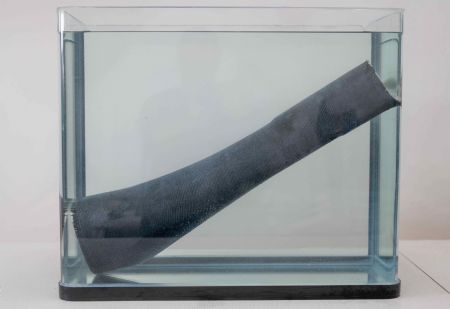 Pictured right: Encapsulated 3-D printed mandrel with skin in bath
There are a number of inherent disadvantages of using conventional mandrel production technologies, key among which is that they are often time-consuming, labour-intensive, often generate a lot of waste material, and they are limited in the extent of geometric complexity that can be achieved.
3-D printing can be used to create mandrels with complex geometries that would be difficult or impossible to produce using traditional methods. AM offers a more flexible approach that can create mandrels with intricate designs and internal features extremely quickly, without the need for expensive cutting tools. Traditional mandrel production methods also require multiple parts to be produced if there are complex geometries or overhangs etc, otherwise it would not be possible to remove the mandrel core. Producing multiple parts means extra cost, is time-consuming, and opens up the possibility of errors and reworkings.
The benefits of using AM to make mandrels include lower tooling costs, shorter lead times, and greater flexibility in design. Additively manufactured mandrels can be made quickly and easily from a digital file, making them ideal for short-run or one-off production runs. Additionally, they offer designers greater freedom in terms of shape and geometry compared to traditional techniques.
The Massivit solutionIsrael-based
Massivit 3D has developed a proprietary 3-D printing process for producing strong and durable mandrels. This represents a highly innovative solution for the production of composite parts, offering significant advantages over traditional manufacturing methods and enabling the production of high-quality composite parts with reduced lead times and lower costs.
One of the key advantages of using 3-D printing to make mandrels is that it allows for more complex designs than traditional machining methods. With AM, there are no constraints on the geometric shapes that can be produced, meaning that mandrels can be made with very intricate designs. This opens up a whole new range of possibilities for designs and means that they can be tailor-made to suit the specific needs of a particular application.
As the demand for composite parts increases, so does the need for more-efficient and cost-effective production solutions — the Massivit 10000 AM system has been developed for this purpose. The machine uses Cast In Motion (CIM) technology in combination with Massivit 3D’s patented Gel Dispensing Printing (GDP) method. It allows direct casting of the mould into a 3-D printed sacrificial shell. To achieve this, the system uses a dual-head system, ultra-fast patented technology, and for the mandrels uses water-breakable material that crumbles in water. All these allow manufacturers to rapidly produce complex mandrels within a matter of hours instead of weeks. The material is also lightweight — making it easy to handle and transport during the production process, as well as strong and durable — allowing it to be used for a variety of mandrel applications.
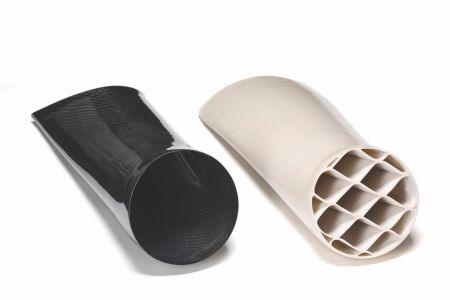 Pictured left: Massivit 10000 — 3-D printed sacrificial mandrel with carbon skin
To illustrate the disruptive nature of the Massivit 3D approach to mandrel production, the following case study illustrates the process steps involved in the manufacture of a mandrel for the company
Kanfit which serves the defence and aerospace sectors. The commissioned mandrel needed to be 3-D printed in Massivit’s water-breakable material, and the outer surface of the AM mould needed to be very smooth.
First, a CAD model of the mandrel with X,Y and Z dimensions of 381 x 191 x 567mm was created. To make it optimally aligned to Massivit’s 3D’s AM technology, the flange area of the model was extended digitally for better lay-up fabrication, and the wall of the mould was designed with three printing contours with a final width of 5.4mm to withstand the vacuum pressures at the fabrication stage. From the finished CAD file, the G-code of the mandrel was created on the Massivit Smart slicer software. The print was designed to use minimum time and material, and took in total only 8hr — the mandrel was produced using Massivit’s water-breakable DIM WB photo polymer material.
The part was then post-processed — the surface was sandpapered, and one coat of epoxy was applied to make the surface of mandrel air tight. For the lay-up stage, the mandrel was set up on a rotating jig, enabling the application of epoxy and carbon-fibre sheets — six in total — around the tool. Once coated in carbon-fibre, the mould entered the vacuum process, where it remained under vacuum pressure for 3hr. It was then removed and allowed to rest for 24hr before the final cure.
The finished mould was then placed in plain water for 24hr, and all remains of the water-breakable material were removed from the skin. The mandrel was then trimmed, and validated in the quality control department before release. Using AM to produce the mandrel around which composite parts in such applications are made introduces a simplification and streamlining of the process of composite production when compared to legacy mandrel production.
Mandrels made using AM have the potential to revolutionise the way composite parts and components are made. Mandrels produced using AM offer several advantages over traditionally manufactured mandrels. They are lighter, more precise, and can be easily customised to fit the specific needs of each part. This results in faster production times and a reduction in waste. In addition, mandrels made using AM can be produced from advanced materials such as Massivit’s water=breakable material which simplifies removal.
This enables the production of composite parts that are of higher quality and more reliable. The future of composite part manufacturing is bright with the advent of AM mandrels, and this technology and Massivit’s 10000 is poised to revolutionise the industry.