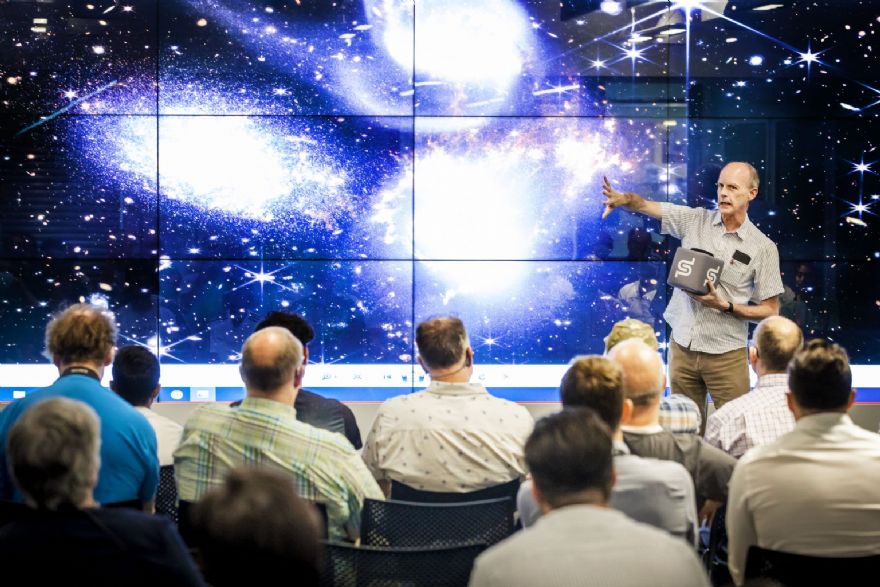
 First images from the James Webb Space Telescope revealed last year. Photo: Space Park Leicester
Engineers in Leicester involved in the £10 billion
James Webb Space Telescope mission say it is ‘only just getting started’ after celebrating its first-year anniversary last week. On 12 July last year, the world got its first glimpse of groundbreaking views of the cosmos from the telescope at a special event at
Space Park Leicester, including the deepest and sharpest infrared image of the distant universe so far, views of a ‘stellar nursery’ and a roaring sphere of gas around a dying star.
NASA said the revelations were the ‘dawn of a new era in astronomy’ but engineers from the
University of Leicester and Space Park Leicester, who have been part of the Webb project for more than 20 years and have been involved in the design, manufacture and testing of Webb’s Mid-InfraRed Instrument (MIRI), say what we have seen so far is just a fraction of what it will uncover.
Speaking ahead of the first anniversary of the images release last week, Space Park Leicester’s Piyal Samara-Ratna, who is the senior mechanical engineer for the James Webb Space Telescope, said: “Over the past year, James Webb has been going over the greatest hits of the Universe – looking at things the Hubble Telescope has already seen but in greater detail.
“That has enabled us to make exciting discoveries and learn things about the formation of the universe and we’re working out that the Universe potentially had stars forming at an earlier age than we thought. However, this year has really been about demonstrating the capability of James Webb by taking images, similar to those Hubble did, but in infrared.
“What we have seen so far is really the tip of the iceberg of what it will do. Moving forward it’ll start looking at things that we really don’t know about and begin to find answers that are going to revolutionise our understanding.”
Mr Samara-Ratna said James Webb’s predecessor, the Hubble Telescope, had done an amazing job but its performance is hampered because it is so close to the Earth’s atmosphere. He added: “What we wanted to do was put an observatory somewhere deep into space where it can see the Universe in real clarity.
“James Webb does that and it uses the latest technologies so we can really elevate our understanding of the Universe. It also looks at it in a slightly different way. Whereas Hubble looks at the visible, James Webb also looks in the infrared which means it can cut through dust clouds and see things which the Hubble Telescope just can’t see.”
It is hoped that the James Webb Space Telescope will be operational for up to 20 years.