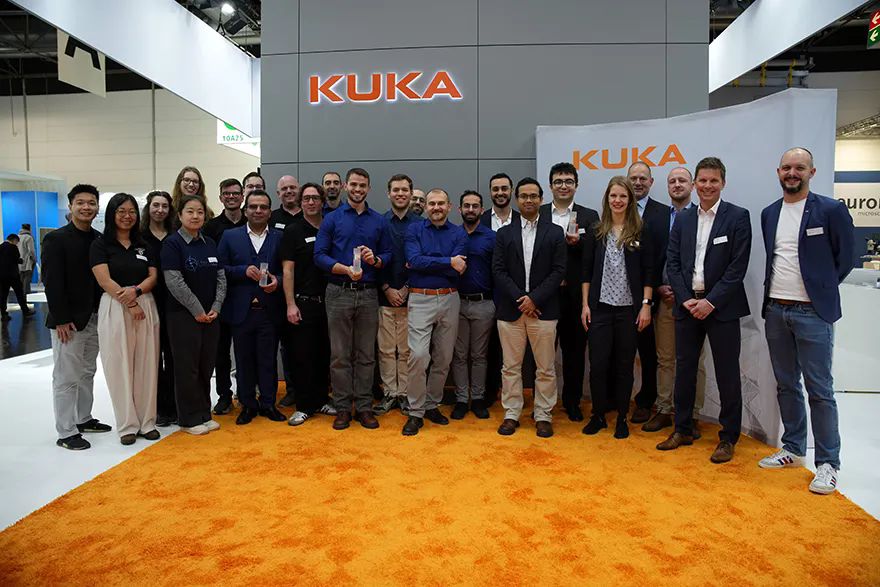
A team of researchers from Belgium and Switzerland has claimed the
KUKA Innovation Award 2025 with a pioneering medical robotics application that uses ultrasound to examine the spine during surgery. Robots and smart technologies are reshaping medicine — from operating theatres to rehabilitation centres — improving treatments, reducing strain on specialists and enhancing preventive care. Reflecting this trend, the ‘KUKA Innovation Award 2025’ was held under the theme ‘Medical Robotics Challenge 2.0’.
Throughout the
MEDICA trade fair, which was held from 17-20 November in Düsseldorf, five finalist teams showcased concepts for gentler operations, improved preventive check-ups and intelligent robotic assistants at the KUKA stand. On the penultimate day of the fair, an international jury selected the winning team.
Axel Weber, vice president of the medical robotics business unit at KUKA, said: “Using ultrasound to examine vertebral bodies: we were impressed by the team’s innovative approach. The method offers decisive advantages for clinical use. It is non-invasive and helps to significantly reduce operating time. This reduces risks for patients and noticeably speeds up recovery.”
Anatomically challenging environmentsThe winning team, Ultratopia, from
www.kuleuven.be/english/kuleuven KU Leuven in Belgium and
www.balgrist.ch/en Balgrist University Hospital at the University of Zurich in Switzerland, partners in the EU-funded FAROS project, presented an advanced approach to pedicle screw placement (PSP) — a surgical technique used to stabilise the spine in anatomically challenging environments, commonly for spinal fractures, scoliosis and degenerative disc disease.
Ultratopia’s system employs collaborative multi-robot technology to improve PSP accuracy through non-radiative imaging. A robotic arm equipped with ultrasound monitors and guides a second robotic drilling arm during the procedure. This approach aims to improve precision, reduce registration errors and compensate for physiological movements, ultimately enhancing surgical outcomes.
Looking ahead, the KUKA Innovation Award enters its next round with a new challenge. Packaging is a key element of the modern economy, and the industry faces radical change. For 2026, the motto is ‘Circular Packaging Challenge’ — seeking creative ideas to make packaging more sustainable, from recycling and waste prevention to redesigning entire packaging processes.