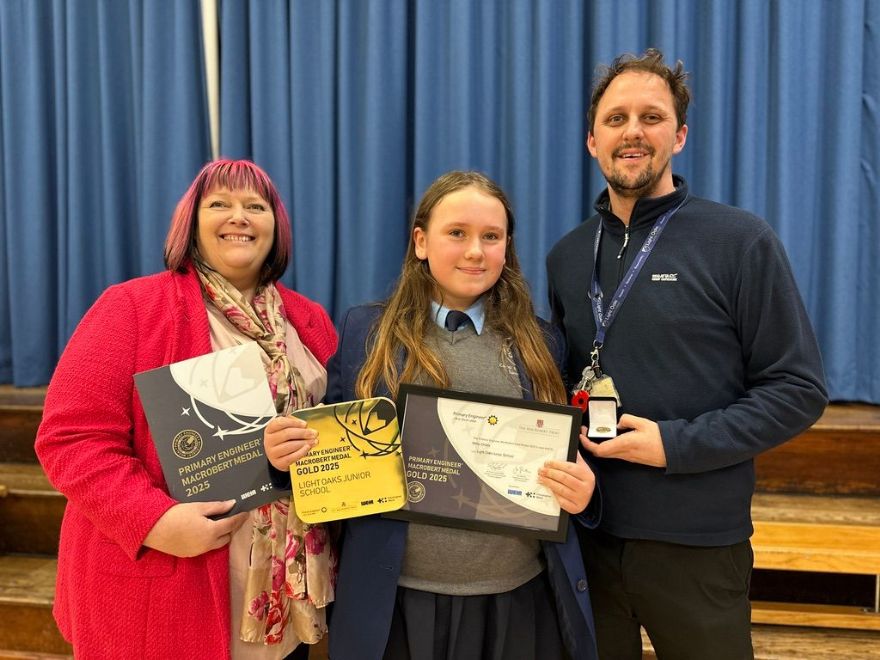
A young Salford inventor has won a national engineering award for creating colour-changing glasses that could help people with dyslexia read more easily, with the prototype already attracting interest from the NHS. Millie Childs first developed the idea while a pupil at Light Oaks Junior School, taking part in
Primary Engineer, a national STEM competition that challenges pupils to design creative solutions to real-world problems. Her invention, Rainbow Glasses, features a pair of glasses with interchangeable or adjustable coloured lenses designed to reduce visual stress and improve reading comfort for people with dyslexia.
As part of the competition, engineers from
Thales UK in Cheadle selected Millie’s design to turn into a working prototype. After months of research and testing, the team produced an LED-based solution that allows the lenses to shift between red, green or blue depending on the user’s needs. Millie, now a Year 7 pupil at
Co-Op Academy Swinton, has gone on to win a Gold Award in the
Primary Engineer MacRobert Medal, the sister award to the UK’s most prestigious engineering prize, the
MacRobert Award. Her former teacher, Rob Entwistle, collected the award on her behalf during the ceremony in London last week.
This week Millie returned to Light Oaks Junior School to talk about her invention and inspire the next generation of young engineers. Millie, 11, said: “My dyslexia has always made reading a challenge, so I wanted to invent something that could make it easier. Seeing the engineers turn my idea into real glasses has been incredible.
The thought that they might one day help other people with dyslexia is something I’m really proud of.” Millie’s mum, Sarah, added: “Millie has loved every second of this experience and it has really motivated her. She has been excited through the whole journey and she is so hopeful about the future. Her grandad was an engineer and this is the sector she has always wanted to work in, and her dreams have been made into a reality.”
Outstanding ideaTeacher Rob Entwistle said: “Millie’s idea stood out from the moment she presented it. She wanted to help others who faced the same challenges she did. Watching her idea grow from a drawing into a working prototype has been inspiring.”
Zandra Wilkinson, headteacher at Light Oaks Junior School, added: “Primary Engineer’s competition is an incredibly powerful activity for our pupils. It shows them that their ideas matter, that engineering is creative, and that they can solve real-world problems. We are unbelievably proud of Millie — he has shown our whole school community what is possible, and we could not be more delighted for her.”
Primary Engineer’s annual UK competition asks pupils aged 3–19 the question “If you were an engineer, what would you do?”. All entries are read and graded by professional engineers, with every pupil receiving a named certificate. Regional exhibitions and awards ceremonies then showcase shortlisted designs, with winners invited on stage to receive their awards. Millie was recognised as one of the winners at the Greater Manchester event in 2024, one of 25 regional UK awards, and her idea was selected to be built into a prototype and revealed in July 2025.
Sam Hassan, bid and programme management graduate at
Thales UK, said: “We had an amazing time working with Millie’s Rainbow Glasses idea. Over seven months we researched, planned, built and tested the design to create a prototype that met her expectations. Our journey included weekly meetings, input from researchers at the University of Georgia, delivering STEM lessons in Millie’s school and a visit from Millie and her friends to see the final prototype. When we unveiled it we were thrilled to see the reaction, and even had a member of the NHS asking whether this might progress further.”