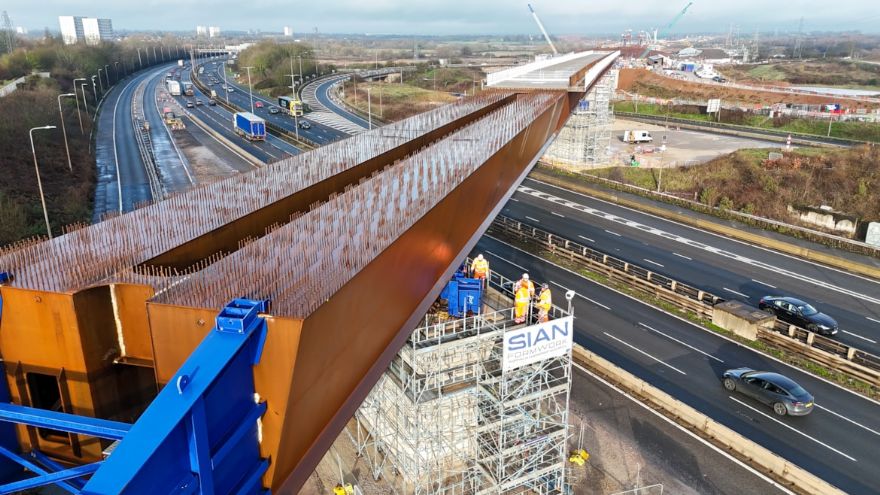
Engineers working on the
HS2 project achieved a UK-first earlier this month by sliding a 4,600-tonne viaduct across the M6 without closing the motorway, dramatically reducing disruption for drivers. The 17hr operation marked the completion of a three-stage process to install the 315m East deck of the M6 South viaduct, which will carry high-speed trains to Birmingham and beyond.
Unlike the previous slide, which required a full weekend closure, HS2’s main works contractor
Balfour Beatty VINCI (BBV) collaborated with National Highways to develop a ‘fully restrained’ technique that allowed the structure to move safely over live traffic. It is believed to be the first time this method has been used on a UK motorway.
To prepare, the M6 was closed overnight between Junctions 4 and 5 on 11 December so the viaduct could be shifted forward by 12m, ensuring both ends were supported on concrete piers. On 13 December, the structure was pushed the remaining distance at a speed of 13m per hour, with only the M42 slip road closed during the operation.
Caroline Warrington, HS2 Ltd’s head of delivery, said: “Along the HS2 route we are pioneering new approaches to engineering and construction in order to deliver more efficiently and with less impact on our neighbours. We believe this fully restrained slide was a first for the country, but most importantly it means we have been able to cut in half the number of times we have had to close the motorway.”
Sense of prideThe successful slide marks the halfway point in constructing the M6 South viaduct. A parallel West deck will be installed next year using the same technique to carry trains heading south. Russell Luckhurst, BBV’s lead engineer, said: “We are all feeling a huge sense of pride after sliding a 4,600-tonne viaduct into its final position this weekend. The third and final slide of the East deck viaduct was delivered over a live motorway for the first time in the UK, making this achievement even more special. Our focus will now turn towards the neighbouring West deck viaduct, which will be launched in multiple phases throughout 2026, as well as the East deck finishing works.”
The viaduct consists of a hollow double-box structure made from weathering steel, which forms a protective oxidised layer to reduce maintenance. Four pairs of concrete piers support the structure, the tallest standing at 9.9 metres. A 4.5-metre-high parapet will be installed to reduce noise for nearby Chelmsley Wood residents. The slide was achieved using strand jacks and non-stick pads similar to those found on frying pans to minimise friction.
Victoria Lazenby, National Highways regional director for the Midlands, added: “Our key focus is the impact that these major construction works have on our roads – we must both ensure the safety of road users and minimise the disruption they face. So we are delighted that this innovative technique has meant that not only was this enormous structure slid into place without having to close the motorway during the day but also that the total number of closures needed has also been halved.”