The
University of Birmingham has launched a new facility in the West Midlands for separating and recycling rare-earth magnets that will help to reduce the UK’s reliance on imports. Rare-earth magnets are among the key ‘critical minerals’ that are integral to modern life and form a core building block in technologies such as wind turbines, electric vehicles, medical equipment, pumps, robotics, and electronics. Demand for these minerals will only increase as the adoption of low-carbon technologies accelerates and are fundamental to the UK’s modern industrial strategy.
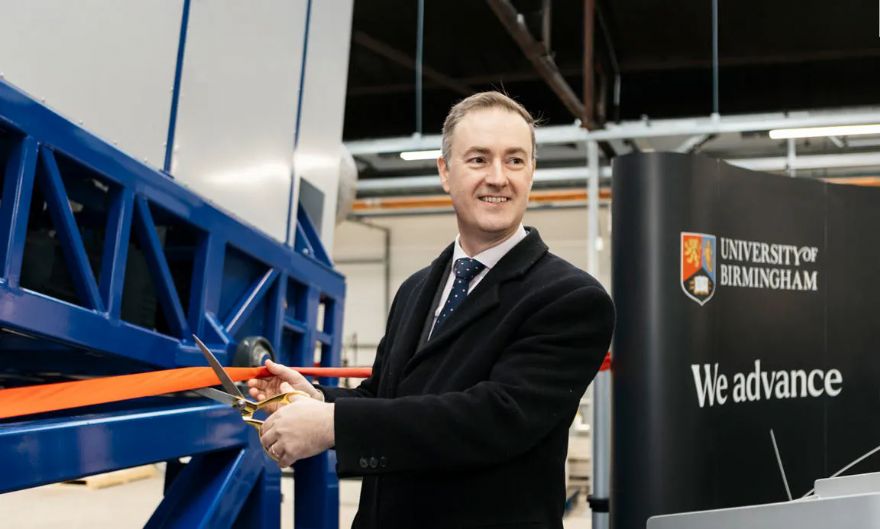
Opened by Chris McDonald, Minister for Industry in the Department for Energy Security and Net Zero and the Department for Business and Trade, Birmingham’s rare-earth magnet recycling facility uses a pioneering hydrogen-based process developed by researchers at the University of Birmingham.
Hydrogen Processing of Magnet Scrap (HPMS) technology is an extremely efficient method to extract rare earth magnets from end-of-life products without the need to fully disassemble them. It transforms waste into a sustainable UK source of rare earths that can be used to manufacture new metals, alloys and magnets while reducing both environmental impact, cost and supply chain risk.
The facility at Tyseley Energy Park in Birmingham scales the process to commercial production levels. The previous proof-of-concept plant handled batches of 50-100kg size while the new scaled-up facility can recover over 400kg of rare-earth alloy per batch and into new sintered magnets at 100-tonne capacity per year on a single shift and over 300 tonnes on multiple shifts. Magnets can be produced at a fraction of the environmental impact and cost compared to primary production methods.
World-leading expertiseThe processing facility reintroduces sintered rare-earth magnet production back into the UK for the first time in 25 years and this can be used for primary production of magnets as well as from recycled feeds. By recycling products such as hard drives, electric motors, wind turbines, robotic actuators, pumps, filters, and electronics, this also delivers a CO
2 saving of around 90% compared to producing magnets from minerals extracted from the ground.
In November 2025, the UK Government published its updated
Vision 2035: Critical Minerals Strategy setting out how the UK will increase resilience in this strategic sector. The Birmingham recycling facility aims to address the strategy’s goals and is a stepping stone to a larger-scale facility being developed on the site.
Mr McDonald said: “This new facility is great news for the West Midlands which will help create hundreds of well-paid local jobs and is testament to our world-leading expertise in rare-earth recycling. This is our Critical Minerals Strategy in action, bringing sintered magnet manufacturing back to the UK for the first time in 25 years and backing innovative projects to boost our critical minerals supply chains and power the green industries of the future.”
Rare-earth recycling sits within the University of Birmingham’s broader research strengths in battery recycling, robotic disassembly, chemical recovery, and energy storage. Professor Rachel O’Reilly, Pro-Vice Chancellor (research) at the University of Birmingham, said: “By developing complete circular solutions for the supply of critical minerals such as those found in rare-earth magnets, the University of Birmingham is playing an essential role in helping the UK become a technological leader in this field.”
Vital role of university-led R&DShe continued: “Supported directly by the university itself and through the allocation of QR funding from Research England and programme funding from UKRI, this is a brilliant development of the UK’s competitive advantage. Opening the Birmingham magnet recycling facility highlights the vital role of university-led research and development in delivering industrial capabilities and addressing national resilience and sustainability goals identified among the UK Government’s strategic and societal priorities.”
The recycling facility has received £4.5 million of funding from
Innovate UK’s Driving the Electric Industrialisation Centres (DER-IC) with supporting grants via the Innovate Climates Programme, EPSRC, the Advanced Propulsion Centre, and EU Horizon grants. This investment supported the UK’s push towards a ‘net zero’ carbon economy and contributes to the development of clean technology supply chains.
Bruce Adderley at Innovate UK said: “Through the realisation of this magnet recycling facility, the UK now has all the constituent parts of a rare-earth permanent magnet supply chain for the first time in over two decades. As an open access facility this provides UK industry the opportunity to access the skills and expertise, from the University of Birmingham team to scale and commercialise this innovate recycling process.
“This is a fantastic example of research to industry knowledge transfer and has the potential to de-risk the supply of rare earth permanent magnets to the UKs manufacturing industry and make these crucial components more sustainable.”