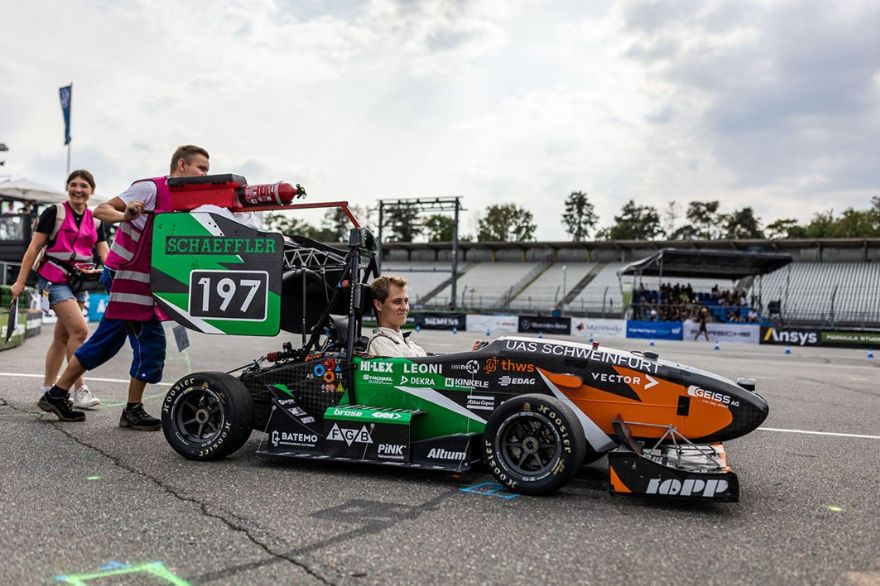
In modern racing, weight, aerodynamics, and the materials used in vehicles determine victory or defeat. For the
Formula Student racing team
Mainfranken Racing e.V. at the
Technical University of Würzburg-Schweinfurt, the production of carbon parts is also a central component of vehicle optimisation.
As part of a design competition, the crew develops its new model every year, relying on state-of-the-art manufacturing processes. This also applies to the vacuum technology from
Atlas Copco, which is used to produce the lightweight, high-quality carbon components of the racing cars.
To ensure maximum quality and reproducibility in the process, the racing team uses the oil-sealed rotary vane vacuum pump GVS 100A sponsored by Atlas Copco Vacuum. Alexander Braun, sales engineer from Atlas Copco Vacuum in Germany, said: “The robust, compact pump ensures uninterrupted operation and stable, reliable vacuum performance – even under the most demanding conditions. Its ease-of-use, quiet operation, and low maintenance requirements round off the package of advantages.”
Marius Hofmann, chief technical officer from the Mainfranken Racing Team, said: “Production begins with cutting and applying several layers of carbon-fibre fabric, which are impregnated with epoxy resin. These layers are carefully stacked on top of each other, with the orientation of the fibres varying depending on the direction of stress. In the next step, the component is either placed in a vacuum chamber or packed airtight with a special vacuum film.”
The GVS 100A from Atlas Copco generates a stable vacuum that evacuates the air from the chamber or film package. Mr Hofmann said: “This step is crucial, because the vacuum removes air pockets that would later lead to structural weaknesses such as micro cracks in the component and ultimately to defects.”
Extremely resilient carbon componentsAt the same time, the negative pressure causes the resin to penetrate the fibres evenly and excess resin to be squeezed out – this increases the fibre volume fraction, which in turn improves the mechanical properties of the components. Following complete evacuation, the parts are cured at high temperatures for around 12hr to achieve their final strength and dimensional stability. The result is a high-quality, lightweight, and extremely resilient carbon component that can withstand the high demands and material stresses of racing.
The Atlas Copco GVS 100A impresses with its robust, reliable rotary vane technology, which was specially developed for these demanding industrial applications. Thanks to its oil-sealed design, it generates a stable and consistent vacuum, which is essential for precise processes such as the manufacture of carbon components.
The integrated oil separation ensures a clean working environment, while the gas ballast valve facilitates the handling of moist gases. A check valve at the inlet protects the system from back flow and increases operational safety. With its compact design, the GVS 100A can be flexibly integrated and offers a reliable solution for applications where repeatability and quality are key.
The combination of innovative vacuum technology and student engineering skills impressively demonstrates how important reliable tools are in the manufacture of high-performance components. The Atlas Copco GVS 100A not only enables precise lamination processes, but also promotes technical training and progress in racing – and that is a real gain for the Mainfranken Racing e.V. team.