What began in 1926 as a modest tool and machine workshop in Munich has evolved into a global industrial force, operating production sites on three continents, employing more than 9,000 people, and maintaining a forward‑looking vision for the manufacturing landscape of tomorrow. As
Grob marks its centenary, the company reflects on a history shaped by a pioneering mindset, a relentless pursuit of technical excellence, and a willingness to redefine what is possible in machine tool engineering.
The company’s capacity for innovation emerged early. In 1933, Grob unveiled its first thread‑milling machine, signalling its entry into machine tool manufacturing and setting a precedent for precision and process refinement. This momentum accelerated with the development of a proprietary chipless metal‑forming process, leading to thread‑rolling machines that were not only efficient and gentle on materials but also exceptionally accurate. This instinct for re-thinking established methods would become a defining characteristic of the business.
A new era began in 1952 under Burkhart Grob, whose leadership steered the company towards special-purpose machinery for high‑volume production. Throughout the 1960s and 1970s, GROB established itself as a benchmark in transfer technology, delivering multi‑way and multi‑station machines that transformed productivity. In 1970, just three years after opening its Mindelheim facility, the company engineered its first fully independently developed transfer line — a milestone that underscored a deep commitment to in‑house design expertise.
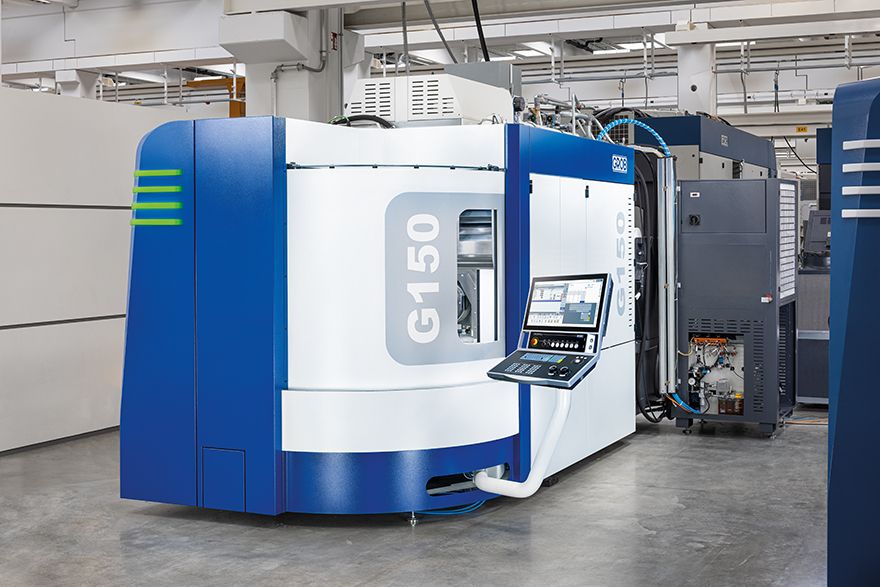
By the 1990s, GROB recognised the industry’s growing need for flexible production systems. Its response was a new generation of dynamic, compact machining centres, culminating in the introduction of linear motor technology. The launch of the BZ 600L in 1998 positioned the company at the forefront of high‑speed machining, while the 2004 debut of the modular G‑series brought a unified machine concept focused on adaptability, precision and durability. Thousands of installations worldwide soon followed, reflecting the market’s strong endorsement of this new direction. As CSO Christian Müller puts it: “The best machine is the one that adapts to the customer – not the other way around.”
Automation and digitalisationAlongside mechanical advancements, Grob invested heavily in automation and digitalisation. Flexible manufacturing systems, intelligent production lines and proprietary automation modules became integral to the expanding portfolio. The GROB‑NET4Industry platform, designed to interconnect machines, processes and data, represented a significant stride into Industry 4.0. From pallet‑handling systems to robotic cells and automated transport units, the company steadily evolved into a full‑service provider for modern production environments. Mr Müller noted: “Our machines think for themselves today – but they always make decisions in the interests of the operators.”
A pivotal development came in 2016 with Grob’s strategic move into electromobility. The company broadened its activities beyond traditional machine tool manufacturing, becoming a system supplier for complete production solutions for electric motors, battery cells, battery modules and fuel‑cell technologies. Its portfolio now spans hairpin and needle‑winding systems, stator and rotor production, battery‑cell assembly and cell‑to‑pack solutions. CEO German Wankmiller captures this transformation clearly: “We don't just build machines – we create production systems for the mobility of tomorrow.”
In parallel, Grob expanded into additive manufacturing (AM) with the GMP300 liquid‑metal printing machine, offering industrial‑grade performance for functional components, prototypes and specialised materials. Mr Wankmiller said: “What we build is more than technology – it is trust in our own engineering skills.”
Despite its scale and sophistication, Grob remains grounded in the values of a family‑owned business. Training, vertical integration and in‑house engineering are deliberately maintained to ensure quality, independence and continuity. The late Burkhart Grob articulated the company's ethos with characteristic clarity: “My greatest experience, which shaped my entire life, was my father’s relationship with his employees . . . His way of dealing with them ultimately led to the success of the company and the well‑being of the employees.”
Standing the test of timeNow in its third generation under Christian Grob, with the fourth represented by Florian Grob already taking on responsibilities, the company continues to prioritise long‑term stewardship. As supervisory board chairman Christian Grob puts it: “Running a family business means thinking in terms of generations – making decisions that are not only right for today, but will also stand the test of time tomorrow. Responsibility does not end at the factory gate, it begins there.”
Grob’s international expansion has mirrored its technological evolution. What started with the export of individual machines has grown into a fully global production, service and technology network. Subsidiaries and facilities across Europe, the Americas and Asia enable the company to stay close to its customers, respond rapidly and maintain consistent quality worldwide. Its international presence reflects not just strategic growth but a commitment to understanding local needs and delivering globally reliable performance.
In its anniversary year, Grob is showcasing a series of technological premieres that reinforce its status as an innovation leader, including the GP1350 five‑axis portal milling centre, the GRC‑M60 robot cell and the new MES/MOM platform Grob COSERA. Together they highlight the company’s continued drive to enhance productivity, automation and digital integration. From 17 to 20 March, visitors to Grob’s in‑house exhibition will have the opportunity to explore the company’s journey from its Munich origins to its role as a global engineering innovator, while experiencing the latest technologies first‑hand.