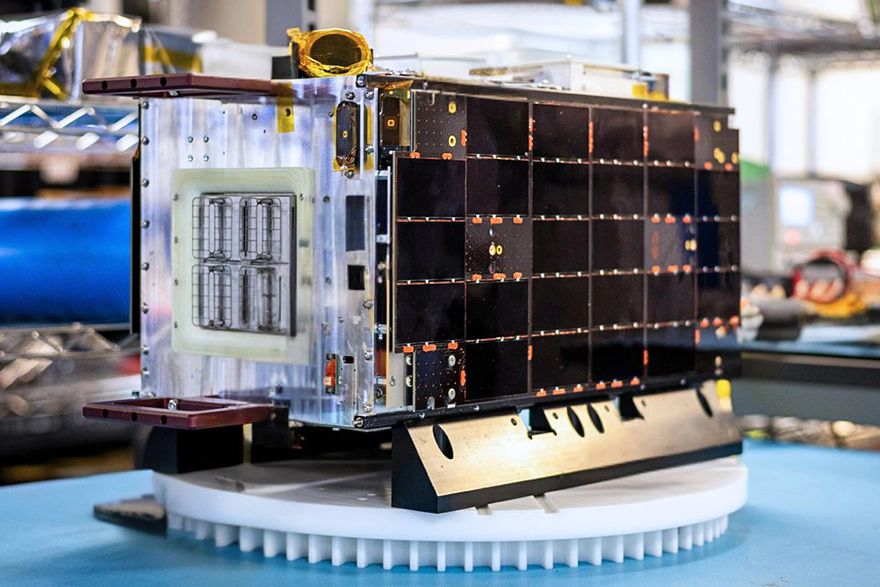
 AAC Clyde Space’s VIREON satellite. Photo: AAC Clyde Space
The Scottish space sector is driving next-generation satellite technology through a partnership with SpaceX. Satellites, developed by
Spire Global and
AAC Clyde Space in Glasgow, have been backed by
UK Space Agency funding delivered through the
European Space Agency’s Pioneer Programme, which helps emerging UK space companies become new mission providers. The Pioneer Programme falls within the programme of Advanced Research in Telecommunications Systems (ARTES).
The Government has identified satellite communications as a priority area for further support, due to its increasingly important role in both civil and defence applications, from delivering broadband services to remote areas to providing secure connectivity for military operations. As part of this commitment, the UK Space Agency will invest more than £600 million in satellite communications research and development over the coming years.
One of the satellites was launched by Spire Global UK to test an innovative optical inter-satellite link (ISL) payload. Designed to demonstrate high-speed laser crosslinks on a compact 6U platform, the mission aims to significantly reduce data latency for aviation, maritime, weather and space-weather services. The technology, once validated, will support near-real-time global data delivery across nanosatellite constellations.
As part of the xSPANCION project, two satellites were developed by AAC Clyde Space, in collaboration with several UK partners, including Bright Ascension Ltd, the University of Strathclyde, the Satellite Applications Catapult, Alden Legal and D-Orbit UK. These satellites represent the first in-orbit demonstration of the UK’s emerging high-volume, low-cost satellite production and operations capability.
Space-enabled insights The satellites will form part of VIREON, AAC Clyde Space’s new constellation designed to enhance decision-making across agriculture, forestry and environmental management, delivering space-enabled insights to governments, industry and environmental organisations.
Together, the missions strengthen British capability across optical ISL technologies, volume manufacturing, advanced operations platforms and high-skilled jobs across the UK supply chain. They also demonstrate Glasgow’s position as the leading city for small satellite manufacturing in Europe.
Henny Sands, head of telecommunications at the UK Space Agency, said: “This Transporter-16 launch marks an important step forward for the UK’s ambitions in next-generation satellite communications. By supporting both breakthrough optical technologies and high-volume production methods, we are enabling British companies to lead in the markets that will define the future of global connectivity.
Companies can also apply to an open funding call from the UK Space Agency’s Connectivity in Low Earth Orbit (C-LEO) programme, with £30 million currently available to support the development of new components and technologies for satellite constellations, with a further funding call due to open later this year.