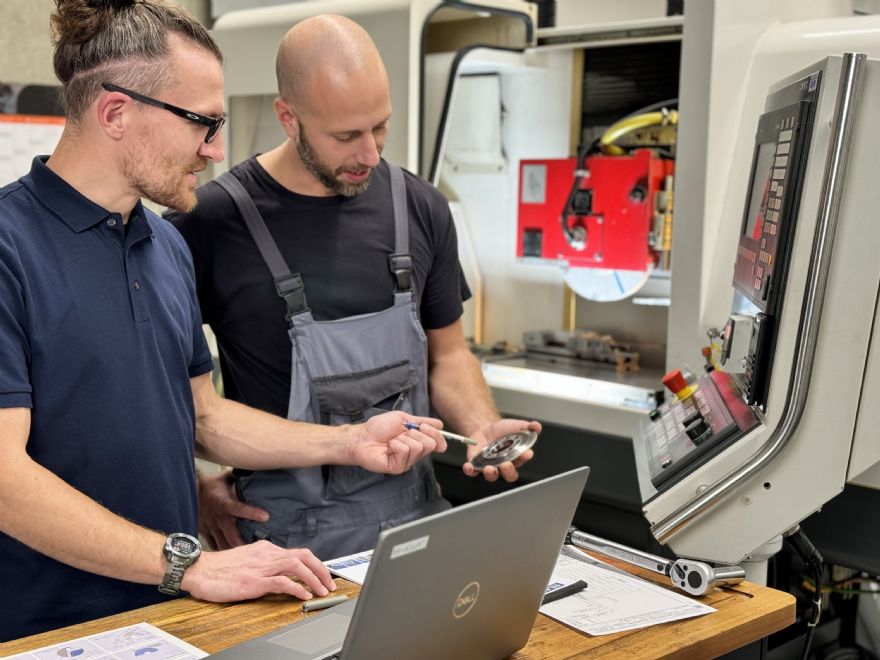
Medical technology currently stands out as a shining example in the German industrial landscape. It is driven by demographic trends as well as growing demand for products such as minimally invasive surgical instruments, implants, and artificial knee and hip joints.
When it comes to quality and functionality, surface finish, or a perfect fit, grinding processes play a particularly important role in the manufacturing of these products. It is fortunate, then, that
www.grindinghub.de/en GrindingHub 2026, taking place 5-8 May alongside
Medtech (May 5–7) in Stuttgart. In the quest for greater production efficiency, close coordination throughout the value chain is becoming increasingly important.
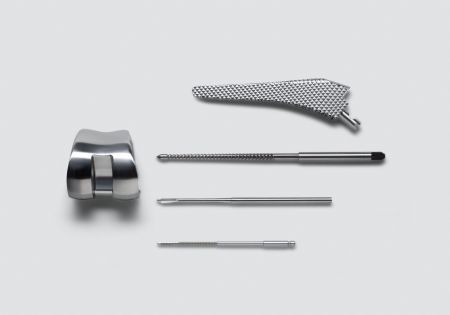
In Germany alone, the medical technology industry is growing steadily by about 5% annually. According to the latest industry figures, approximately 68% of revenue comes from exports. It is therefore not surprising that manufacturing companies are drawn to these successes, especially when they need to offset declines in other areas. However, the barriers to market entry are high, primarily due to the highly complex requirements of the European Medical Device Regulation (MDR).
Nevertheless, the
www.vdw.de/en German Machine Tool Builders’ Association (VDW), the organiser of GrindingHub, is also focusing on medical technology as an important growth market. Most recently, experts discussed current trends in medical technology with representatives from customer industries at last year’s
EMO Economic Forum in Hanover. The main topics discussed were the high precision required for complex, patient-specific devices, flexibility in production to accommodate customisations, and full traceability across global supply chains.
Innovative grinding technology is in high demand, particularly for diagnostic, surgical, and intensive care medical devices, as well as for implants and endoprosthetics. If diseased joints are to regain the ability to move without pain, no bacteria must adhere to the surfaces of the prostheses. When it comes to artificial hip ball joints, experts refer to a surface finish with a roughness of Ra <0.005µm. To ensure pain-free injections, the tips of micro-injection needles, which may have a diameter of just 0.18mm, must be ground to be burr-free. In the case of metallic and bio-resorbable stents, smooth-polished surfaces help reduce turbulence in blood flow.
According to estimates by the Federal Ministry of Health, there are currently around half a million different medical products. Diversity also poses a challenge for grinding technology. In addition to high precision requirements, this also involves a wide range of materials, ranging from titanium and cobalt-chromium alloys to stainless steel alloys and ceramics.
The goal is a fully integrated system“Our solutions are used primarily in highly demanding processes, complex shapes, high-strength and difficult-to-machine materials, and for tolerances in the micrometer range," explains Christoph Müller, head of sales at
Dr Kaiser Diamantwerkzeuge. “From the precision grinding of titanium pins and bone drills to optical devices and the manufacture of dental drills, medical technology covers a wide range of applications.”
As a manufacturer of high-precision grinding and dressing tools, the company based in Celle, Lower Saxony, also sees growing potential in the field of medical technology. Christoph Müller said: “Amid the current tension between cost pressures on the one hand and increased demands for quality, process stability, and sustainability on the other, our customers are increasingly turning to customised solutions and process optimisations.”
A coordinated, integrated system rather than individual components is the key to greater efficiency. In addition to the products themselves, the field of application engineering is therefore becoming increasingly important, whether through the transfer of expertise in seminars, digital support via apps, or in-house testing facilities, as well as process design and optimisation at the customer’s site.
Ongoing research and developmentMarie-Sophie Maier, CEO of the grinding machine manufacturer
Adelbert Haas in Trossingen, also confirms this increased focus on process optimisation. She currently sees three main challenges in the field of medical technology. These include the desire for greater process reliability, increasing demands for precision and reproducibility, and a growing variety of product variants. This requires automated or at least semi-automated environments. He emphasised: “In our view, the seamless interaction between machinery, software, clamping, and measurement technology is crucial.”
According to the company’s own estimates, approximately 2.4 million knee replacements are manufactured annually on grinding machines made by Adelbert Haas. According to the company, investments in such machines pay for themselves very quickly thanks to significant reductions in setup time, faster programming, combined grinding and milling, and in-process dressing.
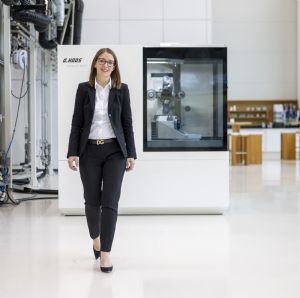 Pictured right: Marie-Sophie Maier, CEO of the grinding machine manufacturer Adelbert Haas
Marie-Sophie Maier says that medical technology is one of the most demanding fields of application there is. "We are constantly involved in application-oriented research and development projects, particularly at the interface between grinding processes, software, and measurement technology.”
In addition to further improving process stability, the focus is on the data-driven optimisation of grinding processes and the integration of closed-loop solutions. A closed-loop system enables the seamless integration of machining and measuring machines. The software ensures that data is transferred directly from the machining centre to the measuring machine. The measurement report is sent back to the machine, which then makes the necessary corrections on its own. According to Adelbert Haas, the projects are developed in close collaboration with industry partners and research institutions.
Ms Maier sees a clear trend for the future, she said: “We are seeing increasing functional integration in medical components, coupled with stricter regulatory requirements.” For grinding experts, this means that processes must not only be highly precise, but also transparent, reproducible, and documentable. In addition, flexible machine and software concepts are becoming increasingly important for efficiently handling new materials, complex geometries, and changing requirements.
This trend is likely to become a topic of discussion in Stuttgart as well. For the grinding experts, the concurrent trade shows are a win-win situation. Mr Müller concluded: “As an exhibitor at
GrindingHub, we are excited about this and hope to see synergies with
MedTech.”
Additionally, visitors can attend both events with just one ticket.