At the
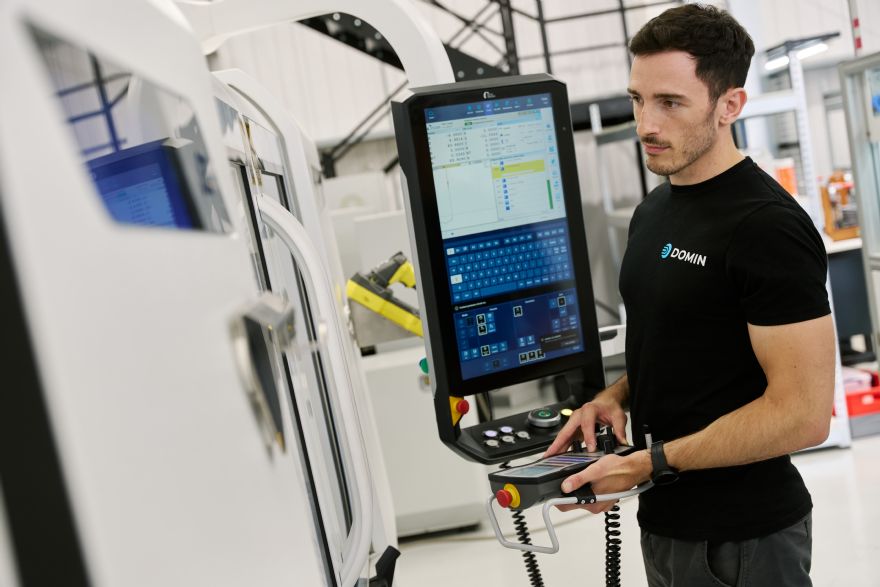
Domin Technology Centre (DTC), just outside of Bristol, innovation is in the air. The atmosphere is characterised by concentrated energy, because this is where the future of motion control is being shaped. The bright, modern halls are home to ‘state of the art’ 3-D printing systems, EDM, and milling machines – and, most recently, an S33 cylindrical grinding machine supplied by
Studer.
These are tools for the talented professionals at the centre who are united by a common mission to revolutionise hydraulics and making Domin one of the most innovative companies in the UK. Hydraulics uses pressurised fluids to precisely control force and movement even with the heaviest loads with seemingly effortless ease and these systems have become an indispensable part of our modern world, whether in excavators moving tons of material on construction sites, in aircraft for the extension of their landing gear, or in cars executing braking commands in fractions of a second. But it is also true that, compared to other industries, there has been relatively little innovation and progress in this field since the 1950s.
High-tech Valve and Pump AdvancesCameron Adams, manufacturing engineering manager at Domin, said: “Traditional hydraulics are incredibly powerful, but also notoriously inefficient. Conventional systems can waste up to 70% of their input energy.”
Mr Adams and his team have therefore made it their mission to take this key technology for virtually every modern industry into the next era, so that more can be achieved with less. Domin aims to achieve this with its core products — extremely responsive servo valves and ultra-compact high-performance pumps.
The company is leveraging the design freedom of metal 3-D printing to manufacture novel components with complex, flow-optimised internal structures. Such complex channel structures would be unthinkable with conventional subtractive manufacturing. The result is digitally controllable hydraulic systems that enable efficiency gains of up to 90% over conventional solutions. For example, a single modern valve from Domin reduces costs by around $400 per year, which leads to significant savings in large systems.
Scalable Production thanks to StuderDomin manufactures its products from extremely hard, durable, and corrosion resistant maraging steel using 3-D metal printing. The additive process is followed by post-processing of the surfaces and fine geometries, known as edge matching. This involves aligning the control edges of the valve slide with the windows of the valve housing with an accuracy of a few micrometres. This alignment is crucial for the overall performance of the valve.
Until now, Domin has performed edge matching using wire erosion (EDM). This is a process that delivers high accuracy but is comparatively slow. Mr Adams continued: “We were faced with the problem of scaling an extremely precise but slow process for our growing production.”
To do this, Domin needed a machine that would reliably guarantee the highest precision and also offer the flexibility to combine different machining operations. After an intensive evaluation, the choice fell on the S33 CNC universal cylindrical grinding machine from Studer.
High Precision ExceededDomin now uses the S33 for high-precision grinding of the diameters and fine control edges of valve spools for key products such as the S4 Pro, S6 Pro, and S10 Pro series valves. The accuracy requirements for this are extremely high. For example, the S6 Pro valve requires a diameter tolerance of just 3µm (0.000.12in), a value that is 20-times smaller than the diameter of a human hair.”
"The precision and reliability of the Studer machine exceeded our expectations. During the acceptance test, the deviation across 50 components was only 0.0006mm (0.000.024in) thanks to in-process measurement – and no, that is not a typo!” asserts Mr Adams.
This is made possible by the latest grinding technologies and high-quality components with which the Swiss quality manufacturer, with over 113 years of tradition, equips its cylindrical grinding machines. The S33 features the revolutionary C.O.R.E. hardware and software architecture, whose large touch display not only ensures intuitive operation but also smart visualisation of relevant production data.
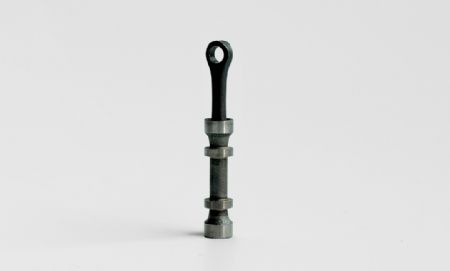 Pictured right: A Domin Spool finished on the Studer S33
Furthermore, with features such as frequency-controlled motor grinding spindles for external and internal grinding, as well as a machine bed made of Granitan S103 mineral cast for the necessary thermal stability and vibration damping—reliable, precise results are achieved.
Process Time ReductionsOverall, the S33 has enabled Domin to raise its production to a higher level. Thanks to the extremely low tolerances, the hydraulics specialists can now produce their valve spools and blocks as fully interchangeable components in series production. The manual pairing of components that was previously necessary is no longer required. For Domin, the decisive technological advantage of the S33 was its configuration with two grinding wheels.
Mr Adams explained: “The ability to grind both the diameters and the shoulders of the spools in a single machine is a gamechanger for us. We know that if there is a possibility for errors, they are likely to occur at some point. To reduce this risk, we designed the process so that grinding wheel changes or tailstock movements are not necessary. This approach not only reduces setup time, but also minimises the costs typically associated with errors.”
In addition, the transition from EDM to cylindrical grinding on the S33 for the S6 Pro valve has led to a dramatic improvement in efficiency – machining time has been reduced from nearly 1hr to just 5min
Furthermore Domin and Studer have enjoyed a trusting and productive working relationship. Michael Läuffer, area sales manager UK/Ireland and Benelux at Studer, said: “Communication between our specialists and the excellent engineers at Domin worked very well right from the start. Together, we were able to identify the S33 as the optimal machine and configure it for the specific production requirements.”
This advice and mutual trust were key for Domin. Mr Adams continued: “We didn't just get a machine; we got a well-thought-out solution. The technical support and ability to respond to our wishes were first-class and made the entire implementation process much easier.”
Looking to the future, Domin is clearly focused on growth. Production volume is set to increase exponentially in the coming years. To cope with this, the next step has already been decided —automating part loading is the next milestone on the road to highly efficient series production. This is another reason why the S33 with its smart and future-proof automation options was chosen.
Mr Adams concluded: “With Studer, we have a partner at our side who will accompany us through these development steps and help us realise our vision of a fully automated, intelligent manufacturing process.”