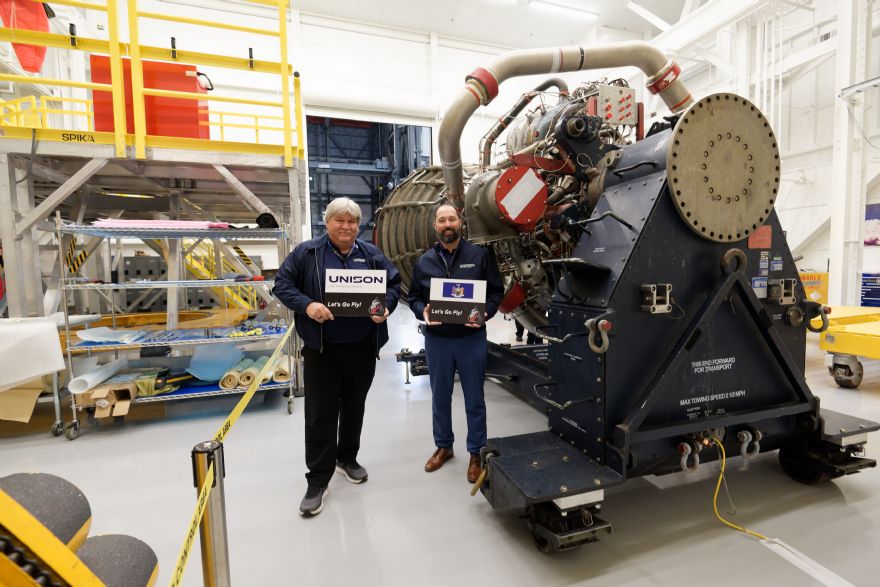
Brendon Mee, a principal engineer at the GE Aerospace company
Unison Industries where engineers designed and built ignition systems for the core-stage and upper-stage rockets that sent Artemis II into space, watched the recent launch of NASA’s Artemis II — the first crewed mission near the moon since 1972 — from a viewing spot about eight miles from Kennedy Space Centre.
Commenting on the launch, he said: “That may not seem like a front-row seat, but when you’re witnessing the most powerful rocket in history blasting off with more than 8 million pounds of thrust, it’s extremely close — and incredibly brilliant.”
Working closely with NASA and partners like L3Harris Technologies, Mr Mee and Unison teams in Jacksonville (Florida) and Norwich (New York) had spent years preparing for this moment.
Lucas Miller, the lead programme management specialist at Unison for the Artemis II program, said: “We manufactured those ignition parts here in Norwich and had the opportunity to see them being applied at the Kennedy Space Centre. It was amazing to see the full product life cycle like that — and obviously the launch was a tremendous success.”
Unison’s ignition components first came into play just seconds before liftoff, when the augmented spark igniters (ASI) system completed a rapid series of steps to light the core-stage rocket’s four RS-25 engines, made by Unison partner L3Harris Technologies. The RS-25s, assisted by two solid rocket boosters, lifted the ‘5.75-million-pound stack — the Space Launch System rocket and Orion space capsule’ — off the launchpad and into space.
Dual Direct Spark IgnitionAround 8min into the flight, some 100 miles above Earth, the main engines shut down, and the core-stage rocket dropped away. Soon after, Unison’s ‘Dual Direct Spark Ignition’ (DDSI) system lit the RL10 engine (also made by L3Harris) that powered the upper-stage rocket. The RL10 engine functions in stages, known as the perigee and apogee, which positioned the Orion spacecraft into a temporary ‘parking’ orbit around Earth, travelling at some 17,500mph. It fired up again about an hour later to send Orion and its crew on a trajectory toward the Moon.
Mr Miller continued: “It is mission critical in both stages, especially within that first few minutes after launch, when there is a lot that must happen perfectly. If something goes wrong, it could be catastrophic, but I had full confidence in our components, and that they would operate as intended; we have a very collaborative, very open relationship with L3Harris. Ignition components, like every part used in the Artemis II mission, must be ‘space-rated’, which means certified to function in the demanding environments of launch and while speeding through the cosmos.
“They need to hold up under extreme mechanical stress and engine temperatures that range from cryogenic levels up to hundreds of degrees Fahrenheit, for example — and perform optimally in the vacuum of space, which is why every component is tested under space conditions, first at Unison, again after engine assembly by L3Harris Technologies, and later at NASA.
"In Norwich, we put our products in what is basically a big vacuum jar, then suck out all the air, and ensure the products are functioning correctly. They get vibration testing, they get put through additional thermal cycles, electrical testing — the pedigree and quality that goes behind this, and the engineering, is a lot, and all to make sure we never see a failure.”